limit
Limit
Every single thing in calculus is in fact based on the formal definition of limit.
At its core, a limit describes the behavior of a function as the input approaches a particular value. It answers the question: "What value does the function get closer to as the input gets closer to some specific point?". In fact, when we say that the limit of \[f(x)\] at \[x=a\] is \[L\] doesn't necessarily mean \[f(a)=L\]. A nice example would be although \[\lim_{x\to0}\frac{\sin(x)}{x}=1\], the value of \[\frac{\sin(0)}{0}\] is in fact, undefined. We are just claiming that \[\frac{\sin(x)}{x}\] becomes arbitrarily close to 1 when we let \[x\] be close enough to 0.
Definition
The definition of a limit at a finite point (a real number that is not unbounded like \[\infty\] or \[-\infty\]) that has a finite value (a specific, real number that isn't indefinitely large or small) is:
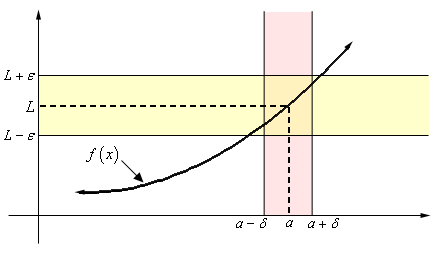
Let \[f(x)\] be a function defined on an interval that contains \[x=a\], except possibly at \[x=a\]. Then we say that \[\lim_{x\to a}f(x)=L\] if for every number \[\epsilon>0\] there is some number \[\delta>0\] such that \[\left| f(x)-L \right|<\epsilon\] whenever \[0<\left| x-a \right|<\delta\].
It is imperative to understand that \[\epsilon\] and \[\delta\] here refers to \[x\]-tolerance and \[f(x)\]-tolerance in the context of "if \[x\] is within \[\delta\] units of \[a\], then the corresponding value of \[f(x)\] is within \[\epsilon\] units of \[L\]", which is as shown in the graph. Mathematically, "\[x\] is within \[\delta\] units of \[a\]" can be written as \[0<\left| x-a \right|<\delta\] (as the definition states that \[x\ne a\]) while "\[f(x)\] is within \[\epsilon\] units of \[L\]" can be written as \[\left| f(x)-L \right|<\epsilon\].
\[\left| x-a \right|<\delta\] can also be written as:
For other types of limits:
- \[\lim_{x\to a^{\pm}}f(x)=L\]: limit (right and left-handed)
- \[\lim_{x\to a}f(x)=\pm\infty\]: limit (infinite limit)
- \[\lim_{x\to\pm\infty}f(x)=L\] and \[\lim_{x\to\infty}f(x)=\infty\]: limit (at infinity)
- \[\lim_{\left( x,y \right)\to \left( x_{0},y_{0} \right)}f(x,y)=L\]: limit (multiple dimensions)
See here for proofs of various limit properties and here for an excellent explanation regarding the basic idea of the proof.
Idea behind the definition
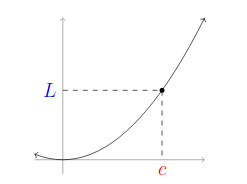
\[\lim_{x\to a}f(x)=L\] (although the graph uses \[c\], for the sake of uniformity we'll be using \[a\]) essentially tells us that \[f(x)\] becomes very close to \[L\] as \[x\] approaches, but does not reach \[a\]. Unfortunately, this statement isn't mathematically rigorous, as the statement "very close" is too vague.
What if we define it as \[\lim_{x\to a}f(x)=L\] if \[f(x)\] comes within 0.001 of \[L\] as \[x\] approaches \[a\]? Logically, by observing the graph, it is trivial to see that you can definitely find an \[x\] that fulfills that condition. You can probably see that no matter what numerical requirement we put on how close \[f(x)\] must be to \[L\], it will be possible for \[f(x)\] to satisfy that requirement.
For instance, if we zoomed in on the graph far enough, we could technically see that \[f(x)\] will come within \[10^{-100}\] of \[L\]. So, to avoid confusion regarding what constitutes a "very small" number, we'll redefine it as \[\lim_{x\to a}f(x)=L\] if \[f(x)\] can satisfy any requirement on how close it must be to \[L\] once \[x\] gets close enough \[a\].
Rephrasing it, we would get \[\lim_{x\to a}f(x)=L\] if for any requirement that \[f(x)\] be within a certain distance of \[L\], there is a second requirement that \[x\] be within a certain distance \[a\], such that the first requirement is satisfied whenever the second requirement is satisfied.
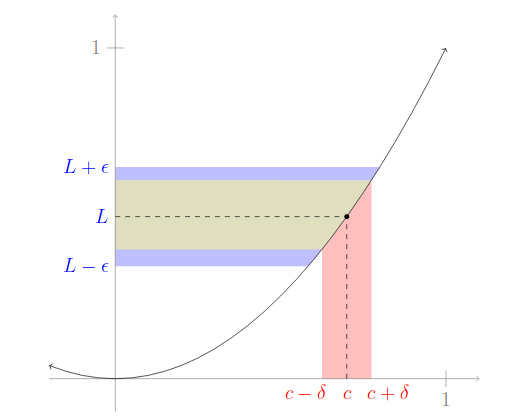
Adding the symbols, our first requirement would be that the range of \[f(x)\] being within the blue band, and the band's width represented as \[\epsilon\] (mathematical representation of the phrase "certain distance", or any distance). While the second requirement is for \[x\] to be within the red band (of width \[\delta\]). If both conditions can be fulfilled no matter how small we shrink the blue band, we can confidently say that \[\lim_{x\to a}f(x)=L\].
If we rewrite that with less words and more symbols, we would thus get the formal definition of limit, \[\lim_{x\to a}f(x)=L\] if,
- For any positive number \[\epsilon\] (\[f(x)\] be within certain distance of \[L\]),
- there is a positive number \[\delta\] such that (the second requirement where \[x\] be within certain distance of \[a\])
- \[\left| f(x)-L \right|<\epsilon\] whenever \[0<\left| x-a \right|<\delta\] (the first requirement is satisfied whenever the second requirement is satisfied)
Thus, the entire idea of the epsilon-delta definition for limit is to show that for any small positive number \[\epsilon\], no matter how tiny, we can find always find a corresponding \[\delta\] such that whenever \[x\] is within \[\delta\] units of \[a\] (meaning all \[x\] values within a range \[\delta\] units smaller or larger than \[a\]), but not equal to \[a\], the value of \[f(x)\] will always be within \[\epsilon\] units near \[L\].
Undefined limits
Essentially there are two behaviors that a function can exhibit near a point where it fails to have a limit, where each of them are different types of discontinuities in functions.
The graph below shows the first scenario (jump discontinuity):
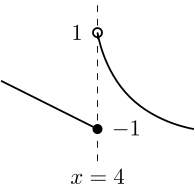
Which indicates that \[x\] shows a jump at value \[a=4\], and while the limits of \[\lim_{x\to a^{+}}f(x)\] and \[\lim_{x\to a^{-}}f(x)\] are defined, \[\lim_{x\to a}f(x)\] is undefined as\[\lim_{x\to a^{+}}f(x)\ne\lim_{x\to a^{-}}f(x)\]. The reason why it's undefined is that the function is not settling towards a single value near \[a\]. Mathematically, this can be explained as that supposed we attempted to set the limit, \[L\], at \[x\to a\] as the left-hand limit, \[L=-1\]. According to the \[\epsilon\]-\[\delta\] definition of limits, we would need to find a small distance \[\delta\] around \[a\] so that for all \[x\] within this distance, \[f(x)\] stays close to \[L\] within margin of \[\epsilon\], or \[\left| f(x)-L \right|<\epsilon\].
In this case, assuming we wanted our \[\epsilon\] tolerance to be 0.01, no matter how small \[\delta\] is, as soon as \[x\] is tiny bit larger than 4, \[\left| f(x)-L \right|\] would definitely be larger than \[\epsilon\] (as at \[x=4.0001\], \[f(x)\approx 1\], \[\left| f(x)-L \right|=\left| 1-(-1) \right|=2\]). Similarly, if we assigned \[L\] to the right-hand limit, we would find that as soon as \[x\] is tiny bit smaller than 4, \[\left| f(x)-L \right|\] will definitely be larger than some \[\epsilon\]. Since we can't find any value that \[f(x)\] approaches from both sides, the limit at \[x\to a\] is impossible to find, or simply, undefined.
In this second example (essential discontinuity):
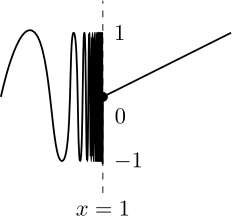
As \[x\] approaches 1 from the left, the function \[f\] does not settle towards a single value. Instead, it exhibits infinitely rapid oscillations between the values -1 and 1. This means that no matter how close \[x\] gets to \[1^{-}\], the output \[f(x)\] keeps fluctuating and does not stabilize. Thus, \[\lim_{x\to1^{-}}f(x)\] is then said to be undefined. Additionally, we also know that \[f(1)\] doesn't exist, so there must be a discontinuity of some kind.
Mathematically, this is explained by letting \[a=1\] and assuming we set our \[L\] at \[x\to1^{-}\] to 0, since \[f(x)\] will oscillate between 1 and -1 for \[x<1\], we cannot find any \[\delta\] such that \[\left|f(x)-0\right|<\epsilon\]. This is because for any \[\delta\] we set, say 0.01, we will still be able to find \[f(x)\] values ranging from 1 to -1 from the range \[a-\delta\] to \[a+\delta\] (\[\delta\] units to the left and right of 1, especially the left-side of 1). As a result of this, we cannot show that there exists a \[\delta\] for any \[\epsilon\le1\] (as the minimum and maximum values of \[f(x)\] will always be -1 and 1 respectively, thus the maximum value of \[\left|f(x)-L\right|\] would be 1, and for \[\left| f(x)-L \right|<\epsilon\] to hold, \[\epsilon\] must be larger than 1). Therefore, we can't satisfy the requirements for it to be a valid limit, as it requires us to show that \[\epsilon\] can be any positive number no matter how small.
As for \[\lim_{x\to1}f(x)\], since \[\lim_{x\to1^{-}}f(x)\] is undefined, there's no way for us to find the limit at \[x\to1\], thus it can also be said to be undefined.
Now, we can say that \[\lim_{x\to a}f(x)\] does not exist, if for every number \[L\] the following is false: for every positive number \[\epsilon\] there is at least one positive number \[\delta\] such that \[\left| f(x)-L \right|<\epsilon\] whenever \[0<\left| x-a \right|<\delta\].
Evaluating a limit using the definition
Show that \[\lim_{x\to4}\sqrt{x}=2\].
Before we use the formal definition, let's try some numerical tolerances. What if \[\epsilon=0.5\]? In this case, we can proceed as follows:
Let \[L=2\], \[\epsilon=0.5\], \[a=4\], find \[\delta\].
So, how do we find \[\delta\]? Since \[\left| x-a \right|<\delta=a-\delta<x<a+\delta\], then \[\delta\] must be \[\le1.75\]. Note that in some sense, it looks like there are two tolerances, \[4-2.25\] and \[6.25-4\]. However, we can't use the larger value of \[6.25-4\] for our \[\delta\] as that would cause our interval for \[x\] to be \[1.75<x<6.25\] and the resulting \[L\] value would be \[1.323<L<2.5\] which clearly contains values not within 0.5 units of 2.
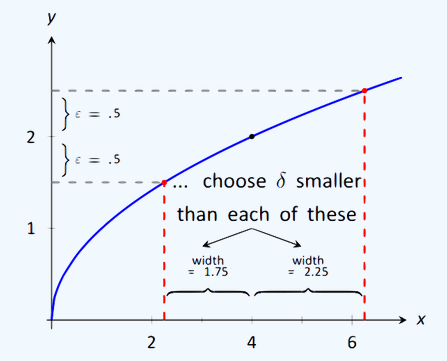
Thus fulfilling our condition of finding a corresponding \[\delta\] for our \[\epsilon\].
Now, let's test a smaller \[\epsilon\], \[\epsilon=0.01\]. Following the same steps above:
Thus, \[\delta\] must be less than or equal to 0.0399.
What we've done so far is to show that common sense is indeed empirically correct. However, we have yet to form a general equation to determine \[\delta\] symbolically. Now, assuming \[f(x)\] is within \[\epsilon\] units of \[L\]:
We now have a form of "\[a-\text{something}<x<a+\text{something}\]". Repeating what we've done above, since \[\epsilon\] is larger than zero, \[4\epsilon-\epsilon^{2}\] must be the smaller compared to \[4\epsilon+\epsilon^{2}\]. Thus, \[\delta\le4\epsilon-\epsilon^{2}\].
So, given any \[\epsilon>0\], \[\delta\le4\epsilon-\epsilon^{2}\]. Then if \[0<\left| x-4 \right|<\delta\], then \[\left| f(x)-2 \right|<\epsilon\], satisfying the definition of the limit.
Proving the limit of a function
Prove that \[\lim_{x\to1}(2x+1)=3\].
- Establish an inequality relating \[\left| f(x)-L \right|\] and \[\left| x-a \right|\]
- Solve for \[\left| x-a \right|\] in terms of \[\epsilon\]
- Relate \[\delta\] in terms of \[\epsilon\]
- Verify that \[\delta>0\] and conditions are met
Let \[\epsilon>0\] be any number. Now according to the definition of the limit, if this limit is to be true we will need to find some other number \[\delta>0\] so that the following will be true:
\[\left| (2x+1)-3 \right|<\epsilon\] whenever \[0<\left| x-1 \right|<\delta\], or upon simplifying things it would be \[\left| 2 \right| \cdot \left| x-1 \right|<\epsilon\] whenever \[0<\left| x-1 \right|<\delta\]. Do note that \[\left| (2x+1)-3 \right|<\epsilon\] is equivalent to \[\left| x-1 \right|<\frac{\epsilon}{2}\].
Since \[0<\left| x-1 \right|<\delta\] and \[\left| x-1 \right|<\frac{\epsilon}{2}\], we let \[\delta=\frac{\epsilon}{2}\]. This makes sense as \[\delta\] has to be larger than \[\left| x-1 \right|\], and since \[\frac{\epsilon}{2}\] is also larger than \[\left| x-1 \right|\] then having \[\delta=\frac{\epsilon}{2}\] will still satisfy the equation. Thus \[0<\left| x-1 \right|<\delta\] can now be written as \[0<\left| x-1 \right|<\frac{\epsilon}{2}\].
However, we will still need to verify that \[\left| (2x+1)-3 \right|<\epsilon\] whenever \[0<\left| x-1 \right|<\frac{\epsilon}{2}\] (now that we've assumed \[\delta=\frac{\epsilon}{2}\]).
Therefore, we have demonstrated that:
- For every positive \[\epsilon\], we can find a corresponding positive \[\delta\]
- \[\delta\] relates on \[\epsilon\], specifically \[\delta=\frac{\epsilon}{2}\], which also must be positive since \[\epsilon>0\]
- Whenever \[x\] is within \[\delta\] units of \[a\], the value of \[f(x)\] is within \[\epsilon\] units of \[L\]
So, by definition \[\lim_{x\to1}(2x+1)=3\], since our definition states that \[\lim_{x\to 1}(2x+1)=3\] if for every number \[\epsilon>0\] there is some number \[\delta>0\] such that \[\left| (2x+1)-3 \right|<\epsilon\] whenever \[0<\left| x-1 \right|<\delta\].
The process seems to suggest that we have to essentially redo all our work twice, once to make the guess for \[\delta\] and then another time to prove our guess. However, that isn't the case for more complex equations like \[\lim_{x\to4}x^{2}+x-11=9\].
Prove that \[\lim_{x\to4}x^{2}+x-11=9\].
Similar to what we've done above, let \[\epsilon>0\] be any number, and we have to find a number \[\delta>0\] so that \[\left| (x^{2}+x-11)-9 \right|<\epsilon\] whenever \[0<\left| x-4 \right|<\delta\].
We know that \[\left| (x^{2}+x-11)-9 \right|\] can be broken down into \[\left| x+5 \right|\left| x-4 \right|\]. However, unlike the previous example, there is a term, specifically \[\left| x+5 \right|\], that does not show up in the \[\delta\] inequality. What we can do is to assume that \[\left| x+5 \right|\] is smaller than some number \[K\], then logically \[\left| x+5 \right|\left| x-4 \right|<K\cdot \left| x-4 \right|\].
If we now assume that rather than showing \[\left| x+5 \right|\left| x-4 \right|<\epsilon\], we were to show that \[K\cdot\left| x-4 \right|<\epsilon\] (which if shown to be true, will also mean that \[\left| x+5 \right|\left| x-4 \right|<\epsilon\]) , we would get a new inequality \[\left| x-4 \right|<\frac{\epsilon}{K}\].
Since we're working with limits, it is safe to assume that as \[x\] approaches 4, \[\left| x-4 \right|\] will most definitely be smaller than 1 (or any positive number of your choice, just that 1 is a nice number to work with). So, let's start with getting rid of the absolute values, \[\left| x-4 \right|<1\] becomes \[-1<x-4<1\], which is equivalent to \[3<x<5\].
As we're trying to prove that \[\left| x+5 \right|\] is smaller than \[K\], we rewrite \[3<x<5\] as \[8<x+5<10\]. We can now say that provided \[\left| x-4 \right|<1\], \[x+5\] will always be positive, and \[K=10\] (as \[\left| x+5 \right|<K\], \[x+5 < 10\] and we don't have to worry about \[x+5\] being negative). Which when substituting the value of \[K\] into our equation above,\[\left| x-4 \right|<\frac{\epsilon}{K}\] gives us \[\left| x-4 \right|<\frac{\epsilon}{10}\].
Up till this point, we have assumed that both \[\left| x-4 \right|<1\] (to ensure that \[\left| x+5 \right|<10\]) and \[\left| x-4 \right|<\frac{\epsilon}{10}\] (to ensure that \[10\left| x-4 \right|<\epsilon\]). In our previous example, our \[\delta\] value only had one option so we did not have any problems, but here we have satisfy two conditions simultaneously, thus mathematically \[\delta\]'s value is written as \[\delta=\min\left\{1,\frac{\epsilon}{10}\right\}\] to guarantee that the proof holds. \[\delta\] has to be the minimum, as from the original inequality \[0<\left| x-4 \right|<\delta\], \[\left| x-4 \right|\] is bounded by \[\delta\], and since \[\left| x-4 \right|\] must be too smaller than both 1 and \[\frac{\epsilon}{10}\], then letting \[\delta\] to be the smaller of the two would logically mean that whatever the value of \[\delta\] is it will always fulfill both conditions.
Now, we've made out choice for our \[\delta\], assuming that \[0<\left| x-4 \right|<\delta=\min \left\{ 1,\frac{\epsilon}{10} \right\}\],
- If \[\frac{\epsilon}{10}\] is the smaller out of the two, then \[0<\left| x-4 \right|<\delta\le \frac{\epsilon}{10}\implies \left| x-4 \right|<\frac{\epsilon}{10}\]
- If 1 is the smaller out of the two, then \[0<\left| x-4 \right|<\delta\le1 \implies \left| x-4 \right|<1\implies \left| x+5 \right|<10\]
Finally,
We've now managed to show that \[\left| (x^{2}+x-11)-9 \right|<\epsilon\] whenever \[0<\left| x-4 \right|<\min \left\{ 1,\frac{\epsilon}{10} \right\}\], thus by definition we've shown that \[\lim_{x\to4}x^{2}+x-11=9\].
Prove that \[\lim_{x\to0}\frac{1}{x}\] does not exist
Assume there is an \[L\] that exists such that \[\lim_{x\to0}\frac{1}{x}=L\]. First, we simplify the problem, \[\lim_{x\to0}\frac{1}{x}=L\] implies that \[\lim_{x\to0^{+}}=L\], where \[L\ge0\].
Remember, pick \[\epsilon\] first, then find \[\delta\] (not the other way around, this will come in important later).
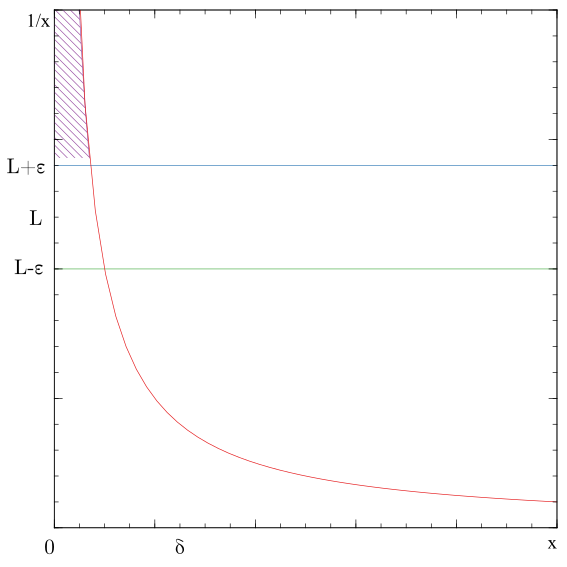
Intuitively, when \[x\] approaches zero, \[\frac{1}{x}\] continuously gets larger, so no matter the value \[L\], for some \[\epsilon\], there is no way \[\frac{1}{x}\] stays within range of \[L-\epsilon\] and \[L+\epsilon\] for all possible \[\Delta x\] values within \[0<x<\delta\]. A simple way to demonstrate this is to pick a random \[\epsilon\]. Assume \[\epsilon=1\], regardless of the choice of \[\delta\] , there will be a interval of \[x\] (see shaded region of graph) where \[L-1<\frac{1}{x}<L+1\] does not hold. This directly contradicts the definition of limit where there must exist a valid \[\delta\] for every \[\epsilon\]. Therefore, the limit does not exist.
Referenced by:
-
limit (at infinity)
-
limit (right and left-handed)
-
monotone convergence theorem
-
fundamental theorem of calculus
-
improper integral
-
continuous function
-
proofs of various limit properties
-
differential and derivatives
-
Squeeze theorem
-
discontinuous function
-
differentiation notations
-
integral
-
limit (sequence)
-
uniform continuity
-
compact space
-
summation
-
Bolzano-Weierstrass theorem
-
limit (multiple dimensions)
-
limit (infinite limit)
-
differentiable function
-
derivative