continuous function
Continuous function
A continuous function is a function such that a small variation of the argument induces a small variation of the value of the function. This implies there are no abrupt changes in value, known as discontinuities. The epsilon-delta definition of a limit was introduced to formalize the definition of continuity.
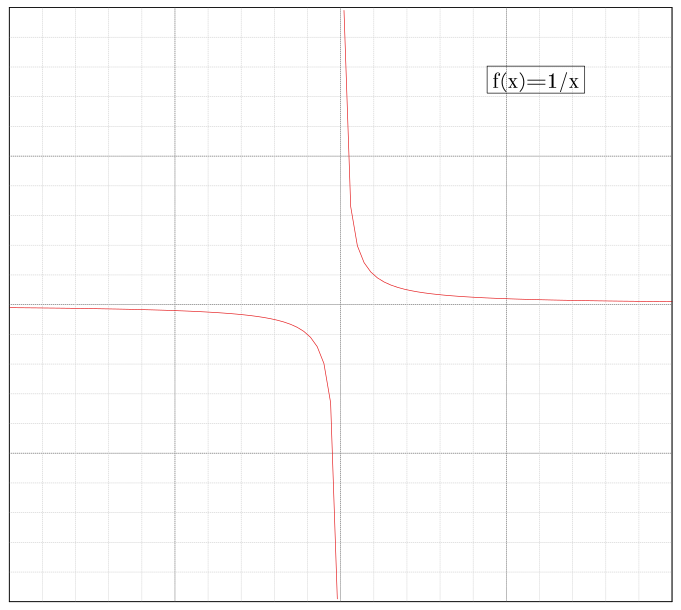
We'll take \[f(x)=\frac{1}{x}\] as an example. The function \[f(x)\] is continuous on its domain \[\left(\mathbb{R}\, \backslash\, \{0\}\right)\], meaning set \[\mathbb{R}\] without zero, as the graph is an unbroken curve. However, it is discontinuous at \[x=0\] as there's a jump in between \[x\to0^{-}\] and \[x\to 0^{+}\].
Continuity is what makes calculators and measurements practical, since they can only give approximate results with limited precision. As without it, even a tiny error in measuring the input could cause a massive and unpredictable change in the output, undermining the reliability of any calculation. Consequently, these special functions would fail to serve as dependable tools when working with approximate measurements and limited precision.
For the things like special functions found on calculator buttons to be truly useful, they must guarantee that if we know an input value \[x\] only to a certain limited precision, then the output \[f(x)\] will still be accurate enough for our purposes. In other words, continuity ensures that if we want the value of \[f(x)\] to be within some small tolerance \[\epsilon\], we can achieve that by measuring \[x\] closely enough. Formally, if \[\left| f(x)-f(x^{\prime}) \right|<\epsilon\] is what we need, then there is a way to choose \[\delta>0\] such that whenever \[\left| x-x^{\prime} \right|<\delta\], it follows that \[\left| f(x)-f(x^{\prime}) \right|<\epsilon\]. This \[\delta\] may change depending on \[\epsilon\] and the particular point \[x\] we care about, but the important thing is that such a \[\delta\] always exists.
Philosophically, the \[\epsilon\]-\[\delta\]-perspective of continuity and uniform continuity capture the notions more directly, whereas the perspective on these from sequences and net is more indirect. Proofs using sequences tend to be indirect proofs, using contradiction. It's often about supposing something isn't true and then, often non-constructively, choosing a counterexample sequence. The reason both of them are used is that neither approach is in itself more useful for all cases.
\[\epsilon\]-\[\delta\] definition
Formally, a function \[f:\mathbb{R}\to \mathbb{R}\] (a function that maps real numbers to real numbers) is said to be continuous at a point \[a\in\mathbb{R}\] if it satisfies the following condition:
For every \[\epsilon>0\] there exists a \[\delta>0\] such that whenever \[\left| x-a \right|<\delta\], it follows that \[\left| f(x)-f(a) \right|<\epsilon\]. Symbolically, it can be written as: \[\forall\epsilon>0,\,\exists\delta>0\,\,\text{s.t.}\,\left| x-a \right|<\delta\implies \left| f(x)-f(a) \right|<\epsilon\]
Intuitively, this can be understood as a function (or a segment of it) is continuous when you can draw it in its entirety without having to lift your pen. This isn't mathematically rigorous, thus we define it as "whenever \[\left| x-a \right|<\delta\], it follows that \[\left| f(x)-f(a) \right|<\epsilon\]", which tells us that for any chosen point \[a\] in the domain, as long as \[x\] stays within a small distance \[\delta\] of \[a\], the corresponding output \[f(x)\] will remain within a small distance \[\epsilon\] of \[f(a)\], making it impossible to find any abrupt jumps when you inspect the graph closely. Since we can define \[\epsilon\] and \[\delta\] to be as small as we want, this leaves no possibility of any jumps in the graph as we can "zoom" into the graph infinitely and still see that the function values remain consistently close to \[f(a)\].
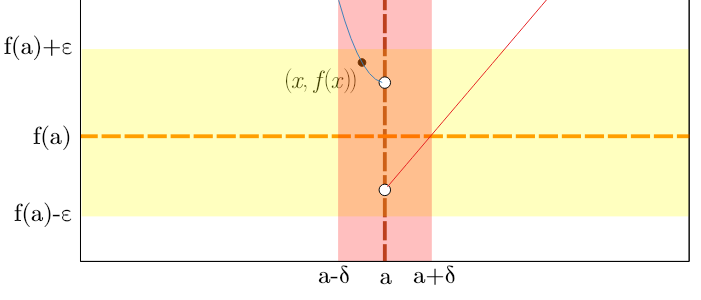
As shown above, since there's a discontinuity at \[a\], the inequality \[\left| f(x)-f(a) \right|<\epsilon\] will fail to hold for some \[\epsilon>0\] (as there's a gap in between the two points, assuming the gap is 2 units apart, the inequality will then not hold when \[\epsilon=1.5\]), no matter how small we choose \[\delta\] to be. This means that even if \[x\] gets extremely close to \[a\], the difference \[\left| f(x)-f(a) \right|\] does not become sufficiently small. We can see in the above that as \[x\] approaches \[a\] from both sides, it does not agree on a single value of \[f(a)\], thus proving that there is a jump.
Sequential definition
This proof is based on the definition that:
\[f\] be a real-valued function whose domain (\[\text{dom}\]) is a subset of \[\mathbb{R}\]. The function \[f\] is continuous at \[x=a\] if, for every sequence of real numbers \[\left\{ x_{n} \right\}\subset\text{dom}(f)\] that converges to \[a\], we have that \[\lim_{n\to\infty}f(x_{n})=f(a)\].
If \[f\] is continuous at each point of a set \[A\subset\text{dom}(f)\], then we say that \[f\] is continuous on \[S\]. Then the function \[f\] will be said to be continuous if it is continuous on \[\text{dom}(f)\].
A caveat of this definition would be that we will also say that \[f(x)=\frac{1}{x}\] is continuous as continuity is only checked at points where the function is defined. Coincidentally \[f(x)\] is defined on \[\mathbb{R}\,\backslash\,\left\{ 0 \right\}\], therefore 0 (which is undefined thus left out of \[f\]'s domain) is skipped in the continuity check, leading us to conclude that \[\frac{1}{x}\] is continuous.
Suppose the condition "for each \[\epsilon>0\] there exists \[\delta>0\] so that if \[x\in\text{dom}(f)\] and \[\left| x-a \right|<\delta\] then \[\left| f(x)-f(a) \right|<\epsilon\]" holds. Let \[\left\{ x_{n} \right\}\subset\text{dom}(f)\] which converges to \[a\], or in simpler words, let a sequence containing \[x_{1},x_{2},\dots x_{n}\], where as \[n\to\infty\], the values in the sequence \[\left\{ x_{n} \right\}\] get closer and closer (infinitely closer) to \[a\]. It should not be confused that \[x_{n}\] itself is a sequence, instead it is just a term in the sequence \[\left\{ x_{n} \right\}\].
An example for such a converging sequence would be to consider \[x_{n}=a+\frac{1}{n}\] for some real number \[a\], as \[n\] gets larger and larger (\[\to\infty\]), \[\frac{1}{n}\] gets smaller and smaller (\[\lim_{n\to\infty}\frac{1}{n}=0\], making \[x_{n}=a\]), thus we can say the sequence \[x_{n}\] converges to \[a\].

Now, we need to show that \[\lim_{n\to\infty}f(x_{n})=f(a)\]. Let \[\epsilon>0\] be given. By the condition there exists a \[\delta>0\] such that \[x\in\text{dom}(f)\] and \[\left| x-a \right|<\delta\] then \[\left| f(x)-f(a) \right|<\epsilon\]. Since \[\lim_{n\to \infty}x_{n}=a\], there must be a natural number \[N\] such that \[n>N\] then \[\left| x_{n}-a \right|<\delta\]. This is due to the fact that no matter how small \[\delta\] is we can always find a large enough \[N\] such that all the term \[x_{n}\] will be even closer than \[\delta\] units to \[a\]. Therefore, it follows that whenever \[n>N\], by definition \[\left|f(x_{n})-f(a)\right|<\epsilon\], showing that \[\lim_{n\to\infty}f(x_{n})=f(a)\].
Proving continuity
Let \[f(x)=3x^{2}+2x-1\] for \[x\in\mathbb{R}\]. Prove that \[f\] is continuous on \[\mathbb{R}\].
We'll first prove this using the \[\epsilon\]-\[\delta\] definition to prove it first.
Let \[a\in\mathbb{R}\], \[\epsilon>0\]. We need to show that \[\left| f(x)-f(a) \right|<\epsilon\] provided that \[\left| x-a \right|\] is sufficiently small.
Assume \[\left| x-a \right|<1\], then \[\left| x \right|<\left| a \right|+1\]. Now, we have to get rid of \[\left| x+a \right|\], so by triangle inequality \[\left| x+a \right|\le \left| x \right|+\left| a \right|\]. Combining it with our first inequality, \[\left| x \right|+\left| a \right|<2 \left| a \right|+1\]. Therefore, \[\left| x+a \right|\le \left| x \right|+\left| a \right|<2 \left| a \right|+1\].
Rewriting our equation for \[\left| f(x)-f(a) \right|\]:
Provided that \[\left| x-a \right|<1\].
To guarantee that \[3 \left| x-a \right|\cdot \left( 2 \left| a \right| +1\right)+2 \left| x-a \right|<\epsilon\], we need \[3 \left| x-a \right|\cdot \left( 2 \left| a \right| +1\right)<\frac{\epsilon}{2}\] and \[2 \left| x-a \right|<\frac{\epsilon}{2}\].
For the second part, we would simply write it as \[\left| x-a \right|< \frac{\epsilon}{4}\], however the first part needs some more work, as \[\left| x-a \right|\] needs to be both less than 1 and \[\frac{\epsilon}{3\cdot2\cdot \left( 2 \left| a \right| +1 \right)}\]. Assume \[\delta=\min \left\{ 1, \frac{\epsilon}{6 \left( 2 \left| a \right| +1\right)} \right\}\], since \[\left| a \right|\ge0\], at a worst case scenario, \[\delta=\min \left\{1, \frac{\epsilon}{6} \right\}\]. As \[\epsilon\] gets closer and closer to 0, \[\delta\] would be equal to \[\frac{\epsilon}{6}\]. Thus, by taking \[\left| x-a \right|<\delta\], we have that \[\left| f(x)-f(a) \right|<\epsilon\], proving continuity exists.
Next, we'll prove this with the sequential definition which would be more simpler.
By definition, suppose \[\lim_{n\to\infty}x_{n}=a\]. Then, by using properties of limits,
Referenced by:
-
probability distribution
-
fundamental theorem of calculus
-
improper integral
-
proofs of various limit properties
-
absolute continuity
-
continuous random variable
-
discontinuous function
-
extreme value theorem
-
integration by substitution
-
Rolle's theorem
-
integral
-
antiderivative
-
law of the unconscious statistician
-
first fundamental theorem of calculus
-
integration by parts
-
uniform continuity
-
boundedness theorem
-
mean value theorem
-
derivative
-
cumulative distribution function