limit (infinite limit)
Limit (infinite limit)
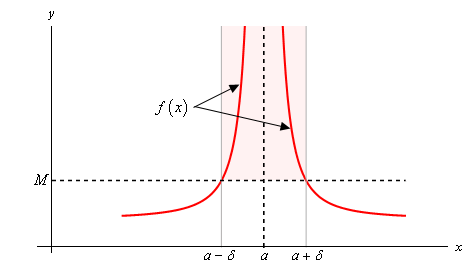
The statement \[\lim_{x\to a}f(x)=\infty\] tells us that whenever \[x\] is close to (but not equal to) \[a\], \[f(x)\] is a large positive number. A limit with a value of \[\infty\] means that as \[x\] gets closer and closer to \[a\], \[f(x)\] increases without bound.
Likewise, the statement \[\lim_{x\to a}f(x)=-\infty\] tells us \[x\] is close to \[a\], \[f(x)\] is a large negative number, and as \[x\] gets closer and closer to \[a\], the value of \[f(x)\] decreases without bound.
However, technically when the limit equals to \[\infty\], the limit in fact doesn't even exist. \[\lim_{x\to a}f(x)=L\] makes sense only if \[L\] is a number, while \[\infty\] isn't a number, it's just a mathematical representation of something that does not end. Thus, when we say a limit is \[\pm\infty\] it is just to indicate this increase/decrease without end, which is more information than leaving it undefined.
Definition (positive infinity)
Let \[f(x)\] be a function defined on an interval that contains \[x=a\], except possibly at \[x=a\]. Then we say that \[\lim_{x\to a}f(x)=\infty\] if for every number \[M>0\] there is some number \[\delta>0\] such that \[f(x)>M\] whenever \[0<\left| x-a \right|<\delta\].
What this definition is telling us is that no matter how large we choose \[y=M\] (referencing the image above) to be we can always find a range \[x=a\pm \delta\] where all the corresponding \[f(x)\] values are greater than \[M\]. The idea is very similar to the definition of limit, just that rather than showing no matter how small \[\epsilon\] goes there is a valid \[\delta\] value, we're showing that no matter how large \[M\] goes, there's a valid \[\delta\] value.
Since our definition states that \[0<\left| x-a \right|\], it implies that the function isn't necessarily required to exist at \[x=a\] as \[\left| x-a \right|\ne 0\].
Definition (negative infinity)
Let \[f(x)\] be a function defined on an interval that contains \[x=a\], except possibly at \[x=a\]. Then we say that \[\lim_{x\to a}f(x)=-\infty\] if for every number \[N<0\] there is some number \[\delta>0\] such that \[f(x)<N\] whenever \[0<\left| x-a \right|<\delta\].
Similar to the definition for positive infinity, this definition tells us that no matter how small (negative) \[N\] gets, we can always find a range \[\pm\delta\] units around \[a\] for \[x\] where all the corresponding \[f(x)\] values are smaller than \[N\].
Again, our function isn't required to exist at \[x=a\] for the limit to be valid.
Proving limits with the definition of limit
Prove that \[\lim_{x\to0}\frac{1}{x^{2}}=\infty\].
Similar to the other proofs, rather than letting \[\epsilon\], we let \[M>0\] be any number and we'll need to choose a \[\delta>0\] so that \[\frac{1}{x^{2}}>M\] whenever \[0<\left| x-0 \right|<\delta\] (as per the definition).
As with the all the previous problems we'll start with the left inequality (\[\left| f(x)-L \right|\]) and try to get something in the end that looks like the right inequality (\[\left| x-a \right|\]). To do this we basically just have to know \[\sqrt{x^{2}}=\left| x \right|\]. Then, \[\frac{1}{x^{2}}>M\implies \frac{1}{M}>x^{2}\implies x^{2}<\frac{1}{M}\implies \left| x \right|<\frac{1}{\sqrt{M}}\]. Now logically we can assume \[\delta\] to be \[\frac{1}{\sqrt{M}}\], as according to our definition, \[\left| x \right|<\delta\].
To verify this statement, let \[M\] be any number, \[\delta=\frac{1}{\sqrt{M}}\] and assume \[0<\left| x \right|<\frac{1}{\sqrt{M}}\].
We've now shown that \[\frac{1}{x^{2}}>M\] whenever \[0<\left| x-0 \right|<\frac{1}{\sqrt{M}}\], thus by definition, \[\lim_{x\to0}\frac{1}{x^{2}}=\infty\].