monotone convergence theorem
Monotone convergence theorem
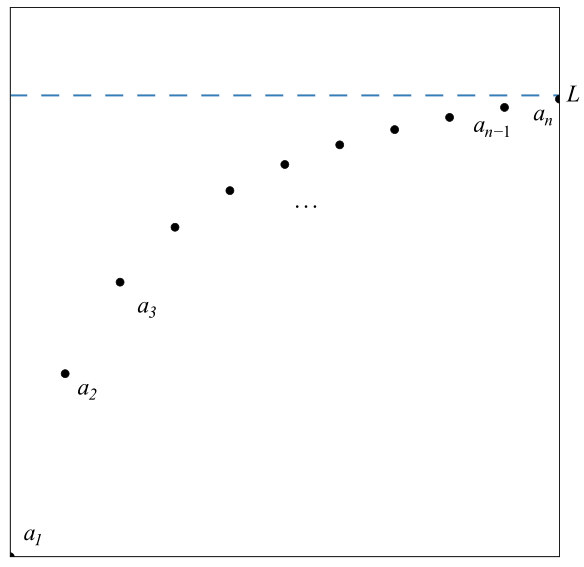
Let \[\left\{ a_{n} \right\}\] be the set of values of \[\left( a_{n} \right)_{n\in\mathbb{N}}\]. If the sequence (which is not a function) \[\left( a_{n} \right)\] is monotone (both increasing or decreasing) and has a bound (upper or lower) then eventually it must level off. Mathematically, this can be written as \[\lim_{n\to\infty}a_{n}=L\].
Proposition
Let \[\left\{ a_{n} \right\}\] be a set of values of a monotonic sequence. If \[\left\{ a_{n} \right\}\] is bounded then it will converge. In addition, if this is the case then:
- If it is monotonically increasing, then it converges to \[\sup \left\{ a_{n}\mid n\in\mathbb{N} \right\}\].
- If it is monotonically decreasing, then it converges to \[\inf \left\{ a_{n}\mid n\in\mathbb{N} \right\}\].
For the notations, see infimum and supremum. \[\sup \left\{ a_{n}\mid n\in\mathbb{N} \right\}\] here refers to the supremum of the set of all elements \[a_{n}\], or in other words, the supremum of set \[\left\{ a_{1},a_{2},a_{3},\dots,a_{n} \right\}\].
Proof
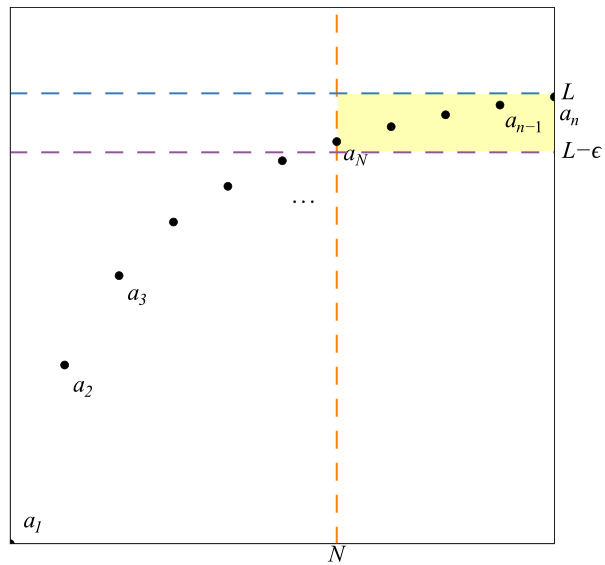
By assumption, \[\left\{ a_{n} \right\}\] is non-empty and bounded above. Define \[S\] to be the set of terms in \[\left\{ a_{n} \right\}\] and define \[L=\sup(S)\] which exists by the Completeness axiom since \[S\] is bounded. Our goal is to prove that \[\lim_{n\to\infty}a_{n}=L\].
According to the definition of limits at infinity:
\[\lim_{n\to\infty}a_{n}=L\] is true if for every number \[\epsilon>0\], there is a \[N>0\] such that \[\left| a_{n}-L \right|<\epsilon\] whenever \[n>N\].
Let \[\epsilon>0\], since \[L-\epsilon\] is not an upper bound for \[S\] (as \[L\] is already the least upper bound), we know there must be some \[N\] such that \[L\ge a_{N}>L-\epsilon\] for every \[\epsilon>0\]. This can simply be explained by listing the sequence out:
The concept is similar to the formal definition of limit, where you can always find a number that's closer to \[L\] no matter how small \[\epsilon\] is.
Since \[L\] is an upper bound (for every \[n\], \[a_{n}\le L\]) and is the least upper bound (for any number smaller than \[L\], say \[L-\epsilon\] there must be some term in the sequence \[\left\{ a_{n} \right\}\] that exceeds it), logically, \[a_{n}\le L<L+\epsilon\] and \[L\ge a_{n}\ge a_{N}>L-\epsilon\]. We can now conclude for all \[n>N\], \[L-\epsilon<a_{n}<L+\epsilon\], or \[\left| a_{n}-L \right|<\epsilon\].
Therefore, according to the definition of limit, \[\lim_{n\to\infty}a_{n}=L\].
The proof for a monotonically decreasing sequence is similar.