discontinuous function
Discontinuous function
Removable discontinuity
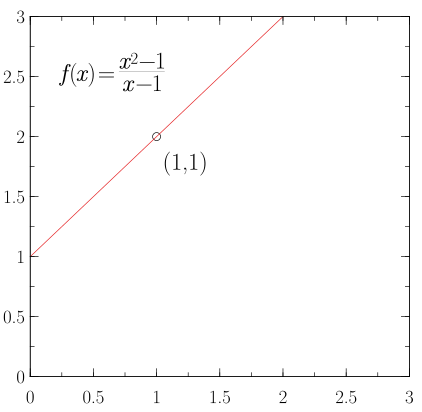
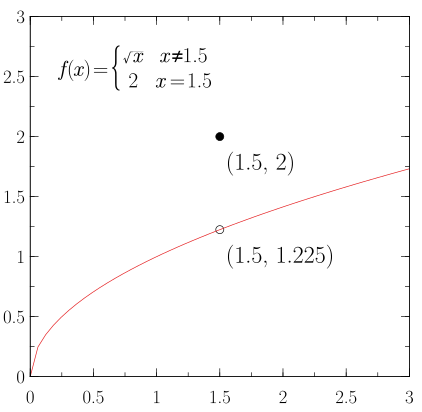
In a removable discontinuity, \[\lim_{x\to a}f(x)\] exists, however \[\lim_{x\to a}f(x)\ne f(a)\]. This may be due to \[f(a)\] being undefined (first example), or \[f(a)\] having a "wrong value" (second example). The discontinuity can be eliminated by changing the definition of \[f(x)\] at \[a\], thus the name "removable".
In the left-most graph, if we modified \[f(x)\] to:
the function would now be a continuous one.
Jump discontinuity
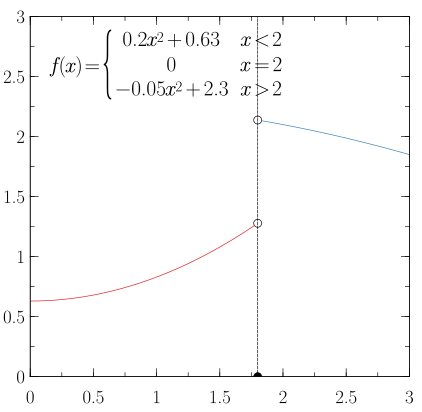
Infinite discontinuity
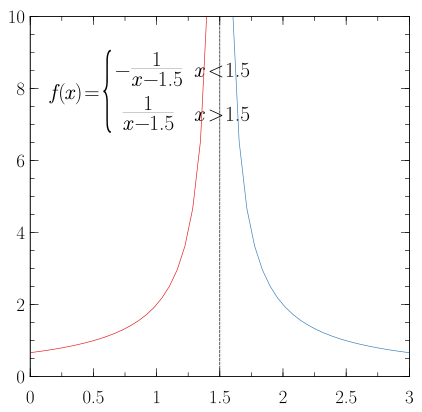
Both of the one-sided limits exist perhaps as \[\infty\] or \[-\infty\], and at least one of them must be \[\pm\infty\].
Essential discontinuity
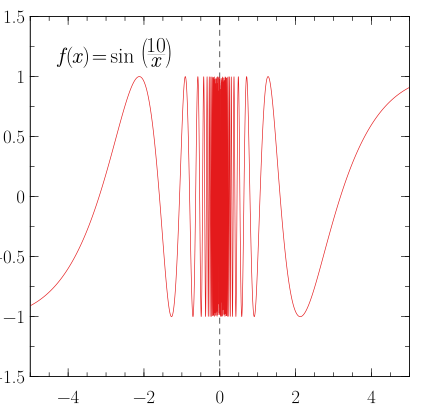
An essential discontinuity is one which isn't of the three previous types, at least one of the one-sided limits doesn't exist, in this case the function infinitely oscillates near 0. Neither \[\lim_{x\to 0^{-}}f(x)\] nor \[\lim_{x\to 0^{+}}f(x)\] exists, and \[\lim_{x\to 0}f(x)\] is undefined as \[f(0)\] is undefined. In applications, these kind of functions are rarely encountered as nature doesn't have much use for such functions.
Derivatives
Let \[f(x)\]:
Although we're inclined to assume that \[f^{\prime}(x)=0\] for the entire graph, this is not so as \[f^{\prime}(0)\] does not exist. By definition,
but \[f(0)\] does not even exist. Therefore \[f^{\prime}(0)\] would be undefined.