fundamental theorem of calculus
Fundamental theorem of calculus
The fundamental theorem of calculus is a theorem that links the concept of differentiating a function (calculating its slopes, or rate of change at each point in time) with the concept of integrating a function (calculating the area under its graph, or the cumulative effect of small contributions). Roughly speaking, the two operations can be thought of as inverses of each other.
This theorem is considered "fundamental" as it establishes a foundational link between the two central operations in calculus, which previously were seen as separate and unrelated processes.
Geometric illustration
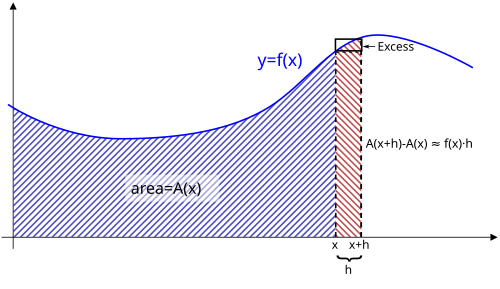
Given a continuous function, \[y=f(x)\] whose graph is plotted as a curve, we can define a function \[x\mapsto A(x)\] such that \[A(x)\] is the area beneath the curve between 0 to \[x\] (which is the result obtained via integrating \[f(x)\] from 0 to \[x\]). The area \[A(x)\] is assumed to be well defined.
The area under the curve between \[x\] and \[x+h\] could be computed by finding the area between 0 and \[x+h\], then subtracting the area between \[0\] and \[x\]. In other words, the area of this red strip would be \[A(x+h)-A(x)\]. As shown, \[A(x+h)-A(x)\approx f(x)\cdot h\] albeit with a slight inaccuracy due to the excess area if \[h\] is large.
Dividing both sides by \[h\] we get \[\frac{A(x+h)-A(x)}{h}\approx f(x)\]. Taking the limit \[h\to0\], the approximation becomes exact, \[\lim_{h\to 0}\frac{A(x+h)-A(x)}{h}=f(x)\] which now tells us that when we differentiate \[A(x)\] (which is \[f(x)\] after integration), we get back \[f(x)\]. This shows that the derivative of \[A(x)\] with respect to \[x\] is \[f(x)\], or \[A^{\prime}(x)=f(x)\]. Therefore, \[A(x)\] is an antiderivative of \[f(x)\], demonstrating that differentiation and integration are inverse operations that reverse each other.
First fundamental theorem of calculus
Establishes the relationship between differentiation and integration by stating that if \[f\] is a continuous function on the interval \[[a,b]\], and \[F\] is defined by \[F(x)=\int_{a}^{x}f(t)\,dt\], then \[F^{\prime}(x)=f(x)\] for all \[x\] in \[(a,b)\]. In essence, this theorem tells us that the derivative of the integral of a function returns the original function, showing that differentiation and integration are actually inverse processes.
Second fundamental theorem of calculus
Provides a practical method for evaluating definite integrals by linking them to antiderivatives. It states that if \[f\] is a continuous function on \[[a,b]\] and \[F\] is any antiderivative of \[f\] on this interval (meaning \[F′(x)=f(x)\]), then the definite integral of \[f\] from \[a\] to \[b\] is given by \[\int_{a}^{b}f(x)\,dx=F(b)-F(a)\]. This theorem simplifies the computation of areas and accumulated quantities by allowing us to use antiderivatives instead of computing limits of sums.