limit (right and left-handed)
Limit (right and left-handed)
).png)
The notation for:
- \[f\] has limit \[L_{1}\] as \[x\] approaches \[a\] from the left (approaching from the left-end of the number line)is \[\lim_{x\to a^{-}}f(x)=L_{1}\]
- \[f\] has limit \[L_{2}\] as \[x\] approaches \[a\] from the right (approaching from the right-end of the number line) is \[\lim_{x\to a^{+}}=L_{2}\]
Definition (left-hand)
For the left-hand limit we say that \[\lim_{x\to a^{-}}f(x)=L\] if for every number \[\epsilon>0\] there is some number \[\delta>0\] that \[\left| f(x)-L \right|<\epsilon\] whenever \[-\delta<x-a<0\].
Similar to the original definition of limits, the only chances is the condition \[0<\left| x-a \right|<\delta\] changed to \[-\delta<x-a<0\]. We've removed the absolute value as we're only interested with values to the left of \[a\]. \[x-a\] will definitely be negative, as \[x\] is approaching from negative infinity and \[x\ne a\] (this constraint mathematically would be \[x-a<0\]).
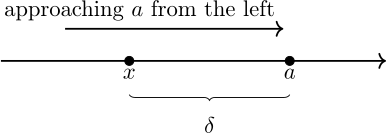
Logically, since \[x-a\] is a negative (thus \[\delta\] would be negative too), \[x\ne a\] (or \[x-a\ne0\]), combining this to form a constraint for \[\delta\] would give us \[-\delta<x-a<0\] (which is equivalent to \[0<a-x<\delta\], but for the sake of standardisation we'll not go with this form).
Definition (right-hand)
For the right-hand limit we say that \[\lim_{x\to a^{+}}f(x)=L\] if for every number \[\epsilon>0\] there is some number \[\delta>0\] that \[\left| f(x)-L \right|<\epsilon\] whenever \[0<x-a<\delta\].
Similarly, the only change is from the original definition is the condition \[0<x-a<\delta\]. Again, the absolute value has been removed as we're only interested in values to the right of \[a\]. \[x-a\] will instead be positive as \[x\] is approaching from positive infinuty and \[x\ne a\].
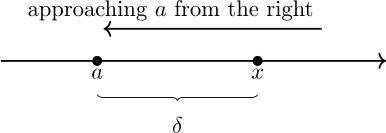
\[x-a\] would definitely be positive (thus \[\delta\] would be positive too) and since \[x\] must not be equal to \[a\], our constraints for \[x-a\] would be \[0<x-a<\delta\].
Proving limits with the definition of limit
Prove \[\lim_{x\to0^{+}}\sqrt{x}=0\]
According to the definition for the right-hand limit definition, to prove that \[\lim_{x\to0^{+}}\sqrt{x}=0\], for every number \[\epsilon>0\], there is some number \[\delta>0\] that \[\sqrt{x}-0<\epsilon\] whenever \[0<x-0<\delta\]. Cancelling all the zeroes would give us \[\sqrt{x}<\epsilon\] whenever \[0<x<\delta\].
The only simplification that we really need to do here is to square both sides to solve for \[x\] in terms of \[\epsilon\], \[\sqrt{x}<\epsilon\implies x<\epsilon^{2}\]. Logically, we can choose \[\delta=\epsilon^{2}\].
Verifying this, let \[\epsilon>0\] be any number and choose \[\delta=\epsilon^{2}\]. Next assume \[0<x<\epsilon^{2}\]. This gives:
We've now shown that \[\left| \sqrt{x}-0 \right|<\epsilon\] whenever \[0<x-0<\epsilon^{2}\], thus by definition of the right-hand limit we have \[\lim_{x\to0^{+}}\sqrt{x}=0\].