Bolzano-Weierstrass theorem
Bolzano-Weierstrass theorem
The Bolzano-Weierstrass Theorem intuitively states that within any sequence of numbers that stays confined within certain bounds (doesn't go off to infinity), there is always a subsequence that gets closer and closer to a specific value. In other words, no matter what numbers are in the sequence, as long as they are in a fixed range, you can always find a smaller sequence that settles down to a particular limit. This ensures that there is some form of order or convergence within bounded sequences.
Imagine we have a sequence of points, \[\left\{ 0,1,0,1,0,1,\dots \right\}\], so on. This sequence itself doesn't settle down to a single number as it keeps switching between 0 and 1. However, according to this theorem, you can extract a subsequence that does converge. For instance, if you take all terms that are zero, \[\left\{ 0,0,0,\dots \right\}\], then this subsequence clearly converges to 0. This example demonstrates how, despite the original sequence not having a single limit, there are always parts of it that do converge to specific values.
Definition
Every infinite bounded sequence of real numbers has a convergent subsequence (of infinite length).
First proof
Let \[\left( x_{n} \right)\] be an infinite sequence of real numbers that is bounded. In other words, there exists a \[K\] where \[\left| x_{n} \right|\le K\] for all \[n\].
We'll now pick our first interval to be \[\left[ -K,K \right]\] and call it \[\left[ a_{1},b_{1} \right]\], this ensures that every term in \[\left( x_{n} \right)\] lies within this interval.
Now we split this interval in half. Let the midpoint of the interval, \[c_{1}=\frac{a_{1}+b_{1}}{2}\], then the subintervals \[\left[ a_{1},c_{1} \right]\] and \[\left[ c_{1},b_{1} \right]\] would each represent exactly half of the original interval \[\left[ -K,K \right]\]. It is guaranteed that at least one of these subintervals must contain infinitely many members (or terms) of \[\left( x_{n} \right)\] (as the sequence itself has infinitely many terms).
If the nested interval \[\left[ a_{1},c_{1} \right]\] contains infinitely many terms, we'll define \[a_{2}=a_{1}\], \[b_{2}=c_{1}\] to form a nested interval \[\left[ a_{2},b_{2} \right]\]. Otherwise, \[a_{2}=c_{1}\], \[b_{2}=b_{1}\] to form a new nested interval. This ensures that every nested interval we define is guaranteed to still have infinite terms.
We will then repeat this process infinitely many times, which would look something like this (\[I\] represents interval and the line is a real number line):
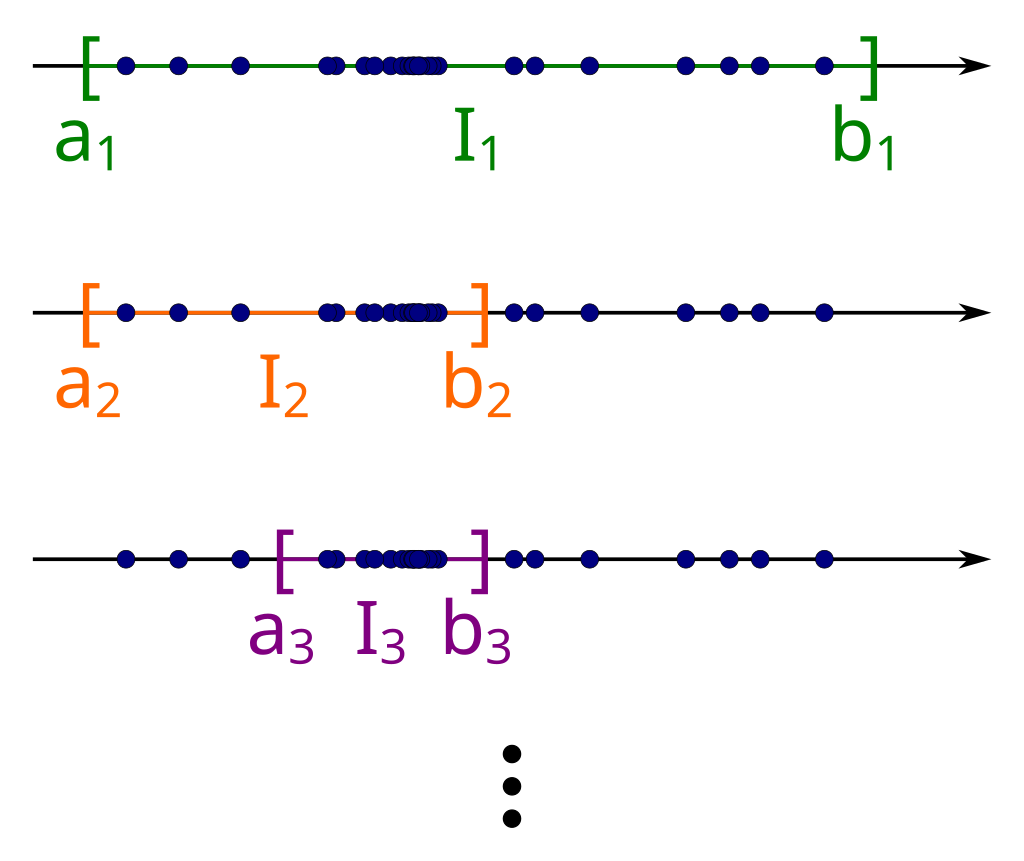
Each blue dot are ordered ascendingly (along the number line), and can represent more than one term (e.g. a blue dot at 0.257 can represent both \[x_{3}\] and \[x_{12376}\]).
Naturally, \[a_{i}\le a_{i+1}\le b_{i+1}\le b_{i}\] as shown in the image above. Notice that \[a_{i}\] forms a monotonically increasing sequence (e.g. \[a_{1}\le a_{2}\le a_{3}\le\cdots\]). Moreover, they are bounded above by \[b_{1}\]. So, according to the monotone convergence theorem, a monotone sequence (\[\left\{ a_{i} \right\}\]) with a bound (\[b_{1}\]) will converge eventually. Similarly, \[b_{i}\] forms a monotonically decreasing sequence and is bounded by \[a_{1}\] and thus the monotone convergence theorem can also be applied on it.
Logically, as \[i\] gets infinitely large, or as we repeat this a good amount of times, we should see \[a_{i}\] getting very close to \[b_{i}\]. However, this isn't mathematically rigorous. So, we will attempt to prove this mathematically.
Assuming, \[\lim_{i\to\infty}a_{i}=a\] and \[\lim_{i\to\infty}b_{i}=b\]. We know that the length of each interval is half the length of the previous interval, \[b_{i+1}-a_{i+1}=\frac{b_{i}-a_{i}}{2}\]. Taking the limit \[\lim_{i\to\infty}\left( b_{i+1}-a_{i+1} \right)=\frac{1}{2}\lim_{i\to\infty}\left( b_{i}-a_{i} \right)\] and simplifying it we get \[b-a=\frac{1}{2}\left( b-a \right)\]. \[\left( b-a \right)=0\], then we can conclude that \[a\] must be equal to \[b\] as \[i\to\infty\].
What does this tell us then? Well, these nested intervals will get reduced down to a single point as it gets infinitely tiny (or in simple words, it converges onto a single point).
Now, to get our converging subsequence, we just have a pick a term from the first interval, \[\left[ a_{1},b_{1} \right]\], e.g. the term \[x_{23}\]. Now, into our next nested interval, \[\left[ a_{1},b_{1} \right]\], the values of the blue dots confined inside this interval is guaranteed to be larger or equal to \[x_{23}\]. Since \[\left[ a_{1},b_{1} \right]\] has infinitely many terms, it is guaranteed that we can find a term that in terms of order comes after \[x_{23}\], say \[x_{317}\].
If we repeat this an infinite amount of times, we would find that our resulting subsequence would both still maintain order of the sequence and will converge to \[a\]. This is because the nested intervals themselves converge to \[a\], therefore if we picked a term from each interval, they are also guaranteed to converge to \[a\].
Second proof
Let a natural number \[n\], be the index of a "peak" in the sequence \[\left( x_{n} \right)\], such that \[x_{n}\ge x_{m}\] for every \[m>n\]. In other words, \[x_{n}\] would be larger or equal to every other term in the sequence that comes after it.
For example, define the sequence \[\left( x_{n} \right)\] where \[x_{n}=\sin(n)\]. Some of it's (infinitely many) peaks are \[x_{90}\] and \[x_{450}\], as 1 would be the largest value in the sequence.
Suppose the sequence \[\left( x_{n} \right)\] has infinitely many "peaks", which means there is guaranteed a subsequence of indices where \[n_{1}<n_{2}<n_{3}<\dots<n_{j}\] where \[x_{n_{1}}\ge x_{n_{2}}\ge x_{n_{3}}\ge\dots\ge x_{n_{j}}\]. This newfound subsequence of \[\left( x_{n_{j}} \right)\] would be an infinite monotone subsequence, therefore according to the monotone convergence theorem, is guaranteed to converge.
Suppose now that there are only a finite number of peaks. Let \[N\] be the final peak if one exists (let \[N=0\] otherwise), and let the first term in a new subsequence \[\left( x_{n_{j}} \right)\], \[x_{n_{1}}\] be \[x_{N+1}\]. Since \[x_{n_{1}}\] cannot be another peak, there must exist a term that's larger or equal to it (otherwise \[x_{n_{1}}\] would be a peak, contradicting our initial statement). Then, we are guaranteed to find a \[x_{n_{2}}\] such that \[n_{2}>n_{1}\] and \[x_{n_{2}}\ge x_{n_{1}}\]. Again, \[x_{n_{2}}\] cannot be a peak, which implies the existence of a \[x_{n_{3}}\]. Repeating this process an infinite amount of times will lead to a monotonically increasing subsequence of \[x_{n_{1}}\le x_{n_{2}}\le x_{n_{3}}\le\dots\], thereby is guaranteed to converge.