derivative
Derivative
The derivative quantifies the sensitivity of change of a function's output with respect to its input. The derivative of a function of a single variable at a chosen input value, when it exists, is the slope of the tangent line to the graph of the function at that point. The tangent line is the best linear approximation of the function near that input value. For this reason, the derivative is often described as the instantaneous rate of change, the ratio of the instantaneous change in the dependent variable to that of the independent variable. The process of finding a derivative is called differentiation. See the difference between differentials and derivatives.
In simple words, the derivative is essentially the gradient. Just that it's in the form of another function, which allows us to represent the gradient of a function which (might) change at different points in the function.
There are multiple different differentiation notations for differentiation, two of the most commonly used being Leibniz's notation and Lagrange's notation.
Definition
A function of a real variable \[f(x)\] is defined as being differentiable at a point \[a\] of its domain, if its domain contains an open interval containing \[a\], and the limit \[L=\lim_{h\to 0}\frac{f(a+h)-f(a)}{h}\] exists. This means that for every \[\varepsilon>0\], there exists a \[\delta>0\] such that for every \[h\] where \[0<\left| h \right|<\delta\], \[f(a+h)\] is defined and \[\left| L-\frac{f(a+h)-f(a)}{h} \right|<\epsilon\].
If the function \[f\] is differentiable at \[a\], then it is called the derivative of \[f\] at \[a\]. The derivative of \[f(a)\] with respect to \[a\] is defined as \[f^{\prime}(x)=\frac{df(a)}{da}=\lim_{h\to0}\frac{f(a+h)-f(a)}{h}\].
Origin of \[\lim_{h\to0}\frac{f(a+h)-f(a)}{h}\]
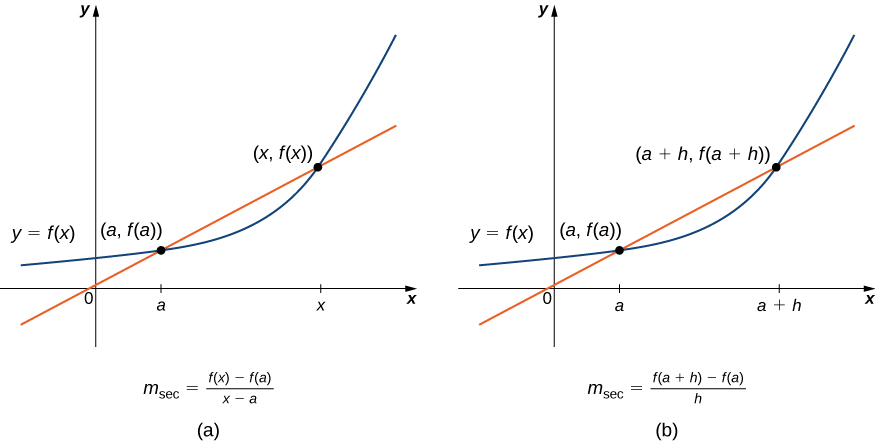
If we move both points closer and closer together, mathematically represented as \[h\to0\], we will obtain the tangent line of point \[a\] as show in figure (a) below.
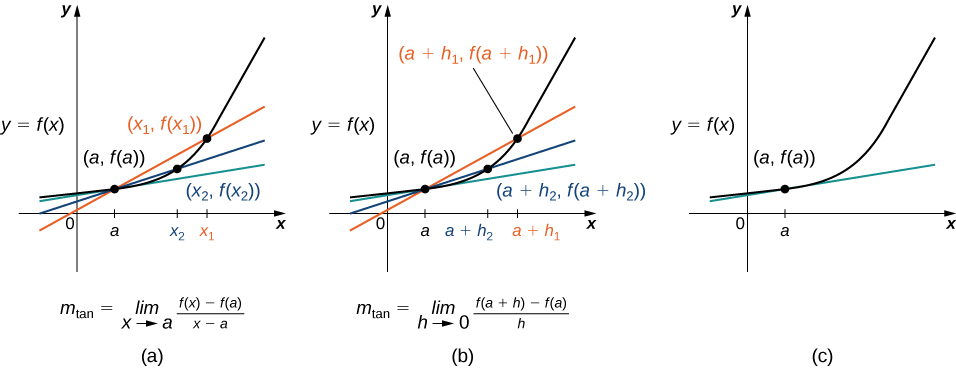
Thus, the gradient, \[m=\frac{f(a+h)-f(a)}{(a+h)-a}\], and when \[h\to0\], \[m=\lim_{h\to0}\frac{f(a+h)-f(a)}{h}\].
Derivatives as linear approximations
\[f(c+h)=f(c)+f^{\prime}(c)h+r(h)\].
Differentiability and continuity
If \[f\] is differentiable at \[c\], then:
which implies that \[f\] is continuous at \[c\].
Referenced by:
-
derivatives of exponential and logarithmic functions
-
probability density function
-
fundamental theorem of calculus
-
derivative of natural logarithm function
-
derivatives of general exponential and logarithmic functions
-
derivatives of trigonometric functions
-
interior extremum theorem
-
absolute continuity
-
discontinuous function
-
chain rule (calculus)
-
integration by substitution
-
integral
-
antiderivative
-
first fundamental theorem of calculus
-
derivatives as linear approximations
-
mean value theorem
-
differentiable function
-
second fundamental theorem of calculus