limit (at infinity)
Limit (at infinity)
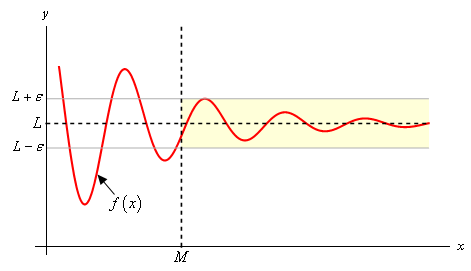
In general, we write \[\lim_{x\to\infty}f(x)=L\] if the function \[f\] has the limit \[L\] as \[x\] increases without bound. Similarly, we write \[\lim_{x\to-\infty}f(x)=L\] if the function \[f\] has the limit \[L\] as \[x\] decreases without bound.
Definition (at positive infinity)
Let \[f(x)\] be a function defined on \[x>M\] for some \[M\]. \[\lim_{x\to\infty}f(x)=L\] is true if for every number \[\epsilon>0\] there is some number \[M>0\] such that \[\left| f(x)-L \right|<\epsilon\] whenever \[x>M\].
Rather than constraining our \[x\] to the usual \[0<\left| x-a \right|<\delta\], we're constraining it to just simply \[x>M\]. This is because we can't approach infinity in the same way because it isn't a point we can get close to, therefore we write \[x>M\] to ensure \[x\] to be sufficiently large. We then adjust \[M\] based on \[\epsilon\] to ensure that \[\left| f(x)-L \right|<\epsilon\] for all \[x>M\].
A visualisation of the definition would be the graph above, where it tells us that the wavy line would approach \[L\] closer and closer and our \[x\] gets larger and larger.
Definition (at negative infinity)
Let \[f(x)\] be a function defined on \[x<N\] for some \[N\]. \[\lim_{x\to-\infty}f(x)=L\] is true if for every number \[\epsilon>0\] there is some number \[N<0\] such that \[\left| f(x)-L \right|<\epsilon\] whenever \[x<N\].
Definition (infinite limit at infinity)
Let \[f(x)\] be a function defined on \[x>M\] for some \[M\]. \[\lim_{x\to\infty}f(x)=\infty\] if for every number \[N>0\] there is some number \[M>0\] such that \[f(x)>N\] whenever \[x>M\].
Proving limits with the definition of limit
Prove \[\lim_{x\to-\infty}\frac{1}{x}=0\].
Let \[\epsilon>0\] be any number and we'll choose a \[N<0\] so that \[\left| \frac{1}{x}-0 \right|<\epsilon\] whenever \[x<N\]. Simplifying the first inequality we get \[\frac{1}{\left| x \right|}<\epsilon\], then by moving \[x\] to the other side of the equation, \[\frac{1}{\epsilon}<\left| x \right|\implies \left| x \right|>\frac{1}{\epsilon}\].
It may seem logical to pick \[\frac{1}{\epsilon}\] as our \[N\], however since \[x\] approaches \[-\infty\] and \[\epsilon>0\], to ensure that \[N\] is always negative, \[N\] must be \[-\frac{1}{\epsilon}\], so that \[x<N\] is true.
Now that we have our \[N\], we'll verify it. Let \[\epsilon>0\] and \[N=-\frac{1}{\epsilon}\], assume \[x<-\frac{1}{\epsilon}\].
So, we've shown that \[\left| \frac{1}{x}-0 \right|<\epsilon\] whenever \[x<-\frac{1}{\epsilon}\], thus \[\lim_{x\to-\infty}\frac{1}{x}=0\].