integral
Integral
An integral is the continuous analog of a sum, which is used to calculate areas, volumes, and their generalizations. Integration, the process of computing an integral, is one of the two fundamental operations of calculus, the other being differentiation.
A definite integral computes the signed area of the region in the plane that is bounded by the graph of a given function between two points in the real line. Conventionally, areas above the horizontal axis of the plane are positive while areas below are negative.
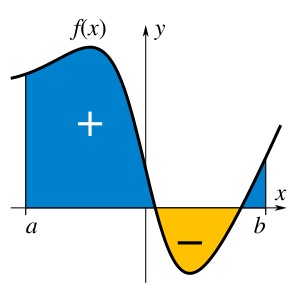
Integrals also refer to the concept of an antiderivative, a function whose derivative is the given function; in this case, they are also called indefinite integrals.
Notation
In general, the integral of a real-valued function \[f(x)\] with respect to a real value \[x\] on an interval \[[a,b]\] is written as \[\int_{a}^{b}f(x)\,dx\].
- The symbol \[dx\] represents the differential (infinitesimal changes) of \[x\]
- The function \[f(x)\] is known as the integrand
- \[[a,b]\] represents the interval of integration
When limits are omitted, \[\int f(x)\,dx\], the integral is called an indefinite integral, which represents the antiderivative whose deriative is the integrand, \[f(x)\].
Integrals (or definite integrals) should not be confused with antiderivatives (indefinite integrals), as integration is used to find the area (essentially just the difference between \[F(b)-F(a)\]), while antidifferentiation is used to calculate \[\int f(x)\,dx=F(x)\]. Thus, the calculation of \[\int_{a}^{b}f(x)\,dx\] is a two-step process, involving antidifferentiation followed by integration.
Formal definition
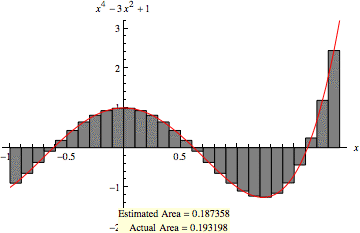
Riemann integral is one of the most commonly used definition for integrals. The definition for \[\int_{a}^{b}f(x)\,dx\] is the limit \[\lim_{\Vert \Delta x_{i} \Vert\to 0}\sum_{i=1}^{n}f \left( x_{i}^{\ast} \right)\Delta x_{i}\], where \[\Vert \Delta x_{i} \Vert\] refers to the mesh (the length of the largest sub-interval).
The Riemann integral is defined in terms of Riemann sums of functions with respect to tagged partitions of an interval. A tagged partition of a closed interval \[[a,b]\] on the real line is a finite sequence, \[a=x_{0}\le x_{1}^{\ast}\le x_{1}\le x_{2}^{\ast}\le x_{2}\le\cdots\le x_{n-1}\le x_{n}^{\ast}\le x_{n}=b\], where \[x_{i}^{\ast}\] represents the type of Riemann sum (e.g. \[x_{i}^{\ast}=x_{i-1}\] for left Riemann sum) and \[\Delta x_{i}=x_{i}-x_{i-1}\].