Squeeze theorem
Squeeze theorem
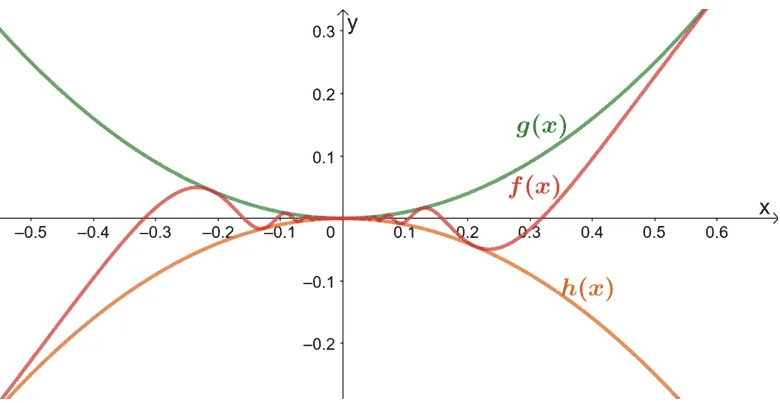
The Squeeze theorem is a theorem regarding the limit of a function that is bounded between two other functions.
The formal statement for this theorem is:
Suppose that \[g(x)\le f(x)\le h(x)\] for all \[x\] in some open interval containing \[a\] except possibly at \[a\] itself. If \[\lim_{x\to a}g(x)=\lim_{x\to a}h(x)=L\] then \[\lim_{x\to a}f(x)=L\].
Intuitively, this means that the function \[f(x)\] gets squeezed between the other functions. Since \[g(x)\] and \[h(x)\] are equal at \[x=a\], it must also be the case that \[f(x)=L\] since there is no room for \[x\] to be anything else.
Proof
Let \[\epsilon>0\]. Assume \[\delta>0\] such that \[\left| f(x)-L \right|<\epsilon\] whenever \[0<\left| x-a \right|<\delta\].
Since \[\lim_{x\to a}g(x)=L\], by definition there must exist some \[\delta_{1}>0\] such that \[\left| g(x)-L \right|<\epsilon\] for all \[0<\left| x-a \right|<\delta_{1}\]. Rewriting it, \[L-\epsilon<g(x)<L+\epsilon\] whenever \[0<\left| x-a \right|<\delta_{1}\]. Similarly, since \[\lim_{x\to a}h(x)=L\], by definition there must exist some \[\delta_{2}>0\] such that \[L-\epsilon<h(x)<L+\epsilon\] whenever \[0<\left| x-a \right|<\delta_{2}\]. Thus, confining both \[g(x)\] and \[h(x)\] within \[\epsilon\] of \[L\] when \[x\] is very close to \[a\].
Additionally, since \[g(x)\le f(x)\le h(x)\] for all \[x\] in some open interval containing \[a\] except possibly at \[a\], there must exist some \[\delta_{3}>0\] such that \[g(x)\le f(x)\le h(x)\] for all \[0<\left| x-a \right|<\delta_{3}\].
Now, we choose \[\delta=\min \left\{ \delta_{1},\delta_{2},\delta_{3} \right\}\] to ensure that all three functions \[g(x)\], \[f(x)\], and \[h(x)\] meet their respective conditions simultaneously when \[x\] is within \[\delta\] of \[a\]. With the three sets of inequalities we constructed above, we have that \[L-\epsilon<g(x)\le f(x)\le h(x)<L-\epsilon\] for all \[0<\left| x-a \right|<\delta\]. This posits that \[L-\epsilon<f(x)<L+\epsilon\], since both \[g(x)\] and \[h(x)\] are within \[\epsilon\] of \[L\], \[f(x)\] must also be within \[\epsilon\] of \[L\].
Therefore, we have proven that \[\left| f(x)-L \right|<\epsilon\] whenever \[0<\left| x-a \right|<\delta\], which proves that \[\lim_{x\to a}f(x)=L\].
Example
One of the most well-known examples for squeeze theorem is the proof for \[\lim_{x\to0}\frac{\sin{x}}{x}=1\].
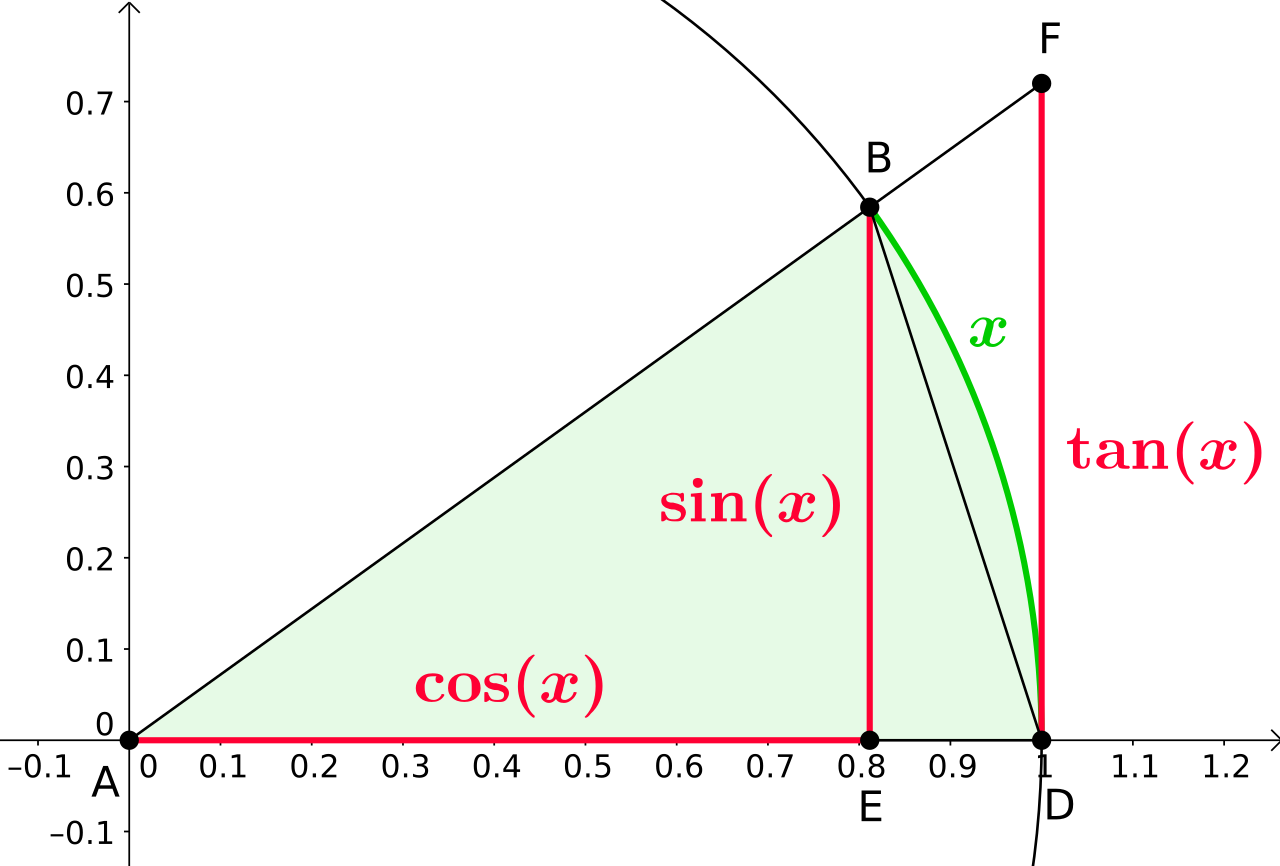
By comparing areas, it is known that, let \[x\] be the angle of the sector in radians, \[A(\triangle ADB)\le A(\text{sector } ADB)\le A(\triangle ADF)\],
According to the Squeeze theorem, since \[\cos{x}\] approaches 1 when \[x\] is close enough to 0, \[\frac{\sin{x}}{x}\] will too approach 1. Thus, proving that \[\lim_{x\to0}\frac{\sin{x}}{x}=1\].