center of mass of lamina
Center of mass of lamina
For a lamina, the coordinate of the center of mass, \[\overline{x}\] and \[\overline{y}\] can be found via dividing the moment and mass, \[\overline{x}=\frac{M_{y}}{m}=\frac{\iint_{R}x\cdot\rho(x,y)dA}{\iint_{R}\rho(x,y)dA}\] and \[\overline{y}=\frac{M_{x}}{m}=\frac{\iint_{R}y\cdot\rho(x,y)dA}{\iint_{R}\rho(x,y)dA}\]. If the density function, \[\rho(x,y)\], is not specified, we would assume that \[\rho(x,y)=1\].
Let's take a triangle for an example.
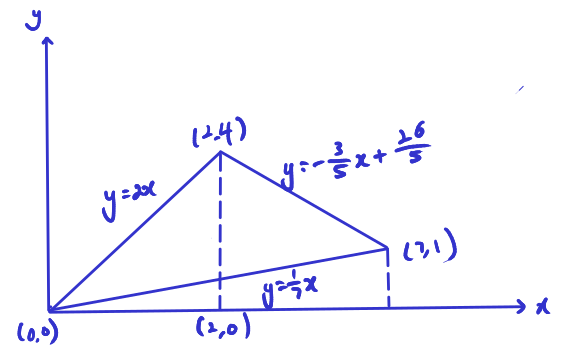
First we find the equations of the boundary for the shape and separate the diagram into two to simplify calculations.
We shall now attempt to find the mass:
We get the mass = 13 (which is also the area since we assumed the density function to equate to 1). Then, we find the moment \[M_{x}\]:
See this for more about double integrals over general regions.
Triangles
A (much) easier method to find the coordinate for the center of mass of triangles would be to simply use the formula \[\left(\frac{x_{1}+x_{2}+x_{3}}{3},\frac{y_{1}+y_{2}+y_{3}}{3}\right)\].
Sector of a circle
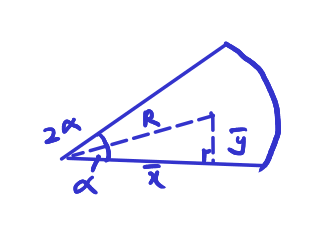
The formula to find the distance from \[O\] to the of the center of mass of a sector of a circle, \[\overline{x}\] would be \[\frac{2r\sin\alpha}{3\alpha}\].
Proof
First we would assume the sector of the circle as such:
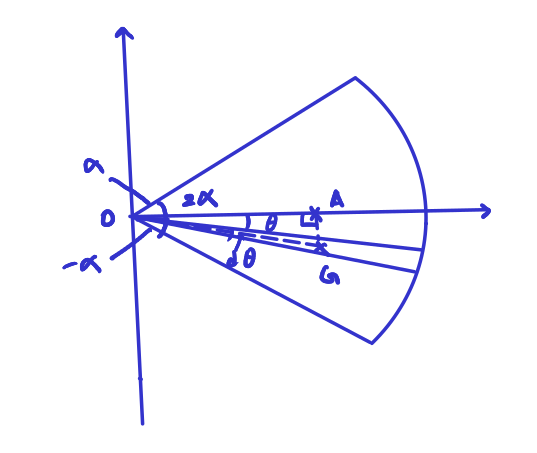
The idea here is to slice the sector into infinitely small slices (with angle \[d\theta\]), then integrating it from angle \[\alpha\] to \[-\alpha\].
- Where \[O\] is the center of the circle
- \[OG\] is the geometric center (center of mass) of small sector with angle \[d\theta\], which would be \[\frac{2}{3}r\]
- Since \[\cos\left(\theta+\frac{1}{2}d\theta\right)=\frac{OA}{OG}\], \[OA=\frac{2}{3}r\cos\left(\theta+\frac{1}{2}d\theta\right)\], and if angle \[d\theta\] is small enough, \[OA\] would approximate into \[\frac{2}{3}r\cos\theta\].
- Assuming the mass per unit area of the small sector with angle \[d\theta\] is \[\rho\], the mass of each small sector will be \[\frac{d\theta}{2\pi}\cdot\pi r^{2}\cdot\rho=\frac{1}{2}r^{2}\rho d\theta\].
- Likewise, the mass of the entire sector would be \[\frac{2\alpha}{2\pi}\cdot\pi r^{2}\cdot \rho=r^{2}\alpha\rho\]
In the beginning, we have established the formula that \[\overline{x}=\frac{M_{y}}{m}\], we will now work towards this formula.
We know that the moment about the vertical \[y\]-axis for each small sector (considered about the origin) is given by its mass times its \[x\]-coordinate. For the whole sector, it is \[M_{y}=\int_{-\alpha}^{\alpha}(\text{mass of small sector}\cdot x\text{-coordinate of it's centroid})\] as our total angle is \[2\alpha\] and we assume \[-\alpha\] to 0 covers the bottom half (below the \[x\]-axis) of the sector and 0 to \[\alpha\] covers the top half of the sector.
After substituting the values we would get \[M_{y}=\int_{-\alpha}^{\alpha}\frac{1}{2}r^{2}\rho d\theta\cdot\frac{2}{3}r\cos\theta\].
NOTE: This formula finds the distance from the center of the circle to the center of mass, denoted as \[R\] here, which means if we want to find the actual \[\overline{x}\] we would have to do \[\overline{x}=R\cos\frac{2\alpha}{2}\].
Arc of a circle
To find the distance between the center of mass of a wire shaped like an arc with an angle \[2\alpha\] from the center, we use the formula \[\frac{r\sin\alpha}{\alpha}\].
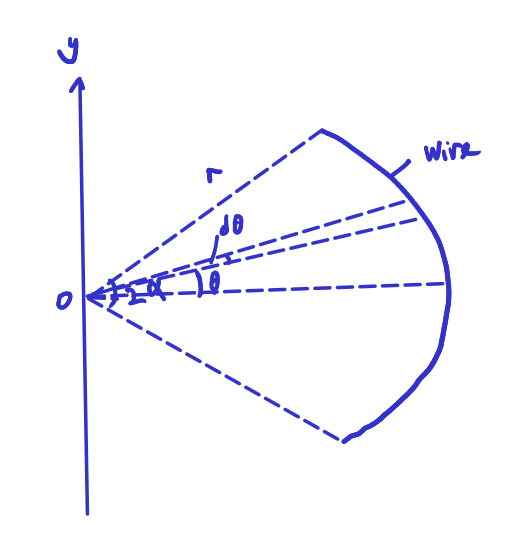
Similar to how we found the formula for the center of mass for a sector, the idea here is to slice the arc into infinitely small arcs with angle \[d\theta\] extended from \[O\] then integrated from \[\alpha\] to \[-\alpha\].
- Mass of wire = \[2\pi r\rho\cdot\frac{2\alpha}{2\pi}=2r\rho\alpha\]
- Mass of small arc \[d\theta\] = \[2\pi r\rho\cdot\frac{d\theta}{2\pi}=r\rho d\theta\]
-
The distance from each small arc of wire to the \[y\]-axis is \[r\cos\left(\theta+\frac{1}{2}d\theta\right)\approx r\cos\theta\].
Which can be clearer represented via the drawing below:
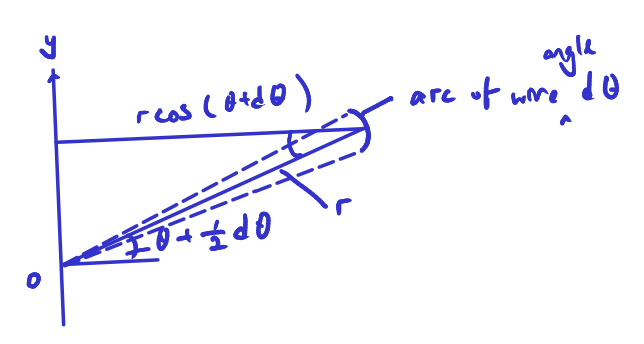
Since we know \[\overline{x}=\frac{M_{y}}{m}\],
Composite lamina
The formula to calculate the center of mass for composite laminas is \[\overline{x}=\frac{\sum m_{i}\overline{x}_{i}}{\sum m_{i}}\], \[\overline{y}=\frac{\sum m_{i}\overline{y}_{i}}{\sum m_{i}}\].
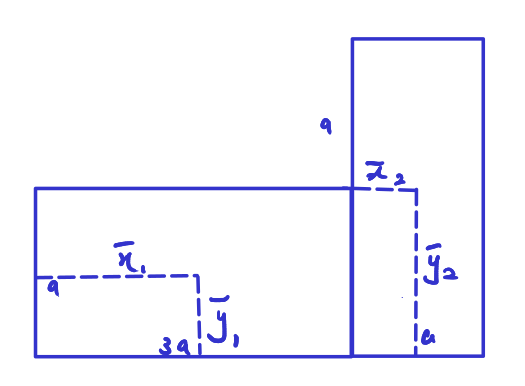
Let's take the diagram above as an example, using the general formula, we get that \[\overline{x}=\frac{(3a^{2}\rho\cdot\frac{3}{2}a)+(2a^{2}\rho\cdot(3a+\frac{1}{2}a))}{3a^{2}\rho+2a^{2}\rho}=2.3a\], \[\overline{y}=\frac{(3a^{2}\rho\cdot\frac{1}{2}a)+(2a^{2}\rho\cdot a)}{3a^{2}\rho+2a^{2}\rho}=0.7a\]. Therefore, the coordinate of center of mass of the combined shape is \[\left(2.3a,0.7a\right)\].
NOTE: If the shape extends to the left of the y-axis (negative x-coordinate value), \[\overline{x}_{i}\] will be negative; If the shape extends below the x-axis (negative y-coordinate value), \[\overline{y}_{i}\] will be negative.