work
Work
Work, \[W\], is the physical concept that we use to relate force and energy. It is meant to quantify how much energy a force transfers to (or from) something as it moves.
In its simplest form, for a constant force aligned with the direction of motion, the work equals the product of the force strength and the distance travelled. Mathematically, work is the energy transferred to or from an object via the application of force along a displacement: \[W=F\cos\theta\cdot s\]. If \[F\] is variable then work done is the path integral of the dot product of force and displacement: \[W=\int \vec{F}\cdot d\vec{s}\]. Thus, only the component of force in the direction of the displacement does any work.
It is important to note that work done on a system means that energy is added to the system while work done by the system means energy removed from the system. Additionally, when work is done on a system, energy comes from external sources, thus energy isn't conserved. However, total energy is still conserved in the system containing both the external source and the original system.
Intuitive idea
We ought to dissociate ourselves from the common definition of "work" when understand the concept of work in physics. "Doing work" in physics means using force to transfer energy from one object to another, or concert energy from one form to another. You could also replace the word "work" with "mechanically transferred energy" and still be saying the same thing.
In a letter sent from René Descartes to Huygens in 1637, he wrote:
An account of devices that enable us to use a small force to raise a heavy weight.
The single underlying principle of all these devices is that a force that can raise a 100lb weight two feet can raise a 200lb weight one foot, or a 400lb weight six inches, and so on.
You'll accept this principle if you consider that an effect must always be proportional to the action needed to produce it. Thus, if what we need to lift a certain weight \[x\] one foot is a force that can raise a 100lb weight two feet, then \[x\] must weigh 200lb. For lifting 100lb one foot twice over is the same as lifting 200lb one foot or 100 pounds two feet.
Now, mechanical devices can rely on this principle to move a weight over a shorter distance by applying a force over a longer distance. They include the pulley, slope, wedge, cog-wheel, screw and lever.
It makes little sense to question why work is defined as \[W=Fs\]. We will not find such a thing as "work" in reality as it is entirely a human concept. After all, physics is just about building models to approximate reality with good accuracy and usefulness. \[W=Fs\] is defined just as it is because we found it useful in predicting the behaviour of physical objects. Same goes with every other formula in physics, as the only use an equation has in physics is how useful it is in describing the world around us. A better question to ask why we want to calculate the work done. The answer is that it is interesting and useful to do so, since the work done on a particle by the resultant of all the forces acting on it is exactly equal to the change in kinetic energy of that particle.
Let's move on to an example. Let's say that a human has a 10% efficiency at converting food to mechanical work. If you spend 1000 kJ of food energy to push a wall, are you doing 1000 kJ of work, or 100 kJ of work, or 0 kJ of work? In strict mechanical sense, you did no work whatsoever as the wall (obviously) did not budge, and all of the energy you used was wasted as heat. If you instead used this energy to push a cart, you would have wasted "only" 900 kJ of the energy as heat, with 100 kJ being work.
Net work
Net work is defined to be the sum of all individual works, equivalently, the work done by the net external force, \[W_{\text{net}}=\sum_{i}W_{i}\]. As shown in the work-energy theorem, the net work is also equivalent to the change in kinetic energy. If \[W_{\text{net}}=0\], speed is unchanged, even though individual forces may each have done substantial positive or negative work.
Sign convention of work
Signs are just fancy mathematics with no physical meaning, they're often arbitrarily chosen by the author for different scenarios. It's like asking whether negative speed means leftwards or rightwards. So, if we adopt the convention that energy transfer into the system is positive, i.e. work done on a system (e.g. someone lifting a chair in an Earth-chair system) is taken as positive work, then work done by a system should be taken as negative work (e.g. the chair falling back down). The signs can also be flipped the other way around without issues.
Assume we're trying to lift up a chair. When we lift the chair up, we're doing positive work on the chair. This can be thought of it two ways, the force from our hand directing upwards and the direction of the chair going upwards is the same direction, thus it's positive work, or, we just gave the chair \[mgh\] amounts of energy, i.e. doing work against gravity, thus it's positive work. At the same time, gravity does negative \[-mgh\] work on the chair because gravitational force is opposite to the movement of the chair.
Now after lifting it up, if we held the chair in the exact same position for a minute or so, neither us nor gravity will be doing work on the chair for the entire duration.
Deviating a little, logically to lift the chair, we will have to accelerate it upwards from rest, giving it kinetic energy, then decelerate the chair to rest when it's up to height \[h\], however since it starts and stops at rest, i.e. change in kinetic energy \[\Delta K=0\]. By work-energy theorem, since change in kinetic energy is zero, net work on the chair is zero, which is true as \[W_{\text{net}}=\Delta K+W_{\text{hand}}+W_{\text{grav}}=0+mgh-mgh=0\], however keep in mind that the work-kinetic energy theorem applies to the chair alone (i.e. treating the chair as its own isolated system). This doesn't mean that energy isn't transferred to the chair, in the system containing just the Earth and chair, indeed the chair has gained some gravitational potential energy.
Calculation
A force is said to do positive work if it has a component in the direction of the displacement of the point of application. A force does negative work if it has a component opposite to the direction of the displacement at the point of application of the force. (Note: work itself does not have direction)
Work is a scalar quantity, with unit joule, \[J\], or \[\text{kgm}^{2}\text{s}^{-2}\].
When \[F\] and \[s\] are in the same direction, \[\theta\] would be zero degrees, otherwise:
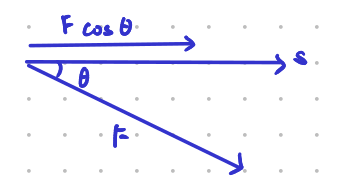 , where \[s\] is the direction of work
(notice the similarity between this and vector projection)
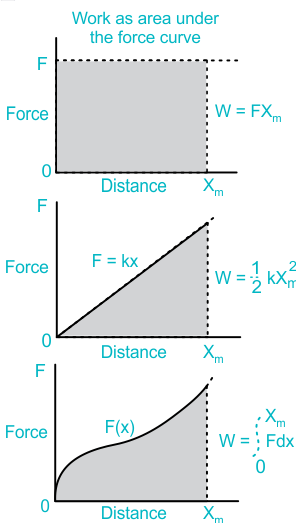
Variable force graph
The work done by a force is the integral of the force with respect to displacement along the path of the displacement: \[W=\int_{x_{i}}^{x_{f}}F(s)\,ds\]. (\[s\] and \[x\] both represent displacement)
Referenced by:
-
thermodynamics
-
dot product
-
potential energy
-
energy
-
elastic potential energy
-
electric potential energy
-
mechanical energy
-
potential difference
-
conservative and non-conservative forces
-
gravitational potential energy
-
gravitational potential
-
work-energy theorem
-
electric potential
-
potential
-
power
-
momentum
-
kinetic energy