Riemann integral
Riemann integral
The Riemann integral is the first rigorous definition of the integral of a function on an interval.
Definition
Before we can start defining the Riemann integral, there are some things we have to define first.
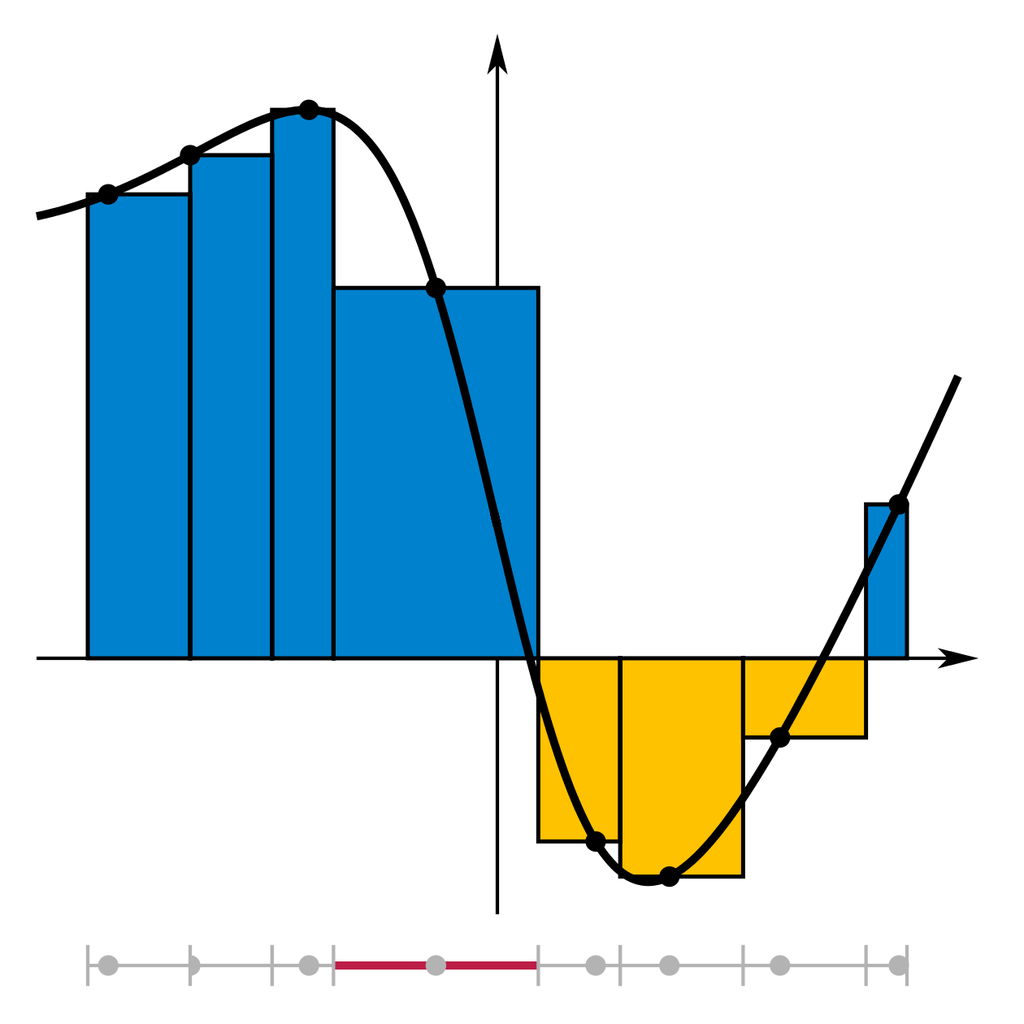
Let \[\left[ a,b \right]\] be a nonempty, compact interval (or a closed interval that doesn't stretch out to infinity). A partition of \[\left[ a,b \right]\] is a finite set collection of intervals \[\left\{ I_{1},I_{2},\dots,I_{n} \right\}\], such that:
- Each \[I_{k}\] is itself a nonempty, compact interval
- The subintervals are almost disjoint (only meet at their endpoints, i.e. they do not overlap in their interiors)
- Their union exactly covers \[\left[ a,b \right]\] with no gaps
A common way to form such a partition is by choosing points \[a=x_{0}<x_{1}<x_{2}<\cdots<x_{n-1}<x_{n}=b\] and then defining each subinterval as \[\left[ x_{k-1},x_{k} \right]\]. This allows us to effectively split \[\left[ a,b \right]\] into these tiny "slices" \[\left[ x_{0},x_{1} \right],\left[ x_{1},x_{2} \right],\dots,\left[ x_{n-1},x_{n} \right]\].
We can then list a partition, \[P\], as subintervals \[P=\left\{ I_{1},I_{2},\dots,I_{n} \right\}\] or simply by writing down the set of endpoints \[P=\left\{ x_{0},x_{1},x_{2}\dots,x_{n-1},x_{n} \right\}\]. There are many more ways to define \[P\] (or "chop" \[\left[ a,b \right]\] into tiny pieces), however we'll only be using these two in this definition (as they're the most practical).
For instance, on the interval \[\left[ 0,3 \right]\] we can pick the points 0,1,2,3. This yields three subintervals \[\left[ 0,1 \right],\left[ 1,2 \right],\left[ 2,3 \right]\] that satisfy our conditions above, which together form a partition of \[\left[ 0,3 \right]\].
We'll adopt specific notations when it is convenient; the context should make it clear which one is being used.
From a geometrical perspective, it is obvious that the sum of the lengths of all subintervals in \[P\], \[\left| I_{k} \right|=x_{k}-x_{k-1}\], must be equal to the length of the entire interval \[\left[ a,b \right]\]. Algebraically, it follows from the telescoping series:
Which tells us that the sum of the length of each and every subinterval is equal to \[x_{n}-x_{0}\], or \[b-a\].
Now, suppose that \[f:\left[ a,b \right]\to\mathbb{R}\] is a bounded function on the compact interval \[I=\left[ a,b \right]\], then \[M=\sup_{I}f\] and \[m=\inf_{I}f\].
If we define \[P=\left\{ I_{1},I_{2},\dots,I_{n} \right\}\], then \[M_{k}=\sup_{I_{k}}f\] and \[m_{k}=\inf_{I_{k}}f\] (the notation simply tells us that \[M_{k}\] is the supremum of \[f\] when it's defined on the interval \[I_{k}\]). These suprema and infima are well-defined, finite real numbers since \[f\] is bounded. Moreover, it follows that \[m\le m_{k}\le M_{k}\le M\], as \[m\] is smaller or equal to every value in \[f\], therefore it follows that any value in \[f\] must be larger or equal to \[m\]. The similar also applies to \[M\], as \[M\] is larger or equal to every value in \[f\].
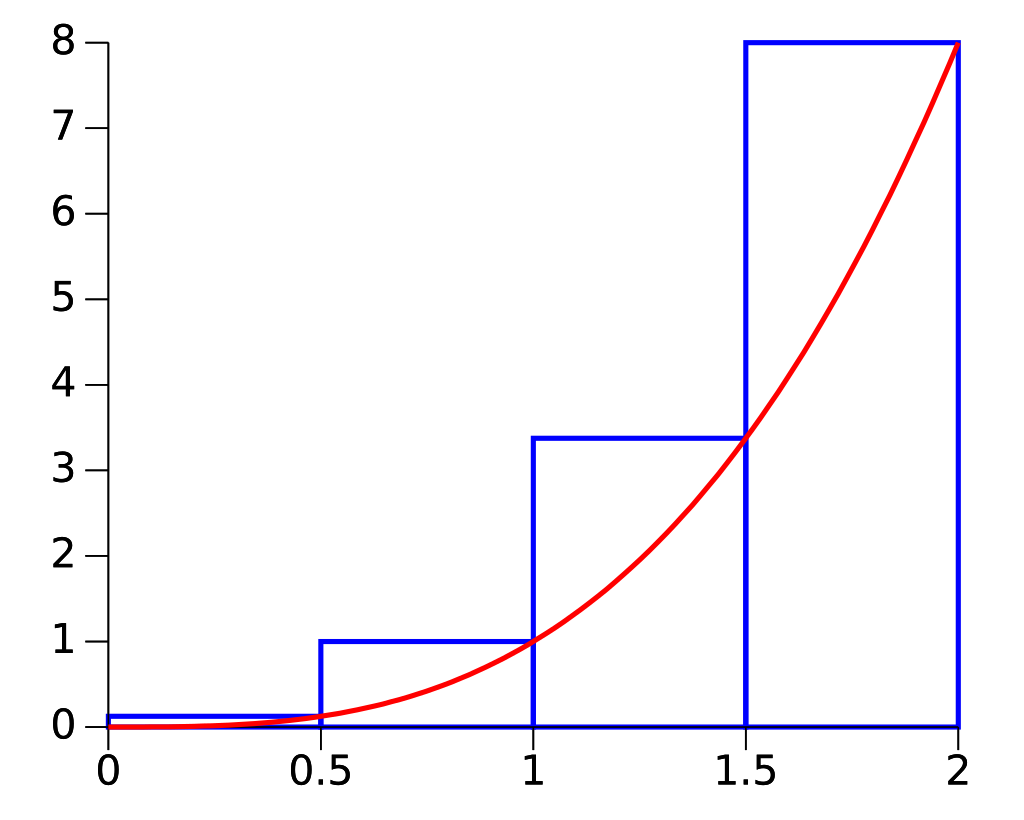
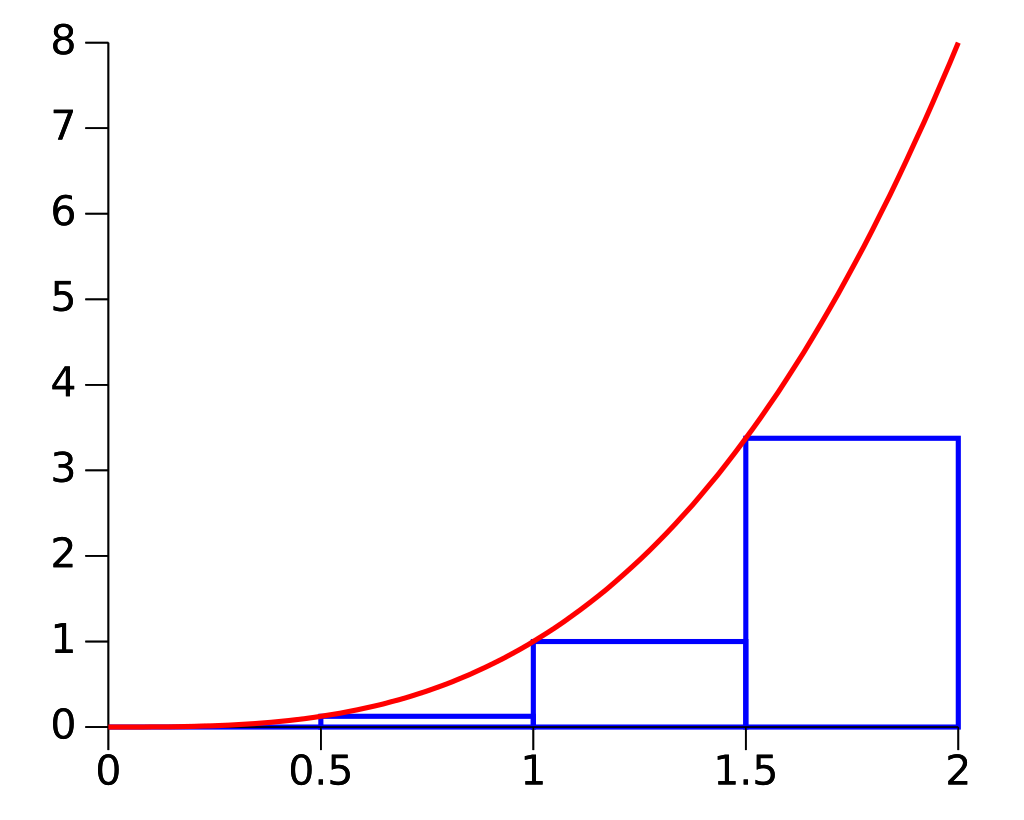
The images above depict the upper Riemann sum (left) and lower Riemann sum (right).
We define the upper Riemann sum of \[f\] with respect to the partition \[P\] as \[U(f;P)\], then \[U(f;P)=\sum_{k=1}^{n}M_{k}\cdot \left| I_{k} \right|\] if we define \[P\] as subintervals. This tells us that the upper Riemann sum is the sum of the supremum of each subinterval multiplied by the subinterval length. Geometrically (as shown above), it's the sum of the areas of rectangles in which it's height (of the rectangle) is defined by the "largest" \[f\]-value of the subinterval. Since \[\left| I_{k} \right|=x_{k}-x_{k-1}\], we can rewrite \[U(f;P)\] as \[\sum_{k=1}^{n}M_{k}\cdot \left( x_{k}-x_{k-1} \right)\]. Do note that there are many more ways to partition \[\left[ a,b \right]\] (or define \[P\]), however it can always be simplified into \[U(f;P)=\sum_{k=1}^{n}M_{k}\cdot \left( x_{k}-x_{k-1} \right)\] (therefore making this the general definition of the upper Riemann sum).
Similarly, the lower Riemann sum of \[f\] with respect to the partition \[P\] is defined as \[L(f;P)\], and \[L(f;P)=\sum_{k=1}^{n}m_{k}\cdot \left| I_{k} \right|=\sum_{k=1}^{n}m_{k}\cdot \left( x_{k}-x_{k-1} \right)\]. In simple words, we're also summing the areas of each rectangle, where it's width is defined by length of the subinterval, however it's height is now defined by the value of the "smallest" \[f\]-value in the sub-interval.
Now, as we've established the relation \[m\le m_{k}\le M_{k}\le M\] above, naturally \[m\cdot(b-a)\le L(f;P)\le U(f;P)\le M\cdot(b-a)\]. To see why this is true, we just have to think of \[m\] and \[M\] as the "heights" of rectangles, as logically for rectangles of same width, the ones with the shortest height must have the least area.
To generalise this, let \[\Pi(a,b)\], or \[\Pi\] for short, denote the collection of all types of partitions of \[\left[ a,b \right]\]. To put it simply, \[\Pi\] is a collection of every way we can partition \[\left[ a,b \right]\], which includes but is not limited to subintervals and endpoints.
We now can finally define the upper Riemann integral (not sum) of \[f\] on \[\left[ a,b \right]\] as \[U(f)\], where \[U(f)=\inf_{P\in\Pi}U(f;P)\]. Breaking down the notation, since there will be many ways to calculate \[U(f;P)\], the upper Riemann integral would be equal to the smallest value that's larger or equal to every possible way we can calculate \[U(f;P)\].
We can calculate Riemann integrals as such, as the set \[\left\{ U(f;P):P\in\Pi \right\}\] and \[\left\{ L(f;P):P\in\Pi \right\}\] is bounded by \[m\cdot (b-a)\] from below and \[M\cdot (b-a)\] from above (as stated beforehand), therefore they (\[U(f)\] and \[L(f)\]) are well-defined and finite.
Similarly, we will define the lower Riemann integral of \[f\] on \[\left[ a,b \right]\] as \[L(f)=\sup_{P\in\Pi}L(f;P)\], or the largest value that's smaller or equal to every possible way to calculate \[L(f;P)\].