elastic potential energy
Elastic potential energy
When an elastic body is stretch/compressed, potential energy is stored in the system. Work, \[W\] is defined by \[W=Fs\] where \[F\] is the force and \[s\] is the displacement.
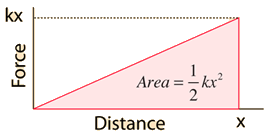
When we are pulling the spring-like body the elongation gets larger and thus we are required to use an even larger force to pull the spring even more, so we say that the average force required to pull the string is \[F_{\text{avg}}=\frac{0+kx}{2}\], substitute \[x\] for \[s\] and combine that we get \[W=Fs=\frac{1}{2}kx^{2}=\frac{\lambda}{2l}x^{2}\].
A more precise proof is that since the force is variable over the length of it's application, we can also integrate force with respect to displacement to get the total work done, i.e. \[W=\int_{x_{1}}^{x_{2}}F\,dx\]. Substituting \[F=kx\], we get
The constant \[C\] will be canceled out as when \[x=0\], the work done is zero thus \[C=0\].
Assuming \[x_{{1}}=0\] and \[x_{{2}}=x\], \[W=\frac{1}{2}kx^{2}=\frac{\lambda}{2l}x^{2}\], which is the same equation as the above.