cumulative distribution function
Cumulative distribution function
The cumulative distribution function (or CDF for short) of a real-valued random variable \[X\], evaluated at \[x\], is the probability that \[X\] will take a value less than or equal to \[x\].
Every probability distribution support on the real numbers, regardless of being discrete, continuous or mixed, is uniquely identified by a right-continuous monotone increase function \[F:\mathbb{R}\to \left[ 0,1 \right]\] satisfying \[\lim_{x\to-\infty}F(x)=0\] and \[\lim_{x\to\infty}F(x)=1\].
Definition
The CDF of a real-valued random variable \[X\] is the function given by \[F_{X}(x)=P(X\le x)\], i.e. the probability that \[X\] takes on a value less than or equal to \[x\].
With this definition, we can calculate the probability that \[X\] lies in the semi-closed interval \[\left(a,b\right]\] where \[a<b\], as \[P(a<x\le b)=F_{X}(b)-F_{X}(a)\]. Note that the \[\le\] sign is just a convention to allow proper use of tables of distributions such as the binomial and Poisson.
Relationship between CDF, PDF and PMF
If \[X\] is a discrete random variable with possible outcomes \[\mathcal{X}\] and the PMF \[f_{X}(x)\], then the CDF is defined as \[F_{X}(x)=\sum_{t\in \mathcal{X}\text{ and }t\le x}f_{X}(t)\].
Similarly, if \[X\] is a continuous random variable with possible outcomes \[\mathcal{X}\] and the PDF \[f_{X}(x)\], then the CDF is defined as \[F_{X}(x)=\int_{-\infty}^{x}f_{X}(t)\,dt\]. Then, by fundamental theorem of calculus, we can find the PDF by differentiating the CDF as such, \[f_{X}(x)=\frac{d}{dx}F(x)\].
Let a PDF \[f_{X}(x)\] be defined as \[f_{X}(x)=\begin{cases}x,&\text{for $0\le x<1$}\\2-x,&\text{for $1<x\le2$}\\0,&\text{otherwise}\end{cases}\], then to find \[F_{X}(x)\] by working over the intervals that \[f_{X}(x)\] has different formulas.
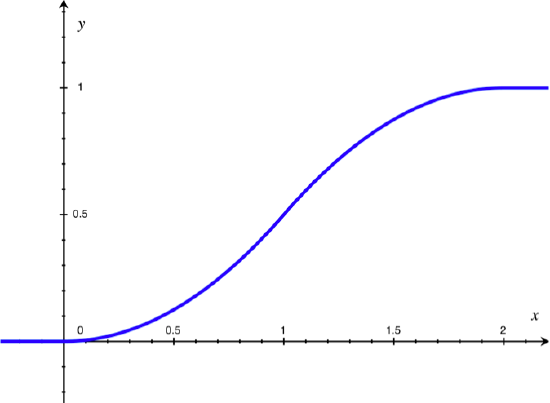
Therefore, \[F_{X}(x)=\begin{cases}0,&\text{for $x<0$}\\ \frac{x^{2}}{2},&\text{for $0\le x\le 1$}\\ 2x-\frac{x^{2}}{2}-1,&\text{for $1<x\le 2$}\\ 1,&\text{for $x>2$}\end{cases}\].