boundedness theorem
Boundedness theorem
If \[f(x)\] is continuous on \[\left[ a,b \right]\], then it is bounded on \[\left[ a,b \right]\].
Proof
This theorem will be proven by contradiction.
Suppose function \[f\] is not bounded above on the interval \[\left[ a,b \right]\]. In simpler words, assume that there is some \[x\] in between \[\left[ a,b \right]\], where \[f(x)\] will be infinity (e.g. \[f(x)=\frac{1}{x}\] going to infinity when \[x\] approaches 0).
Now, for each number \[n\] (\[n\in\mathbb{N}\]), we will pick a point, call it \[x_{n}\], within the interval \[[a,b]\] such that \[f(x_{n})>n\]. This inequality holds up since \[f(x)\] goes to infinity, so there must be some \[x\] where \[f(x)\] is definitely larger than whatever \[n\] is.
To demonstrate this, let \[f(x)=\frac{1}{x}\], \[x=\left[ 0,1 \right]\] (while \[x\] is undefined at 0, we are deliberately using this example to illustrate the kind of unbounded behavior that leads to a contradiction). For our very first \[n\], \[n=1\]. We could pick \[x_{1}\] to be 0.73, and \[f(x_{1})\] would be 1.36986, then \[f(x_{1})>1\]. Similarly, for \[n=2\], we pick \[x_{2}\] to be 0.457, \[f(x_{2})\] would be 2.18818, and \[f(x_{2})>2\].
We can repeat this process an infinite number of times to form an infinite sequence \[\left( x_{n} \right)\], e.g. \[\left( 0.73,0.457,\dots \right)\], such that for every \[n\], \[f(x_{n})>n\]. Then, since every \[x_{n}\] is picked from the interval of \[\left[ a,b \right]\], naturally \[\left( x_{n} \right)\] is too bounded by \[\left[ a,b \right]\]. According to the Bolzano-Weierstrass theorem, any bounded infinite sequence has a convergent subsequence. Let \[p\] to be the value that this subsequence of \[\left( x_{n} \right)\] converges to.
We know that since we can always find a \[f(x_{n})>n\] for any \[n\], the sequence \[\left( f(x_{n}) \right)\] will go to infinity. However, we also know that at the same time \[\left( x_{n} \right)\] converges to a real number \[p\], so the sequence \[\left( f(x_{n}) \right)\] must converge to \[f(p)\]. It is mathematically impossible for \[f(x_{n})\] to both diverge to \[+\infty\] and converge to a real number \[f(p)\].
We have now found our contradiction, which proves that \[f(x)\] cannot be unbounded on \[\left[ a,b \right]\] if it is continuous on \[\left[ a,b \right]\].
Thus, \[f(x)\] must be bounded on \[\left[ a,b \right]\] if it is continuous on \[\left[ a,b \right]\].
Alternate proof
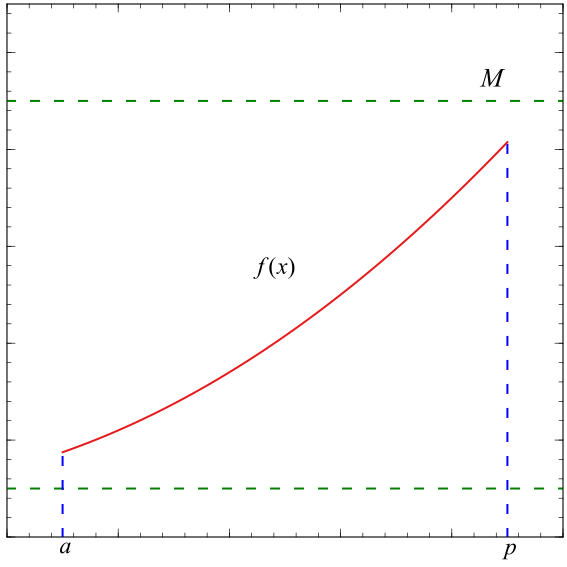
Consider the set \[B\] which consists of all the points, call it \[p\], such that \[p\in \left[ a,b \right]\] and \[f(x)\] is bounded on the interval \[\left[ a,p \right]\].
Logically, \[a\] would be part of set \[B\], as \[f\] is "bounded" on the interval \[\left[ a,a \right]\] by \[f(a)\] as it's just a single point.
If there is some term in set \[B\], call it \[e\], where \[e>a\], then by definition of the set \[B\] the function is bounded on \[\left[ a,e \right]\]. This also implies that we can find an upper bound in the reals for \[f(x)\] on \[\left[ a,e \right]\].
If a function is bounded on a larger interval, it is automatically bounded on any smaller sub-interval, then it follows that every point between \[a\] and \[e\] is also a part of set \[B\]. Thus, starting from \[a\] and extending to the right, set \[B\] forms some interval where \[f\] remains bounded.
To show that the set \[B\] is not empty, we'll use the fact that \[f\] is continuous on the right of \[a\], meaning that given any \[\epsilon>0\], we can find a \[\delta>0\] such that whenever \[x\in \left[ a,a+\delta \right]\], \[\left| f(x)-f(a) \right|<\epsilon\]. The reason why it's just \[\left[ a,a+\delta \right]\] and not \[\left[ a-\delta,a+\delta \right]\] is that:
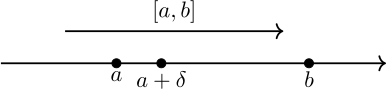
Since the interval is \[\left[ a,b \right]\], then if \[\delta>0\], \[a-\delta\] would be smaller than \[a\] thus not included in the interval.
Now, working with \[\epsilon\] itself is quite a pain, so we'll assign it a value, \[\epsilon=1\]. We can assign \[\epsilon\] with any value, just that choosing 1 makes it easier to work with. Our inequality would be written as \[\left| f(x)-f(a) \right|<1\]. This also means that \[f(x)\] is bounded by \[f(a)-1\] and \[f(a)+1\] when \[x\] is in between \[a\] and \[a+\delta\].
So far, we've shown that set \[B\] is an interval of nonzero length, closed at its left end by \[a\].
Furthermore, set \[B\] is bounded above by \[b\]. Hence the set \[B\] must have a supremum in \[\left[ a,b \right]\], called \[s\]. Since set \[B\] is of nonzero length, \[s\] must be larger than \[a\].
The final step here would be to show that \[s=b\]. We would approach this with arguing by contradiction. Suppose \[s<b\]. Since \[f\] is continuous as \[s\], we can apply the argument that \[\left| f(x)-f(s) \right|<1\] for all \[x\in \left[ s-\delta ,s+\delta\right]\]. Similarly, this means that \[f\] is bounded on \[\left[ s-\delta,s+\delta \right]\] because it lies between \[f(s)-1<f(s)<f(s)+1\].
Since \[s\] is defined as the supremum of set \[B\], this implies that for any number less than \[s\], there must be some points in set \[B\] that greater than that number. In particular, consider \[s-\frac{\delta}{2}\]. There must be some number, call it \[\epsilon\], such that \[e\in B\] and \[e>s-\frac{\delta}{2}\].
We know that \[e\] is a part of set \[B\], so \[f\] is bounded on \[\left[ a,e \right]\]. \[\left[ a,e \right]\] and \[\left[ s-\delta,s+\delta \right]\] also must overlap, as:

However, this also implies that there are points in set \[B\] that are beyond \[s\] for which \[f\] is bounded which contradicts with the fact that \[s\] is lowest upper bound of \[B\] (supremum). This contradiction tells us that \[s<b\] must be false. Therefore, \[s\] must be \[b\].
Ultimately, what is this entire proof trying to tell us? First, recall that we defined set \[B\] such that if a point \[p\in B\], then there exists a real number \[M\] such that \[\left| f(x) \right|\le M\] for all \[x\in \left[ a,p \right]\]. We then proved that set \[B\] is non-empty and it has a supremum \[s\], which is equal to \[b\].
Thus, if \[\sup B=b\], it follows that set \[B\] is equal to the interval \[\left[ a,b \right]\]. Since \[f\] is also defined on the interval \[\left[ a,b \right]\], every point in \[f\] across this interval there exists a real number \[M\] such that \[\left| f(x) \right|\le M\].