vector space
Vector space
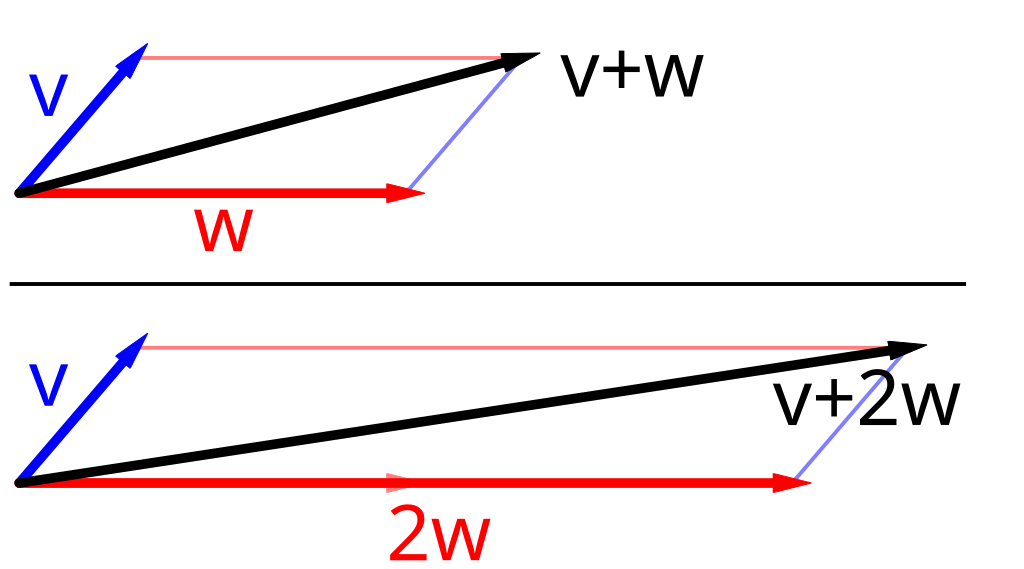
A vector space, is a set whose elements called vectors, can be added together and multipled by scalars. The operations of vector addition and scalar multiplication must satisfy vector axioms.
Vector spaces allow modeling of physical quantities (such as force and velocity) that have not only a magnitude, but also a direction. The concept of vector spaces is fundamental for linear algebra, togther with the concept of matrices, which allows computing in vector spaces.
Introduction
When we multiply a matrix \[A\] by a vector \[\mathbf{x}\] or by another matrix \[B\], we are effectively taking linear combinations of the columns of \[A\].
An excellent example would be to find \[x,y,z\in \mathbb{R}\] that solve the system of linear equations \[3x+2y=8,x+z=2,2x+3y+8z=7\]. Which means we can also write it in the form \[\begin{pmatrix} 3&2&0\\1&0&1\\2&3&8 \end{pmatrix}\begin{pmatrix} x\\y\\z \end{pmatrix}=\begin{pmatrix} 8\\2\\7 \end{pmatrix}\]. However, we can in fact write it using just column matrices, \[x\begin{pmatrix} 3\\1\\2 \end{pmatrix}+y\begin{pmatrix} 2\\0\\3 \end{pmatrix}+z\begin{pmatrix} 0\\1\\8 \end{pmatrix}=\begin{pmatrix} 8\\2\\7 \end{pmatrix}\].
Now, instead of individual columns, we will look at "spaces" of vectors.
We begin with the most common vector spaces, usually denoted by \[\mathbb{R}^{2}\], \[\mathbb{R}^{3}\] or \[\mathbb{C}^{2}\]. Each space (doesn't matter if it's \[\mathbb{R}^{n}\] or \[\mathbb{C}^{n}\] or some other field), consists of all column vectors \[v\] with \[n\] components (or \[n\] rows). Then, each component of \[v\] is an element of that field, e.g. if the vector space is \[\mathbb{C}^{3}\] then the components of \[v\] are complex numbers.
The vector space \[\mathbb{R}^{3}\] is represented by the usual \[xyz\] plane, which follows that each vector \[v\] in \[\mathbb{R}^{3}\] has three components that represents the coordinates of a point in the plane: \[v=\left( x,y,z \right)\]. As before, we print vectors as a column between brackets or along a line using commas and parentheses: \[\begin{pmatrix} 1+i\\1-i \end{pmatrix}\] for \[\mathbb{C}^{2}\] or \[(1,1,0,1,1)\] for \[\mathbb{R}^{5}\].
The two essential vector operations that go on inside the vector space (implying that the result stays in the space) which produces linear combinations are addition and scalar multiplication, i.e. when we add vectors, we add them a component at a time, and when we multiply a vector by a scalar, every component is multiplied by that scalar.
For every vector space, it must also obey the six properties (axioms) as defined in the next section. Based on this definition, we can technically define a vector space of all real \[2\times 2\] matrices or all solutions \[y(t)\] to \[Ay^{\prime\prime}+By^{\prime}+Cy=0\].
One might ask, aren't vectors represented as an arrow on a plane with direction and magnitude? That is actually a popular way to illustrate the column matrix, e.g. \[\begin{pmatrix} 2\\1 \end{pmatrix}\], which is to draw an arrow that starts at the origin in the plane and ending at the point \[(2,1)\]. The "vectors are arrows" idea comes from this particular way of visualising vectors, though when vectors are more complex, e.g. functions and infinite sequences, you can't really visualise those vectors as arrows anymore.
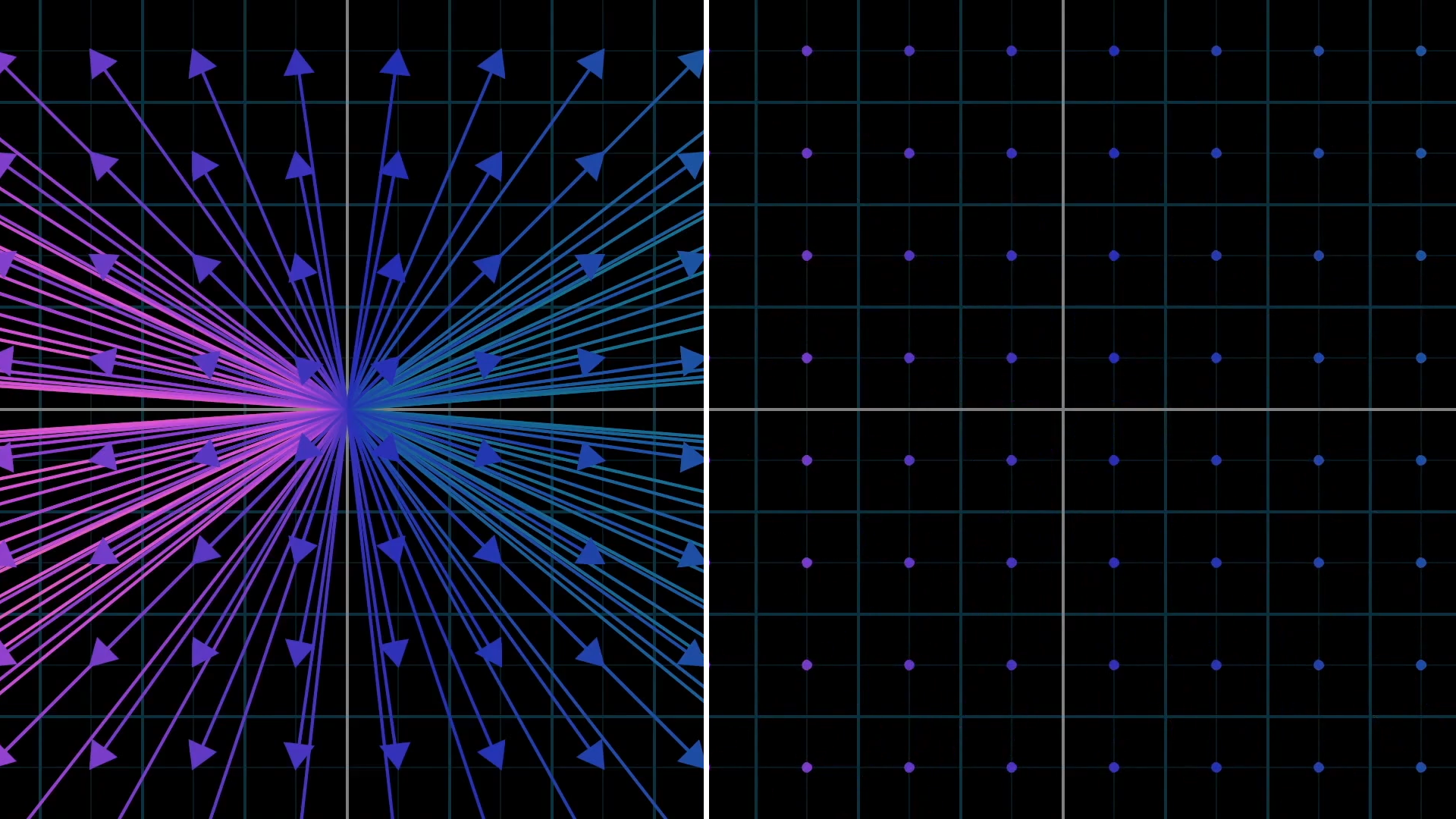
When we're thinking of a handful of vectors, it is more intuitive to think them as arrows, but when we're dealing with a large collection of them, e.g. in the case of spans, it's more convenient to imagine them as single points.
Now, to tie this entire concept of vector space back to vectors, let's make a simple analogy. A recipe can be thought of as two essential parts: the set of ingredients and the instructions for using them to make a dish. Knowing only the ingredients does not constitute a complete recipe without the steps to transform them into a meal. In mathematics, this parallels the idea that simply specifying a set (for instance, \[3\times 1\] real column matrices or 3-dimensional vectors) is insufficient to define a structure like a vector space; one must also specify the operations (vector addition, scalar multiplication, and the scalar field). In practice, we often omit these details if they are understood from context, just as a chef might skip writing out obvious instructions for a simple recipe.
Definition
A vector space over a field, \[\mathbb{F}\], is a set \[V\] together with the operations of addition, \[V\times V\to V\] and scalar multiplication \[\mathbb{F}\times V\to V\] satisfying the following axioms:
Let \[u,v,w\in V\] and \[a,b\in \mathbb{F}\].
- Commutativity: \[u+v=v+u\].
- Associativity: \[(u+v)+w=u+(v+w)\] and \[(ab)v=a(bv)\].
- Additive identity: There exists an element \[0\in V\] such that \[0+v=v\].
- Additive inverse: For every \[v\in V\], there exists an element \[w\in V\] such that \[v+w=0\].
- Multiplicative identity: \[1v=v\] for all \[v\in V\].
- Distributivity: \[a(u+v)=au+av\] and \[(a+b)u=au+bu\].
In one of the more simple (and common) scenarios, \[V=\mathbb{R}^{2}\], \[u,v,w\] are vectors such as \[(3,-1)\], while usually \[\mathbb{F}=\mathbb{R}\] or \[\mathbb{F}=\mathbb{C}\].