linear combination
Linear combination
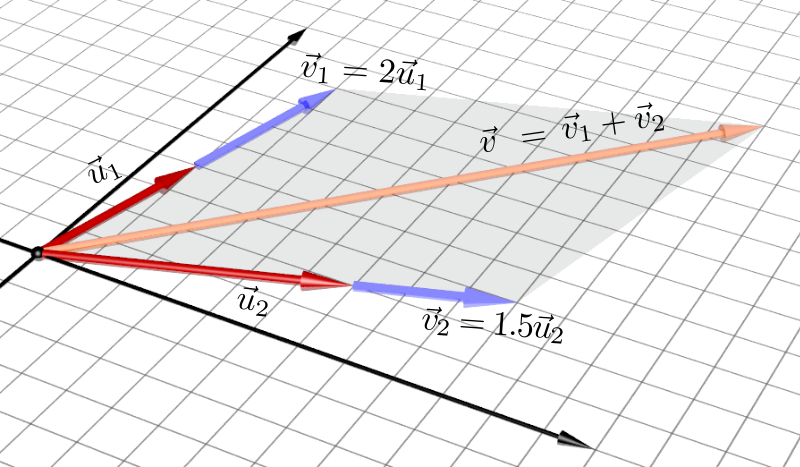
A linear combination (or superposition) is an expression constructed from a set of terms by multiplying each term by a constant and adding the results, e.g. a linear combination of \[x\] and \[y\] would have an expression of the form \[ax+by\] where \[a\] and \[b\] are constants.
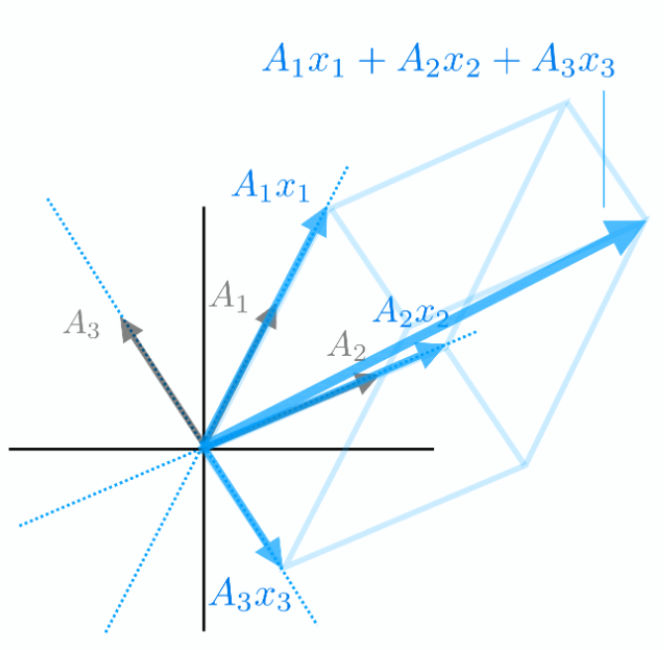
In the context of vectors, a linear combination of vectors \[\vec{v_{1}},\vec{v_{2}},\dots,\vec{v_{n}}\] is a resultant vector of \[d_{1}\vec{v_{1}}+d_{2}\vec{v_{2}}+\cdots+d_{n}\vec{v_{n}}\] where \[d_{1},d_{2},\dots,d_{n}\] are scalars (also known as coefficients). More formally, the vectors as aforementioned are elements of a vector space defined over a field while the scalars are elements of the field itself.
Do note that for the addition to be meaningful, the vectors in the above definition must all be of the same order.
Example
We'll take a more extreme example to demonstrate the concept of linear combinations.
Let \[R\] be the ring \[\mathbb{Z}[x]\] of integer polynomials, i.e. any element in \[\mathbb{Z}[x]\] is an expression of the form \[a_{n}x^{n}+a_{n-1}x^{n-1}+\cdots+a_{1}x+a_{0}\] where each coefficient \[a_{i}\in \mathbb{Z}\] and \[n\] is a non-negative integer.
Then for example, one of our scalars could technically be \[3x^{2}+5x\]. So, if we were to write a linear combination of say \[\left\{ x,2 \right\}\] with integer coefficients, we could write something like \[(3x^{2}+5x)\cdot x+(x)\cdot 2=3x^{3}+5x^{2}+2x\].