linear independence
Linear independence
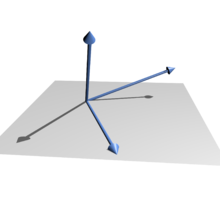
Linearly independent vectors in \[\mathbb{R}^{3}\].
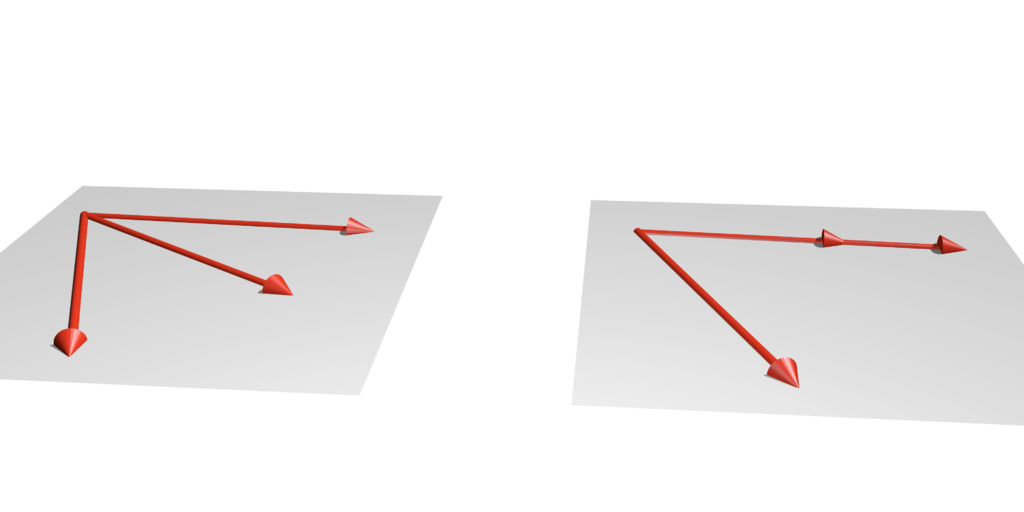
Linearly dependent vectors in a plane in \[\mathbb{R}^{3}\].
A set of vectors is said to be linearly independent if there exists no nontrivial linear combination of the vectors that is equal to the zero vector.
A vector space can be of finite dimension or infinite dimension depending on the maximum number of linearly independent vectors, i.e. if a maximum of \[n\] linearly independent vectors can exist simultaneously in a vector space, then that vector space has \[n\] dimensions.
Intuitive understanding
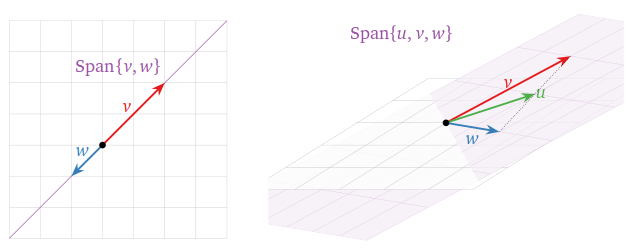
Sometimes the span of a set of vectors is "smaller" than you'd expect from the numbers of vectors, as demonstrated in the figure above. This means that at least one of the vectors is redundant, can be removed without affecting the span, and we call these vectors linearly dependent. After removing the redundant vectors, can say that the remaining vectors are linearly independent, and represent independent directions in our vector spaces. For instance, in the image above, we can remove \[\vec{w}\] in both figures and the span would not be affected.
Mathematically, we would say that if we have two vectors, \[\vec{u}\] and \[\vec{v}\], \[\vec{w}\] is linearly independent if \[\vec{w}\ne a\vec{v}+b\vec{v}\] for some values of \[a\] and \[b\]. Conversely, in this case, \[\vec{w}\] is linearly dependent on both vectors, i.e. \[\vec{w}=a\vec{v}+b\vec{v}\] for some \[a\] and \[b\].