linear subspace
Linear subspace
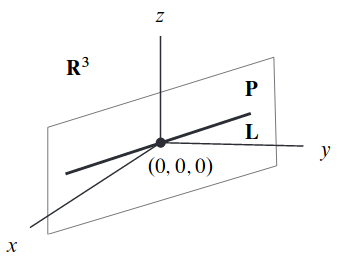
This figure shows three subspaces of \[\mathbb{R}^{3}\], the plane \[P\], line \[L\] and the origin.
A linear subspace or vector subspace is a vector space that is a subset of some larger vector space. A linear subspace is usually simply called a subspace when the context serves to distinguish it from other types of subspaces.
Subspaces should not be confused with subsets, as not all subsets are subspaces but all subspaces are subsets. For instance, the unit circle \[C=\left\{ (x,y)\in \mathbb{R}^{2}\mid x^{2}+y^{2}=1 \right\}\] is a subset of \[\mathbb{R}^{2}\] but is not a subspace.
Difference between vector spaces and subspaces
The main distinction between a "vector space" versus a "subspace" is contextual. When one uses the term "subspace," it emphasizes that the set is embedded within a larger vector space and inherits its operations (which brings us to the definition below). For example, consider the set of all polynomials of degree at most 2 with coefficients in \[\mathbb{R}\]. If we describe this set as a "subspace of the vector space of all polynomials," we are stressing not only that it forms a vector space but also that it exists within a broader vector space. Conversely, if we simply call it "the vector space of all polynomials of degree at most 2 with real coefficients," the focus is exclusively on its structure as an independent vector space.
This distinction is analogous to set theory, where an entity may be considered as a set in its own right or as a subset of another set. The natural numbers, for instance, can be viewed simply as "the set of natural numbers" when considered on their own, or as "the subset of the real numbers consisting of the natural numbers" when their relationship to a larger set is of interest.
It is also important to note that every vector space is trivially a subspace of itself, and any subspace of a vector space, equipped with the inherited operations, is itself a vector space. Thus, whether one refers to an object as a "vector space" or as a "subspace" depends entirely on whether the emphasis is on the intrinsic structure or on its contextual embedding within a larger space.
Definition
A subspace (vector space) \[W\] of a vector space \[V\] over a field \[K\] is a linear subspace if and only if for all vectors \[\vec{u}\] and \[\vec{v}\] in \[W\]:
- \[\vec{0}\in W\] (meaning \[W\] passes through the origin)
- \[\vec{u}+\vec{v}\in W\] (closed under addition)
- \[k\vec{u}\in W\] (closed under scaling)
The rules mentioned above can be also combined into a single requirement that a subspace containing \[\vec{v}\] and \[\vec{w}\] must contain all linear combinations \[c\vec{v}+d\vec{w}\] where \[c,d\] are scalars.
In other words, \[W\] is a subspace of \[V\] if \[W\] is itself a vector space under the addition and scalar multiplication defined on \[V\].
Based on the defined rules, we can then list out all the possible subspaces of a vector space, e.g. all possible subspaces of \[\mathbb{R}^{3}\] are any line through \[(0,0,0)\], any plane going through \[(0,0,0)\], the single vector \[(0,0,0)\] and finally the entire space defined on \[\mathbb{R}^{3}\] (which brings us to the point where every vector space is a subspace of itself).