derivative of natural logarithm function
Derivative of natural logarithm function
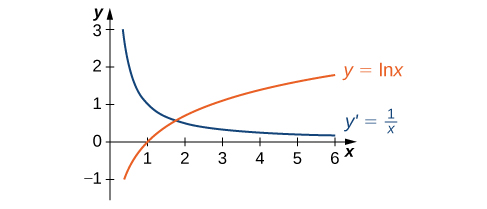
Let \[x>0,y=\ln(x)\], then \[e^{y}=x\]. Thus \[y^{\prime}=(\ln(x))^{\prime}=\frac{1}{x}\].
Proving with chain rule
- Differentiate both sides of the equation with respect to \[x\], while using chain rule and the derivative of natural exponential function, which proves that \[\left( e^{y} \right)^{\prime}=e^{y}\], yielding \[e^{y}\cdot y^{\prime}=1\].
- Using implicit differentiation, we then get \[y^{\prime}=\frac{1}{e^{y}}\].
- Substituting \[x\] back into the equation, \[y^{\prime}=\frac{1}{x}\].
Proving with inverse function rule
Let \[f(x)=e^{x}\], then \[f^{-1}(x)=\ln(x)\]. \[(f^{-1})^{\prime}(x)=\frac{1}{f^{\prime}(f^{-1}(x))}=\frac{1}{e^{\ln(x)}}=\frac{1}{x}\].
Generalising the formula into \[(\ln g(x))^{\prime}\]
Let \[f(x)=\ln(x)\], The definition of chain rule tells us that \[f(g(x))^{\prime}=f^{\prime}(g(x))\cdot g^{\prime}(x)\], thus \[(\ln g(x))^{\prime}=\frac{1}{g(x)}\cdot g^{\prime}(x)\].