derivatives of trigonometric functions
Derivatives of trigonometric functions
tl;dr
- \[(\sin\theta)^{\prime}=\cos\theta\]
- \[(\cos\theta)^{\prime}=-\sin\theta\]
- \[(\tan\theta)^{\prime}=1+\tan^{2}\theta=\sec^{2}\theta\]
- \[(\csc\theta)^{\prime}=-\csc\theta\cot\theta\]
- \[(\sec\theta)^{\prime}=\sec\theta\tan\theta\]
- \[(\cot\theta)^{\prime}=-1-\cot^{2}\theta=-\csc^{2}\theta\]
\[\sin\theta\]
Proof for \[\lim_{\delta\theta\to0}\frac{\sin\delta\theta}{\delta\theta}=1\]
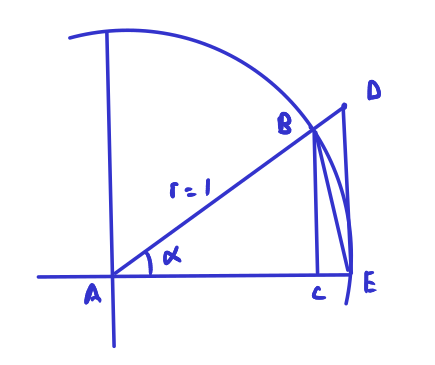
This is a unit circle with radius one. Therefore it is known that \[BC=\sin\alpha\]. \[\triangle ABE=\frac{1}{2}(1)(\sin\alpha)=\frac{\sin\alpha}{2}\]. To find the area of the large triangle \[ADE\], we must find length \[DE\]. \[\tan\alpha=\frac{DE}{1}\], \[DE=\tan\alpha\]. \[\triangle ADE=\frac{1}{2}(1)(\tan\alpha)=\frac{\tan\alpha}{2}\]. Finally, the sector \[ABE\] has an area of \[\frac{1}{2}(1)^{2}(\alpha)=\frac{\alpha}{2}\].
Now that we have all the areas:
We divide everything by \[\frac{\sin\alpha}{2}\] and take the reciprocal:
This limit can also be proved (and has been proven) with the Squeeze theorem.
\[\cos\theta\]
\[\tan\theta\]
Proof for \[\lim_{\delta\theta\to0}\frac{\tan\delta\theta}{\delta\theta}=1\]
\[\csc \theta\]
\[\csc\theta=\frac{1}{\sin\theta}\], using the reciprocal rule:
\[\sec\theta\]
\[\sec\theta=\frac{1}{\cos\theta}\], with reciprocal rule:
\[\cot\theta\]
\[\cot\theta=\frac{1}{\tan\theta}=\frac{\cos\theta}{\sin\theta}\], using the quotient rule: