interior extremum theorem
Interior extremum theorem
Interior extremum theorem, also known as Fermat's theorem, is a method to find local maxima and minima of differentiable functions on real intervals by showing that every local extremum (minimum or maximum) of the function is a stationary point.
Definition
If a function has a local extremum at some point and is differentiable there, then the function's derivative at that point must be zero.
Mathematically, it's written as: Let \[f: \left( a,b \right)\to\mathbb{R}\] (\[f\]'s domain is \[\left( a,b \right)\] and its range is in the reals) be a function, and suppose that \[x_{0}\in \left( a,b \right)\] is a point where \[f\] has a local extremum. If \[f\] is differentiable at \[x_{0}\], then \[f^{\prime}\left( x_{0} \right)=0\].
Proof
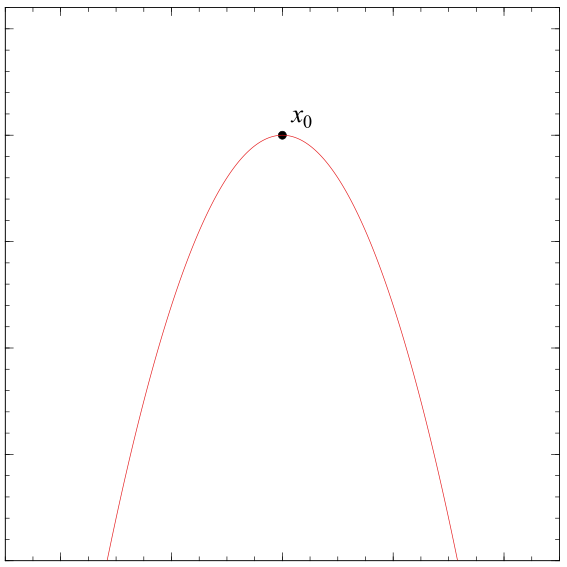
Assume \[f(x_{0})\] is the maximum of \[f\]. The idea is that since \[f(x_{0})\] is the maximum value the function can attain, if we move left, the slope (gradient) would be positive, and if we move right the slope would be negative.
Since \[f^{\prime}\left( x_{0} \right)\] is the limit from the left of these slopes, it must be non-negative, and since it's also the limit from the right of these slopes, it must also be non-positive.
For any \[y\in \left( a,b \right)\], since \[f(x_{0})\] is the maximum of \[f\], \[f(y)-f(x_{0})\le 0\] (if it's \[\ge 0\] then \[f(x_{0})\] isn't the maximum which contradicts our definition).
We'll start with the limit of the slopes from the left. Assume \[y<x_{0}\], then \[y-x_{0}\] is negative. Then \[\frac{f(y)-f(x_{0})}{y-x_{0}}\ge 0\] since the numerator is either negative or zero and the denominator is definitely negative. Thus, based on the definition of derivatives, the gradient (derivative) at \[x_{0}\] is \[f^{\prime}(x_{0})=\lim_{y\to x_{0}}\frac{f(y)-f(x_{0})}{y-x_{0}}=\lim_{y\to x_{0}^{-}}\frac{f(y)-f(x_{0})}{y-x_{0}}\ge 0\].
Then for the limit of the slopes from the right. Assume \[y>x_{0}\], then \[y-x_{0}\] is positive. Then \[\frac{f(y)-f(x_{0})}{y-x_{0}}\le0\]. Again, \[f^{\prime}\left( x_{0} \right)=\lim_{y\to x_{0}}\frac{f(y)-f(x_{0})}{y-x_{0}}=\lim_{y\to x_{0}^{+}}\frac{f(y)-f(x_{0})}{y-x_{0}}\le0\].
Therefore \[0\le f^{\prime}(x_{0})\le 0\], which means \[f^{\prime}\left( x_{0} \right)=0\].
The proof in the case that \[f(x_{0})\] is a minimum is similar.