nitrogen and sulfur
Nitrogen and sulfur
Lack of reactivity of nitrogen
The nitrogen molecule, \[\ce{N2}\], has a strong triple bond with a bond energy of 944.9kJmol-1 between the two nitrogen atoms, \[\ce{N # N}\]. When nitrogen reacts with other things, it tends to split this bond completely, unlike other substances such as \[\ce{C # O}\], which usually doesn't require breaking all bonds in reactions. Thus, nitrogen is generally less reactive, but it doesn't mean it isn't reactive, it just requires a really high activation energy to break the very strong \[\ce{N # N}\] bond.
For example, if nitrogen and oxygen are sparked together, nitrogen monoxide is formed. The nitrogen atoms end up in two different molecules. \[\ce{N2(g) + O2(g) -> 2NO(g)},\,\Delta H_{r}^{\circ}=+181\text{kJmol}^{-1}\]. Or, magnesium nitride is formed when magnesium is heated in nitrogen. Magnesium nitride is ionic, and this time, you end up with two separate nitride ions. \[\ce{3Mg(s) + N2(g) -> Mg3N2(s)},\,\Delta H_{r}^{\circ}=-461\text{kJmol}^{-1}\]. As evidenced here, this reaction is highly exothermic. However, it requires heating to provide the activation energy for the reaction. (Values are sourced from the CRC Handbook of Chemistry and Physics)
Additionally, nitrogen molecules are non-polar, and it is not easily polarisable either, therefore making it less attractive towards nucleophiles or electrophiles.
Ammonia
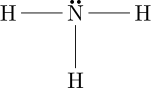
Ammonia, \[\ce{NH3}\], is a weak Bronsted-Lowry base as it has a lone pair which accepts hydrogens ions (dative bond) originating from water molecules to form ammonium ions, \[\ce{NH4+}\], and hydroxide, \[\ce{OH-}\], ions.
However, this reaction is in fact a reversible reaction (as it's a weak base, \[\ce{NH3(aq) + H2O(l) <=> NH4+(aq) + OH-(aq)}\]), and at any given time there should be approximately 99% ammonia present.
Of course, ammonia can too react with other more obvious acids to form ammonium salts, such as the reaction between ammonia and hydrochloric acid, \[\ce{NH3(g) + HCl(aq) <=> NH4Cl(aq)}\]. However, since ammonia is only a weak base, and the extra hydrogen ion is easily removed again. For example, heating ammonium sulfate with calcium oxide will decompose the ammonium sulfate into ammonia gas, \[\ce{(NH4)2SO4(s) + CaO(s) -> CaSO4(s) + 2NH3(g) + H2O(l)}\].
Oxides of nitrogen
Nitrogen monoxide, \[\ce{NO}\], is formed when an electrical spark is passed through a mixture of nitrogen and oxygen during a thunderstorm in the atmosphere. Similarly in an engine, a spark is passed through a mixture of air and gasoline fuel (usually with a ratio of 14.7:1) to ignite the petrol, which also causes oxygen and nitrogen to combine into nitrogen monoxide (\[\ce{N2(g) + O2(g) -> 2NO(g)}\]). Thus, catalytic converters, which is usually a platinum coated honeycomb structure, are installed in cars to catalyse the reaction \[\ce{2NO(g) + 2CO(g) ->[Pt] N2(g) +CO2(g)}\].
\[\ce{NO}\] as pollutants
Nitrogen monoxide reacts with oxygen in the atmosphere to form nitrogen dioxide, \[\ce{NO(g) + \frac{1}{2}O2(g) -> NO2(g)}\]. Now nitrogen dioxide reacts with oxygen and water in the atmosphere to produce very dilute solutions of nitric acid:
- \[\ce{2NO2(g) + H2O(l) -> HNO3(aq) +HNO2(aq)}\]
- \[\ce{2HNO2(aq) + O2(g) -> 2HNO3(aq)}\]
Nitrogen dioxide also acts as a catalyst for the oxidation for sulfur dioxide:
- \[\ce{SO2(g) + NO2(g) -> SO3(g) + NO(g)}\] then \[\ce{SO3(g) + H2O(l) -> H2SO4(aq)}\]
Sulfuric acid can also be produced through the reaction \[\ce{SO2(g) + H2O(l) -> H2SO3(aq)}\], then \[\ce{2H2SO3(aq) + O2(g) -> 2H2SO4(aq)}\].