power
Power
Power, \[P\], is the amount of energy, \[E\], (joules) transferred or converted per unit time, \[P=\frac{E}{t}\]. Power is a scalar quantity with units watt, \[\text{W}\], or \[\text{kgm}^{2}\text{s}^{-3}\].
Power can also be represented as the rate with respect to time at which work is done (since work represents energy transferred): \[P=\frac{W}{t}\], where \[W\] is work.
If we divide both sides of \[W=Fs\] by \[t\] we will get \[P=Fv\], or:
Example
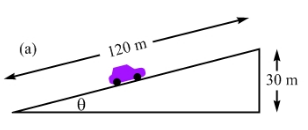
Assume a car with weight \[mg=16000\,\text{N}\] is climbing a hill that is 120 meters long and rises 30 meters vertically. Additionally, the hill has a static force of friction, \[F_{R}\], given as 1000 Newtons.
To calculate the power provided to the drive wheels by the car's engine if it's traveling at a constant velocity of 72 kilometers per hour, we first sketch a free-body diagram,
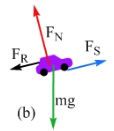
which tells us that if we want to maintain a constant velocity forwards, we must contend with the static friction and the component of \[mg\] that's pulling us down the slope. Therefore, the force moving forward must counteract the force is pulling us backwards, i.e. \[F_{S}=1000+mg\sin\theta=1000+16000\times \frac{1}{4}=5000\,\text{N}\]. Now, 72 kilometers per hour when converted gives us 20 meters per second. Plug this value into \[P=Fv\] we get \[P=5000\times 20=100000\,\text{Watts}\].
So, we can say that the wheels provide 100 thousand Watts of power.