momentum
Momentum
Momentum is the product of mass and velocity of an object. It is a vector, pointing in the direction of the velocity. If \[m\] is an object's mass and \[\vec{v}\] is its velocity (also a vector quantity), then the object's momentum \[\vec{p}\] is given by \[\vec{p}=m\vec{v}\]. It's unit of measurement is \[\text{kgms}^{-1}\], or \[\text{Ns}^{-1}\].
The total momentum of a system of particles is given as: \[p=\sum_{i}m_{i}v_{i}\].
We can think momentum as the property of the object that makes it easier or harder to stop, i.e. the momentum of a body is what changes the force that must be applied to stop it.
Relation to force
If the net force \[F\] applied to a particle is constant, and is applied for a time interval \[\Delta t\], the momentum of the particle changes by an amount \[\Delta p=F\Delta t\].
To find out how we even ended up here, we rewrite Newton's second law by combining it with the definition of acceleration. Combining \[\vec{F}_{\text{net}}=m\vec{a}\] and \[\vec{a}=\frac{\Delta \vec{v}}{\Delta t}\] gives us \[\vec{F}_{\text{net}}=\frac{m\Delta \vec{v}}{\Delta t}\], which we can also write as \[\vec{F}_{\text{net}}=\frac{\Delta (m\vec{v})}{\Delta t}\], as a result of \[m\Delta \vec{v}=m(\vec{v}_{2}-\vec{v}_{1})=m\vec{v}_{2}-m\vec{v}_{1}=\Delta(m\vec{v})\]. Then, we can rearrange it to read \[\vec{F}_{\text{net}}\cdot\Delta t=\Delta (m\vec{v})=\Delta \vec{p}\].
Thus, the math tells us that to change an object's momentum, all we have to do is to apply a net force for a particular time interval. To produce a larger change in momentum, we can apply a larger net force or apply the same net force over a longer time interval.
Impulse
When a particle moves freely then interacts with another system for a (brief) period and then moves freely again, it has a definite change in momentum; we define this change as the impulse \[\vec{I}\] of the interaction forces, i.e. the difference between the initial and final momentum \[\vec{I}=\vec{p}_{f}-\vec{p}_{i}=\Delta \vec{p}\].
Then based on what we derived above, \[\vec{I}=\vec{F}_{\text{net}}\cdot\Delta t\], however that is under the assumption that the force
is constant over the time interval, however it usually isn't, so we sometimes calculate it as \[\vec{I}=\int_{t_{1}}^{t_{2}} \vec{F}\,dt\].
If we're given a graph with force plotted to time, e.g.
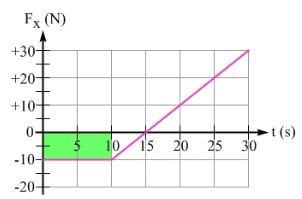
then the area under the graph would be the impulse and \[\Delta t=10\,\text{s}\] (in this example).
Connecting momentum, impulse, force, work and potential energy
Imagine that we hit a billiard ball and it collides with another billiard ball. The ball that we hit will have an initial momentum of \[p=mv\] and kinetic energy \[E_{k}=\frac{1}{2}mv^{2}\]. As they collide with each other, their surfaces come into contact which causes a rapid but brief deformation of the balls, and during that moment, the intermolecular forces between the surfaces temporarily generate a large force. Even though the ball was initially moving with no net force, the collision introduces a new, temporary force \[F\] that acts over a very short time interval \[\Delta t\], changing the ball's momentum by an impulse \[I=F\cdot \Delta t\]. This same force also deforms the billiard ball very slightly, say by a distance of \[\Delta x\], which does work \[W=F\cdot \Delta x\] that is temporarily stored as elastic potential energy (e.g. if the ball's material is spring-like then EPE is \[\frac{1}{2}k(\Delta x)^{2}\] based on Hooke's law).
This stored energy helps the balls rebound, converting back into kinetic energy so that the balls leave the collision with new velocities; in essence, the original force in the billiard ball comes from the energy and momentum they carry, which, during the collision, is partly diverted to deform the balls momentarily (via \[F\]) and then restored, all while ensuring that the impulse (change in momentum) and the work (energy transferred through deformation) are properly balanced.
Example
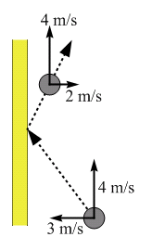
The mass of the ball is constant, i.e. \[m=0.18\,\text{kg}\], so the momentum of the ball changes because there is a change in velocity. Now, the magnitude of the change of the velocity of the ball in the \[x\]-direction is not \[1.0\,\text{ms$^{-1}$}\] but instead \[5.0\,\text{ms$^{-1}$}\], as it's going the opposite direction. Thus, the impulse is \[\vec{I}=m\vec{v_{f}}-m\vec{v_{i}}=m\begin{pmatrix} 2\\4 \end{pmatrix}-m\begin{pmatrix} -3\\4 \end{pmatrix}=m\begin{pmatrix} 5\\0 \end{pmatrix}\]. Substituting \[m=0.18\], we get \[\vec{I}=\begin{pmatrix} 0.9\\0 \end{pmatrix}\]. If we just want the magnitude of impulse, then \[\left\lVert \vec{I} \right\rVert=\sqrt{0.9^{2}}=0.9\,\text{kgms$^{-1}$}\].
If we were to calculate the average force applied to the ball by the board if the ball was in contact for 50 milliseconds, we simply take \[\left\lVert \vec{F} \right\rVert=\frac{\left\lVert \vec{I} \right\rVert}{\Delta t}=\frac{0.9}{0.05}=18\,\text{N}\].