elastic and inelastic collision
Elastic and inelastic collision
There are two types of collisions, while total momentum in both scenarios will always be conserved, the conservation of kinetic energy varies according to the type of collision.
Elastic collision
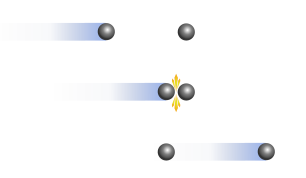
Elastic collision: Defined as \[E_{k\,\text{initial}}=E_{k\,\text{final}}\], where total initial kinetic energy is equal to total final kinetic energy, thus kinetic energy is conserved: \[\frac{1}{2}m_{A}u_{A}^{2}+\frac{1}{2}m_{B}u_{B}^{2}=\frac{1}{2}m_{A}v_{A}^{2}+\frac{1}{2}m_{B}v_{B}^{2}\], where \[v_{A}\ne v_{B}\].
The term "elastic" essentially tells us that the colliding bodies bounce off each other without any lasting change in shape. Here, all the kinetic energy is essentially conserved as the temporary deformation during impact stores energy as elastic potential energy, which is then fully returned as kinetic energy when the bodies separate.
Apart from looking to see if the objects bounce off another or not, we can also judge by looking to see if the objects get deformed, are hotter, have more vibration/rotation or are in an excited state after collision. If any of the above happens, the collision is not elastic. We know the collision is not elastic because some kinetic energy must be transferred to another form evidenced by one of the listed changes.
It is important to note that with macroscopic systems there are no perfectly elastic collisions because there is always some dissipation (for example thermal energy emitted), but most are nearly elastic. The only time there are perfect collisions is on a microscopic level when atomic systems with quantized energy collide.
Inelastic collision
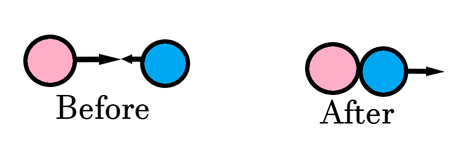
Inelastic collision: \[E_{k\,\text{initial}}\ne E_{k\,\text{final}}\], total initial kinetic energy is not equal to the total final kinetic energy, kinetic energy is not conserved: \[\frac{1}{2}m_{A}u_{A}^{2}+\frac{1}{2}m_{B}u_{B}^{2}\ne\frac{1}{2}v^{2}(m_{A}+m_{B})\].
One type of inelastic collisions is the maximally inelastic collision, also known as the perfectly inelastic collision, in which two objects collide and then remain connected for the duration of the observable interaction, e.g. a bullet shot and embedded into a block of wood. This does not indicate an end to movement, as momentum must be conserved by the end of the interaction. The other type is the partially inelastic collision, which is usually the type of inelastic collisions we encounter.
To demonstrate how kinetic energy is lost in a inelastic collision, we set up a hypothetical scenario. Assume we have a particle with a mass of 1 kilogram traveling at a velocity of 5 meters per second. That would make our initial kinetic energy to be \[E_{i}=\frac{1}{2}(1)(5)^{2}=12.5\,\text{J}\]. Now, assume that it's collision into another identical particle is an inelastic collision, thus both of the particles stick together and move at the same speed. The conservation of momentum tells us that if we start with a momentum of \[p_{i}=(1)(5)\], then \[p_{f}=p_{i}=(2)(2.5)\], which tells us that both particles are moving at a velocity of 2.5 meters per second. Although the momentum is conserved, it cannot be said the same for the kinetic energy, i.e. \[E_{f}=\frac{1}{2}(2)(2.5)^{2}=6.25\,\text{J}\].
This tells us that some of the kinetic energy is transferred into heat, sound, or energy used in permanently deforming the particles. This also implies that inelastic collision can not happen in a system that excludes the channels such as heat, sound, or any energy sink where the energy could be stored. There would be no mechanism for the kinetic energy to disappear. In that idealized scenario, all energy would have to remain as kinetic energy (or be stored in a way that could be fully recovered as kinetic energy), which becomes a perfectly elastic collision.
Partially inelastic collisions
Partially inelastic collisions are the most common form of collisions in the real world, e.g. car crashes. In this type of collision, the objects involved in the collisions do not stick, but some kinetic energy is still lost, usually as friction, sound and heat.