Newton's laws of motion
Newton's laws of motion
The following quotes are translated from Latin.
First law
"Every object perseveres in its state of rest, or of uniform motion in a right line, except insofar as it is compelled to change that state by forces impressed thereon."
It expresses the principle of inertia: the natural behavior of a body is to move in a straight line at constant speed. A body's motion preserves the status quo, but external forces can perturb this.
This law is in fact a restatement of Galileo's discovery that if an object is left alone, is not disturbed, it will continue to move with a constant velocity in straight line if it was originally moving, or it continues to stand still if it was just standing still. The observation was then coined as "inertia" by Kepler. This of course is not observable in nature, as the rubbing against the table, air resistance, etc. slows it to a stop.
Second law
"The change of motion of an object is proportional to the force impressed; and is made in the direction of the straight line in which the force is impressed."
This law was written to give a specific way of determining how the velocity changes under different influences called "forces". It also asserts that the time-rate-of-change of a quantity called "momentum" is proportional to "force".
By "motion", Newton meant the quantity now known as momentum, which depends upon the amount of matter contained in a body, the speed at which that body is moving, and the direction in which it is moving, \[p=mv\].
In modern form, this law can be written as the time derivative of momentum: \[F=\frac{dp}{dt}\]. If the net force applied to a particle is constant, the momentum of the particle changes by an amount \[\Delta p=F\Delta t\].
Assuming the mass of the object is constant over time, then this law implies that the acceleration of an object is directly proportional to the net force acting on the object, i.e. derivative acts only upon the velocity (and not the mass), and so the force is equal to the product of the mass and the time derivative of the velocity, which is the acceleration: \[F=m\cdot\frac{dv}{dt}=ma\].
Third law
"To every action, there is always opposed an equal reaction; or, the mutual actions of two bodies upon each other are always equal, and directed to contrary parts."
Overly brief paraphrases of the third law, like "action equals reaction" might cause confusion as the "action" and "reaction" apply to different bodies. For example, consider a book at rest on a table. The Earth's gravity pulls down upon the book. The "reaction" to that "action" is not the support force from the table holding up the book, but the gravitational pull of the book acting on the Earth. The gravitational force acting on the book by the earth is equal to the gravitational force acting on the earth by the book. The mass of the book is small, \[F=ma\] tells us that the \[a\] would be observable and measurable. However, the mass of Earth is about \[6\cdot10^{24}\] kilograms, which makes the \[a\] undetectable.
One might question, well, why is there motion at all? Should not all forces be equal, cancelling themselves out, so nothing moves at all? In simple words, forces related to Newton's third law applies to different bodies, thus they do not cancel each other out. Imagine a financial transaction. Person A gives person B ten bucks, if we sum \[+10\textdollar\] and \[-10\textdollar\] we do get zero, but the mistake is in considering those two numbers apply to the same person, whereas they apply to different people. Now, imagine we're sitting on a chair with wheels, legs folded up, in front of a table with a calculator.
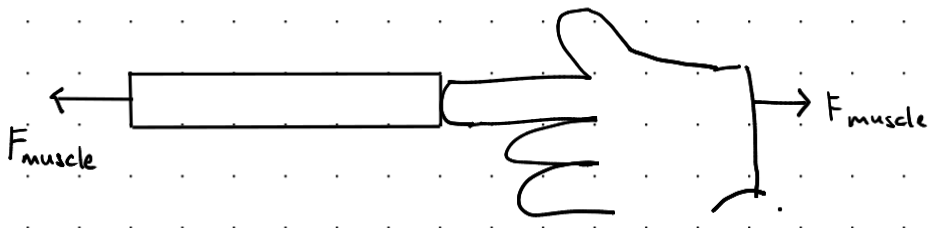
When we push the calculator with our hand (presumably to move it out of the way), we exert a force, say \[F_{\text{muscle}}\] onto the calculator, and the calculator (obviously) moves out of the way. What we do not usually notice is that the calculator does also exert a force \[F_{\text{muscle}}\] back onto us (not onto the calculator, thus we can't cancel the forces out). However, since the equal and opposite \[-F_{\text{muscle}}\], exerting back on us, is relatively minuscule compared to the frictional force (and many other forces) between our body plus chair and the floor, we hardly ever notice us moving in the opposite direction. Assuming in a scenario that our chair had magical wheels that has zero friction with the floor, then the system (i.e. our body and chair) will indeed experience a force equivalent of \[F_{\text{muscle}}=(m_{\text{body}}+m_{\text{chair}})a\].
We will now look at the classical horse and cart paradox. This can be simplified into two masses connected by a light non-extensible string. A common misconception would be, how can a horse move a cart if they exert equal and opposite forces on each other? In fact, this statement would be correct if and only if the system only contained the horse, the cart and nothing else. However in real-world scenarios, people often forget about the fact that when the horse tries to pull the cart, the horse is exerting force onto the ground with its hooves, with the ground exerting an opposite and equal reaction towards the hooves, which drives the entire system (horse and cart) as a whole forward. This doesn't contradict the fact that the horse is ALSO pulling the cart with force \[T\] (tension), and the cart is pulling on the horse with force \[-T\] (equal and opposite), where \[T\] is obviously less than the force exerted on the ground by the horse.
To make this example clearer, we will attempt to calculate all forces mathematically. Assume \[F_{h}\] is the force applied by the hooves onto the ground at angle \[\theta\]. The vertical component, \[F_{h}\sin\theta\] would be the normal force of \[F_{h}\], while the horizontal component, \[F_{h}\cos\theta\] would be the force driving the entire system forward. Assuming here that the cart wheels are magical and have zero friction with the ground, then the net force acting on the cart would be exactly \[T\] in the forwards direction (by the horse), and the net force acting on the horse would be \[F_{h}\cos\theta-T\]. If there were friction between the wheels and the ground, then the net force acting on the cart would simply be \[T-F_{r}\], where \[F_{r}\] is the frictional force.