travelling wave
Travelling wave
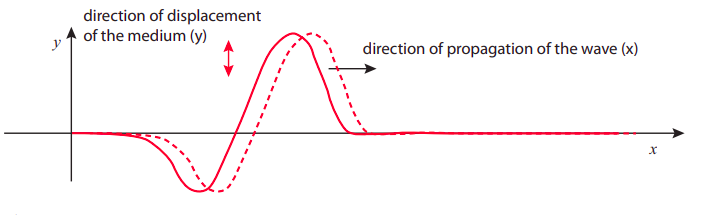
In general, a travelling wave is a disturbance that propagates in a medium (e.g. air, guitar string, etc.) as a function of time, carrying with it energy \[E\] and momentum \[p\]. As the travelling wave propagates, assuming along the \[x\]-axis, if the displacement of atoms or molecules from the equilibrium positions is perpendicular to the direction of propagation, as in the case of travelling waves on a string, we call such waves transverse travelling waves.
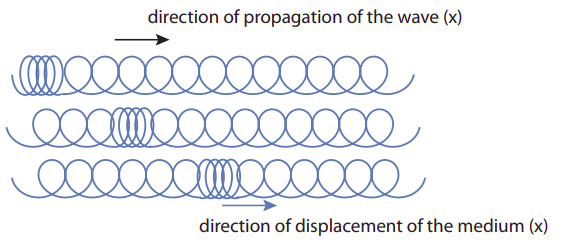
In contrast to this, waves propagating in fluids (e.g. air or water) are longitudinal travelling waves, the displacement of molecules in said fluid would be parallel to the direction of propagation. An important example of longitudinal waves are sound waves; a region of some medium is compressed, and as it expands it pushes on a neighboring region, causing it to compress, and passing the disturbance along.
The idea here is that when a travelling wave reaches a particular location in the medium, it sets that part of the medium in motion by giving it some energy and momentum, which it then passes on to a neighbouring part, and so on down the line. Thus, a remarkable property of wave motion is that it can carry energy and momentum over relatively long distances without an equivalent transport of matter.