magnetic force
Magnetic force
Through experimental observations, we know that charged particles exert forces on other charged particles, which we can think as the charge particle creating an "alteration" in space, commonly known as an electric field. This "alteration" is generated regardless of whether the source of the electric field is stationary or moving.
Further observations will lead us to an observation where two current-carrying conductors lying next to each other will exert forces on each other. We might be inclined to think that it's electrical force at play, however there are a few discrepancies:
- Current flowing through a wire just means when one electron enters the wire, an electron exits it, thus the conductors doesn't have any net charge.
- If one wire is rotated about its centre until it is perpendicular to the other, there is no net force on it.
- If a stationary net charge is placed near a conducting wire with current, there is no force between them. So apparently there must be motion for both sets of charges in order to exhibit this force.
We therefore coin this phenomenon as "magnetic force".
Definition
Magnetic force is the force that moving charges exert on one another.
Experimentally, we have the following observations:
- Strength of magnetic force on a charge is proportional to the magnetic field through which the charge is moving, \[\left\lVert \mathbf{F}_{B} \right\rVert\propto \left\lVert \mathbf{B} \right\rVert\].
- Strength of magnetic force on a charge is proportional to the magnitude of the charge and velocity at which the charge is moving through the field, \[\left\lVert \mathbf{F}_{B} \right\rVert\propto q\left\lVert \mathbf{v} \right\rVert\]
- Strength of the magnetic force on a charge varies proportional to the angle between the direction of the magnetic field and the charge's direction of velocity, \[\left\lVert \mathbf{F}_{B} \right\rVert\propto \sin\theta\]
- The direction of magnetic force is perpendicular to the plane spanned by the velocity and magnetic field and that the direction reverses if the charge is negative
Then, we can summarise the observations above into a simple equation using cross product: \[\mathbf{F}_{B}=q\mathbf{v}\times \mathbf{B}\]
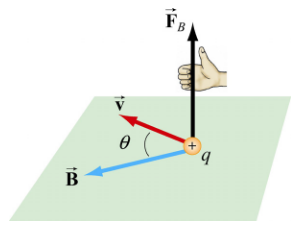
which allows us to easily determine the direction of the magnetic force.
From this equation, we can derive another related equation. We know that the magnetic force on any single charge carrier moving in a current-carrying conductor is \[e\mathbf{v}\times \mathbf{B}\], where \[e\] is the elementary charge. So, the total magnetic force, \[d\mathbf{F}_{B}\], of charge carriers from an infinitesimally thin slice (i.e. a total of \[nA\cdot dl\] charge carriers) of a current-carrying wire is \[d\mathbf{F}_{B}=(nA\cdot dl)e\mathbf{v}\times \mathbf{B}\]. We can then define \[d\boldsymbol{\ell}\] to be a vector of length \[dl\] point in the direction of \[\mathbf{v}\], which allows us to rewrite the equation as \[d\mathbf{F}_{B}=(neAv)d\boldsymbol{\ell}\times \mathbf{B}\]. Notice that \[neAv\] is also the definition of current, thus \[d\mathbf{F}_{B}=Id\boldsymbol{\ell}\times \mathbf{B}\]. If the wire is straight and stationary in a uniform magnetic field, then \[\mathbf{F}_{B}=I\boldsymbol{\ell}\times \mathbf{B}\].
Motion of a charge in a magnetic field
Notice that \[\mathbf{F}_{B}\] is always perpendicular to \[\mathbf{v}\], which means that it can not change the particle's speed. Intuitively, we can think of this in terms of energy, if a force acts perpendicular to an object's direction of movement, the force can never cause a change in the particle's kinetic energy, thus can never do any work.
We can show more concretely that it can do no work on a particle by:
Let \[d\mathbf{s}\] be the infinitesimal displacement along the particle's path, which we can then use the relationship \[\mathbf{v}=\frac{d\mathbf{s}}{dt}\implies d\mathbf{s}=\mathbf{v}dt\]:
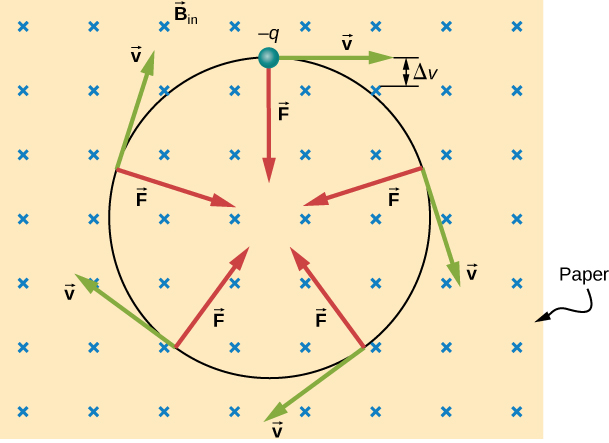
Now that the force doesn't alter its speed, we know that it can only change the direction of motion. Having a force that's constant (assuming the \[\mathbf{B}\]-field is uniform) and always right-angled to the particle's motion sounds very familiar, as it is the conditions required for circular motion. The result is a helical motion:
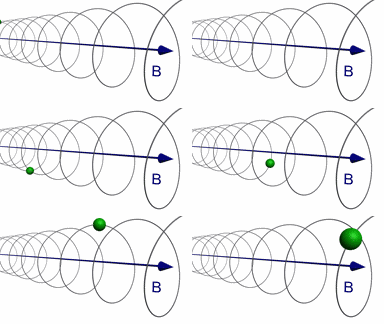
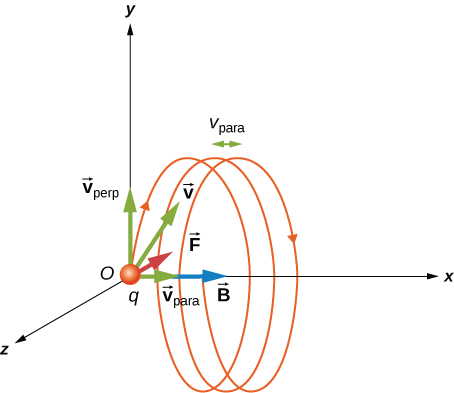
Thus we can form two sets of equations, using the formula for centripetal acceleration \[\mathbf{F}_{B}=m\mathbf{a}_{c}\] and \[v=r\omega\], we get \[qvB\sin \theta=mr\omega^{2}\implies \omega=\frac{qB}{m}\] and \[qvB\sin\theta=\frac{mv^{2}}{r}\implies r=\frac{mv}{qB}\] assuming the direction of motion and the magnetic field are at right-angles.