electric field
Electric field
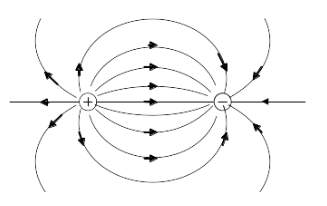
The electric field is defined at each point in space as the force that would be experienced by an infinitesimally small stationary test charge at that point divided by the charge. In layman terms, we can think of an electric field as a mathematical tool that tries to describe an observation of nature regarding charges, whereby we assign a number and direction to every point in space, which is the force per unit we believe any positive charge will experience if it is placed at that exact location.
Suppose we have \[N\] source charges \[q_{1},q_{2},q_{3},\dots,q_{N}\] located at positions \[\vec{R}_{1},\vec{R}_{2},\vec{R}_{3},\dots,\vec{R}_{N}\], applying \[N\] electrostatic forces on some test charge \[Q\] at position \[\vec{R}\]. The net force on \[Q\] is then \[\vec{F}=\vec{F}_{1}+\vec{F}_{2}+\vec{F}_{3}+\dots+\vec{F}_{N}\] (as electric fields satisfy the superposition principle). Let \[\vec{r}_{i}=\vec{R}-\vec{R}_{i}\] then applying Coulomb's law,
where \[\vec{E}\] is a vector field.
More compactly, we can write the vector field \[\vec{E}\] as \[\vec{E}(\mathbf{r})=\frac{1}{4\pi\epsilon_{0}}\sum_{i=1}^{N}\left( \frac{q_{i}}{\left\lVert \mathbf{r}-\mathbf{r}_{i} \right\rVert^{2}}\cdot \frac{\mathbf{r}-\mathbf{r}_{i}}{\left\lVert \mathbf{r}-\mathbf{r}_{i} \right\rVert} \right)\], where \[\mathbf{r}\] is the position of the test charge (can be any point in space) and \[\mathbf{r}_{i}\] are the positions of the source charges. This fulfils the definition of a vector field, as every point in space has a vector associated with it, which tells us the direction and strength of the electric field at that point.
Do note that the value \[Q\] does not matter here as it has no effect on the electric field, only the values for \[q_{i}\] does.
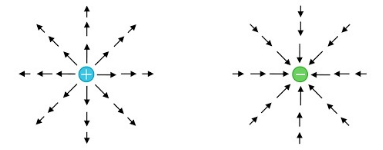
The direction of \[\vec{E}\] depends on whether the source charge is positive or negative, i.e.
Energy in an electric field
When we say "\[x\] amount of energy is stored in some electric field", it means that it takes a total of \[x\] energy to assemble said field as energy is required to bring charges to specific positions in the field. Having energy "stored" in a field does sound confusing, but we can think of it as a "number" associated to a closed system of particles set up at some specific configuration, such that whatever happens after all the particles are released the start moving, the total energy (e.g. sum of kinetic energy, electric potential energy, etc.) will always add up to this "number".
Field lines
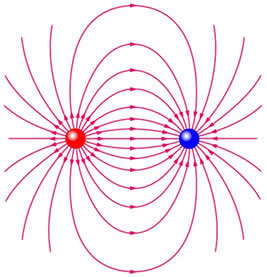
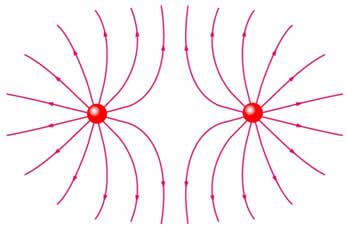
We visualize the field by drawing field lines. The field lines are in general defined by three properties:
- Lines point in the same direction as the field
- Density of lines gives the magnitude of the field
- Lines begin on positive charges and end on negative charges
Field strength of uniform field between charged parallel plates
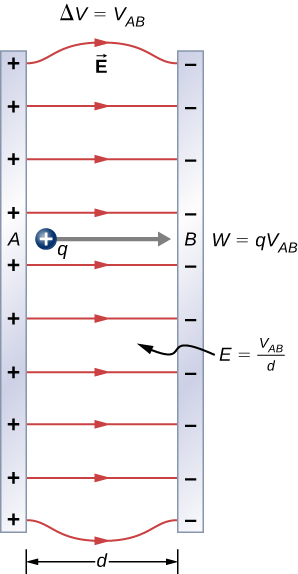
As derived in electric potential, \[\mathbf{E}=-\nabla V\]. Assume that the direction we are concerned with, i.e. the direction perpendicular to both plates, is \[\hat{\mathbf{s}}\]. \[E_{s}\] is then given as \[E_{s}=\mathbf{E}\cdot \hat{\mathbf{s}}=-\nabla V\cdot \hat{\mathbf{s}}=-\frac{\partial V}{\partial s}\]. For a uniform field over a finite distance, \[-\frac{\partial V}{\partial s}\to-\frac{\Delta V}{\Delta s}\], thus \[E_{s}\approx-\frac{\Delta V}{\Delta s}\]. If we are only concerned about its magnitude, \[E_{s}=\frac{\left| \Delta V \right|}{\Delta s}\].