uniform circular motion
Uniform circular motion
Uniform circular motion describes the motion of a body traversing a circular path at a constant tangential speed. Though the tangential speed (the magnitude) is constant, the tangential velocity is not constant as it's direction is constantly changing. This changing direction indicates the presence of an acceleration, commonly known as centripetal acceleration, of constant magnitude and directed at all times toward the axis of rotation. This acceleration is, produced by a centripetal force (maybe by the tension of a string) which is also constant in magnitude and directed toward the axis of rotation.
The reason why it's called uniform is because the tangential acceleration is zero, i.e. the tangential speed is constant.
Formula
For motion in a circle of radius \[r\], the circumference of the circle is \[2\pi r\]. If the period of one rotation is \[T\], the angular speed, \[\omega\] is \[\omega=\frac{2\pi}{T}=\frac{d\theta}{dt}\], with radians per second as it's unit.
The speed of the object traveling the circle is \[v=r\omega=\frac{2\pi r}{T}\] and the angle swept out in time \[t\] can simply be calculate as \[\theta=\omega t\].
As calculated in the article for centripetal acceleration, \[a_{c}=r\omega^{2}=\frac{v^{2}}{r}\]. Then, to find centripetal force, \[F_{c}\] simply substitute \[a_{c}\] into \[F=ma\] to get \[F_{c}=mr\omega^{2}=\frac{mv^{2}}{r}\].
Examples
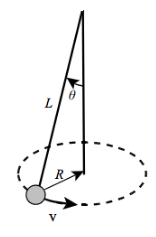
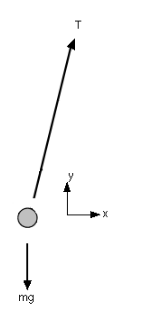
Assume we have an object tied to a rope and traveling in a horizontal circle. The object has mass 3.7 kilograms, the length of the rope, \[l\], is 1.4 meters and the tension of the rope is 100 Newtons.
The free-body diagram only shows two forces, the tension and gravity. We can divide the net force into horizontal and vertical components as follows.
Since there is no vertical acceleration, both forces must balanced each other out, i.e. \[F_{v}=T\cos\theta-mg=0\]. On the other hand, for the object to stay in circular motion, there must be a horizontal force providing the necessary centripetal acceleration required to change the direction of the ball constant. Since the horizontal component of the net force is solely provided by the tension of the string, \[T\sin\theta=\frac{mv^{2}}{r}=\frac{mv^{2}}{l\sin\theta}\].
With these two equations, we can find the angle made with the downward vertical and the tangential speed, i.e. \[100\cos\theta=3.7\times 9.81\implies \theta=68.7^{\circ}\] and \[100\sin68.7^{\circ}=\frac{3.7\times v^{2}}{1.4\sin68.7^{\circ}}\implies v=5.73\text{ms$^{-1}$}\].
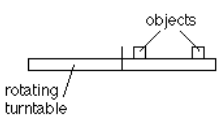
In the case of objects on a turntable, for the objects to not roll off the turntable instantly, the surface of the turntable has to have static friction. The static frictional force point towards the center and opposes any relative motion as the object has a tendency to go in a straight line which, relative to the turntable, would carry it away from the center.
The horizontal component of the net force would be \[F_{h}=F_{\text{friction}}=\frac{mv^{2}}{r}\] and the maximum possible value for the static of friction is \[F_{\text{friction}}=\mu\cdot F_{\text{normal}}\] where \[\mu\] is the frictional coefficient. As tangential speed increases, the centripetal force required to keep it in circular motion would exceed that of the frictional force and the object will move towards the outside of the turntable and fall off.