determinants and volumes
Determinants and volumes
Parallelepipeds
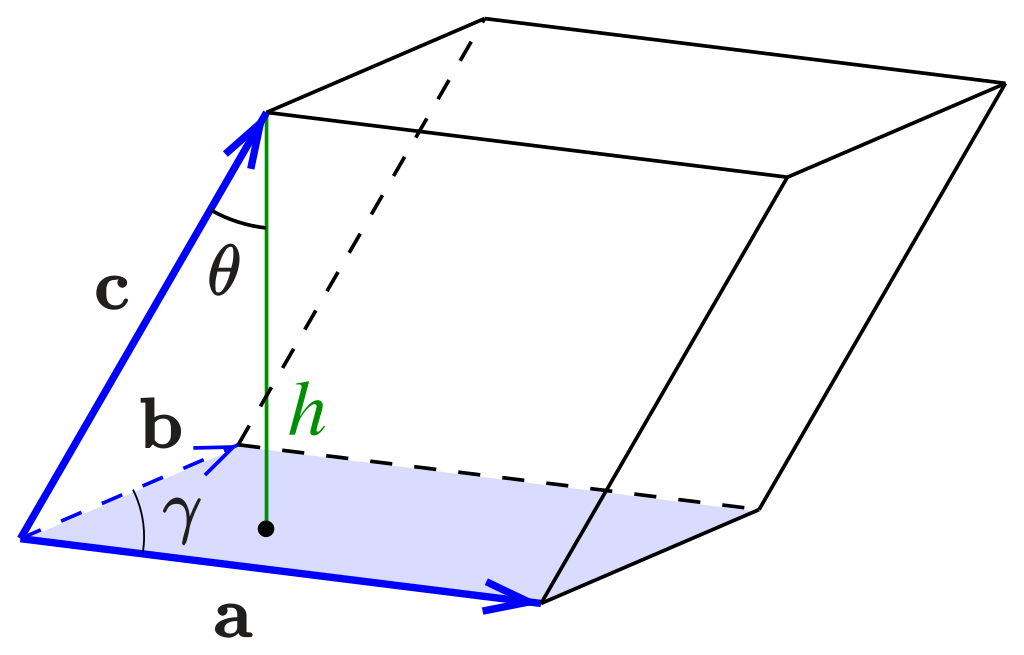
A parallelepiped is a three-dimensional figure formed by six parallelograms. It can also be the volume spanned by three linearly independent vectors.
The volume of a parallelepiped is the product of its base area and height.
Volumes
Assume that for any \[n\]-dimensional volume of parallelepiped on vectors \[v_{1},v_{2},\dots,v_{n}\]. If \[v_{1}=h+e\], where \[h\] is orthogonal to all \[v_{2},\dots,v_{n}\] and \[e\], then the volume of the parallelepiped \[V(v_{1},\dots,v_{n})=\left| h \right|\cdot V(v_{2},\dots,v_{n})\].
The statement above sounds pretty complicated, assume we have three vectors, \[v_{1}=(2,3,4)\], \[v_{2}=(1,0,0)\] and \[v_{3}=(0,1,0)\]. We know that we can split \[v_{1}\] into vertical and horizontal components (a right-angled triangle) in terms of vectors, then naturally \[v_{1}=h+e\] where \[h\] is the vertical and \[e\] is the horizontal component. Now, the horizontal component would be a vector in the \[xy\]-plane (the base of the triangle), thus \[(2,3,4)=h+(2,3,0)\implies h=(0,0,4)\]. We can imagine that \[h\] will definitely be perpendicular to the \[xy-\]plane. Though, in a simple three-dimensional scenario, we would assume that \[v_{13}\] is the height, however in a more general setting, there is no reason that the last coordinate in the original coordinate system must be the height.
With that out of the way, to show that the determinant function matches exactly to the volume function, by Axiom 1 and 2 of the determinant of a matrix, we know that
Call this new matrix \[M^{\prime}\]. Assuming \[v_{11}\ne0\], for every \[\alpha_{n}\], we can always pick a value each such that we end up with \[v^{\prime}_{21}=v^{\prime}_{31}=\cdots=v_{n1}^{\prime}=0\]. This is in essence, performing the Gaussian elimination process only on the first column.
Then, expanding all the vectors, we get
then, define \[M^{\prime}_{11}\] as
Now, according to Laplace expansion, the Laplace expansion for the first column would be \[(-1)^{1+1}\cdot v_{11}\cdot \det(M^{\prime}_{11})=v_{11}\det(M^{\prime}_{11})\] as all the other elements of column are zero.
Now, we've shown that \[\det(M)=v_{11}\cdot \left| \det(M^{\prime}_{11}) \right|\], assuming that \[v_{11}\] corresponds to the height, \[\left| h \right|\], \[\left| v_{11} \right|\cdot \left| \det(M^{\prime}_{11}) \right|=\left| h \right|\cdot V(v^{\prime}_{2},\dots,v^{\prime}_{n})=\left| h \right|\cdot V(v_{2},\dots,v_{n})=V(v_{1},v_{2},\dots,v_{n})\]. Note that the absolute bracket around \[\left| v_{11} \right|\] is used to ensure the volume is positive, as the determinant itself may not be positive and that elementary row operations do not change the determinant/volume. Then, by comparison, we've shown that the determinant function matches exactly with the volume function.