centripetal force
Centripetal force
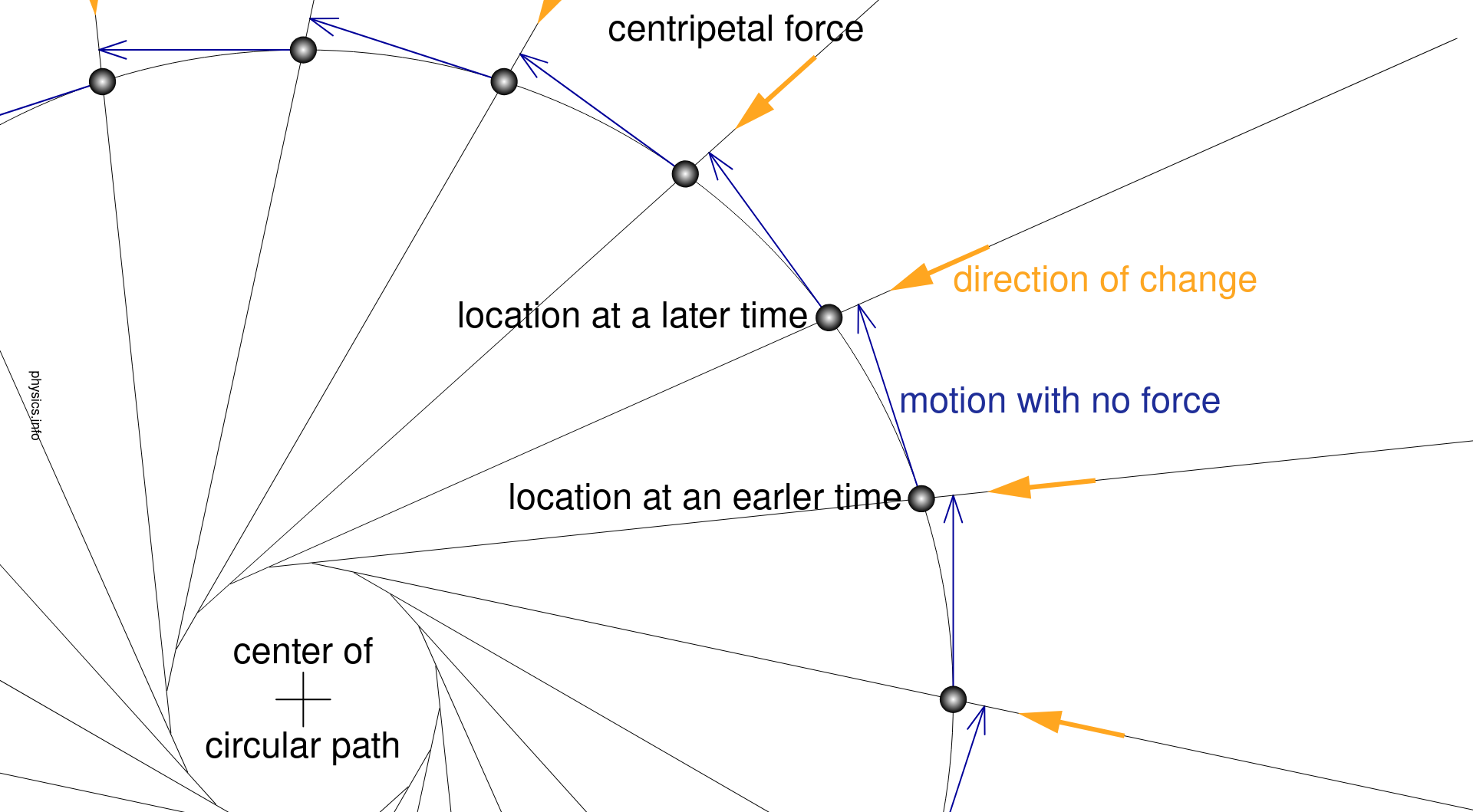
Centripetal force is a force that makes a body follow a curved path. The direction of the centripetal force is always orthogonal (perpendicular) to the motion of the body and towards the fixed point of the center of the path.
Formula
From the kinematics of curved motion (see tangential speed and centripetal acceleration) it is known that an object moving at tangential speed, \[v\], along a path with radius of curvature \[r\] accelerates towards the center of curvature at a rate \[a_{c}=r\omega^{2}\], substitute \[v=r\omega\] we get \[a_{c}=\frac{v^{2}}{r}\].
By Newton's second law, the cause of acceleration is a net force acting on the object, usually referred as a centripetal force. It has a magnitude of \[F_{c}=ma_{c}=mr\omega^{2}=m \frac{v^{2}}{r}\].
Examples for uniform circular motion
Say, we have an object that is swinging around on the end of a rope, the centripetal force on the object is supplied by the tension of the rope. The centripetal force can also be supplied as a pushing force, e.g. the normal reaction of a wall can supply the centripetal force for an object going around a banked wall.
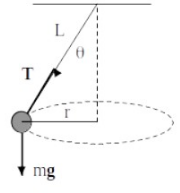
We have a mass hanging from the ceiling with a string with tension. We will now calculate the horizontal and vertical forces.
Define \[F_{h}\] as the horizontal force. It is evident that only \[T\] supplies the horizontal net force, i.e. \[F_{h}=T\sin\theta\]. So, we know that in this case, the string provides the centripetal force, i.e. \[T\sin\theta=\frac{mv^{2}}{r}\]. Next, define the vertical net force \[F_{v}=mg=T\cos\theta\], as the tension of the string must also counteract the gravitational force.
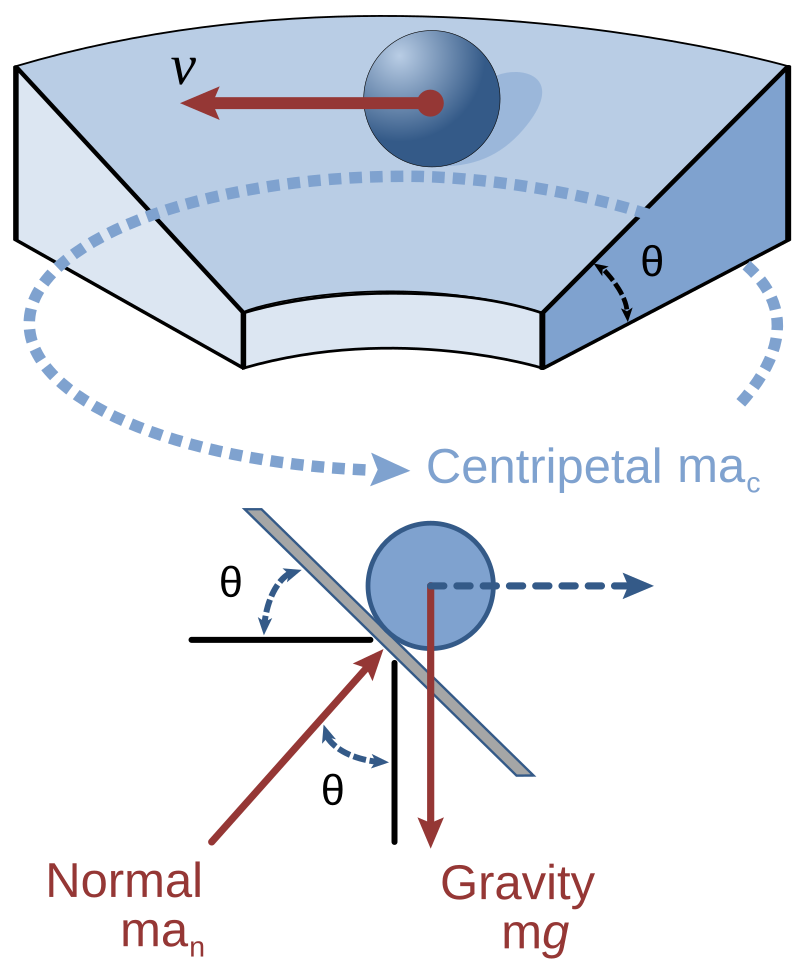
We will review an example of a ball moving in circular motion along a frictionless banked curve and form an equation to find the angle of the bank must have so that the ball does not slide off when provided with the radius and linear (tangential) speed.
The above is an example of centripetal force supplied by a pushing force. Note that centripetal force is not a third force applied to the ball, but rather provided by the net force on the ball resulting from the normal force and the force of gravity. Assume the normal force provided by the bank is \[N=m\cdot a_{n}\].
Only the horizontal component of the normal force from the road contributes to the horizontal net force on the ball, i.e. \[F_{h}=ma_{n}\cdot\sin\theta\]. The vertical component of the normal force must counteract the gravitational force, i.e. \[F_{v}=ma_{n}\cdot\cos\theta=mg\]. This implies that \[a_{n}=\frac{g}{\cos\theta}\], substituting this into \[F_{h}=m \frac{g}{\cos\theta}\cdot\sin\theta=mg\tan\theta\].
At the same time, since \[F_{h}\] is our centripetal force, \[mg\tan\theta=m\cdot a_{c}=\frac{mv^{2}}{r}\]. Consequently, we can say that for the ball to roll around the bank without sliding off, it needs to satisfy \[\tan\theta=\frac{v^{2}}{gr}\].
If the surface has a frictional coefficient of \[\mu\], then we simply factor in the friction, e.g. if the ball is at maximum speed and tends to slide up and bank, then the frictional force acts downwards along the bank, or if it is a minimum speed and tends to slide down, then the frictional force acts upwards along the bank. Keep in mind that the frictional force contributes to both \[F_{h}\] and \[F_{v}\].