Newton's law of universal gravitation
Newton's law of universal gravitation
Newton's law of universal gravitation describes gravity as a force that every particle attracts every other particle in the universe with a force that is proportional to the product of their masses and inversely proportional to the square of the distance between the centres of mass.
This is a law derived from empirical observations and inductive reasoning.
Despite the having the word "universal" in its name, this law isn't quite as "universal" as the name implies. It is indeed a sufficiently accurate approximation of the reality of physics in most places in the entire universe. However, this law breaks down when we start entering the territories of more extreme phenomena such as extremely strong gravity (e.g. black holes) or very fast motion. This is because Newton's law assumes that any change in the position of one mass is instantly communicated to all other masses. However, it was later shown by Einstein that information cannot transfer faster than the speed of light, thus an alternate way to model gravity more accurately was introduced called the theory of General Relativity.
Origins
Beginning in the 1500s, astronomers such as Copernicus and Brahe discovered that the Earth and other planets revolved around the Sun. Kepler then studied Brahe's observations and found that each planet goes around the sun in a curve called an ellipse, with the sun at a focus of the ellipse. One of his discoveries that mattered most to Newton's formulation was the discovery that between any two planets, their orbital periods are proportional to the \[\frac{3}{2}\] power of the orbit size, i.e. \[T^{2}\propto r^{3}\]. However, at that point no one yet knew why planets moved in an elliptical orbit.
At the same time, Galileo was studying motions and discovered the principle of inertia, i.e. if something is moving, with nothing touching it and completely undisturbed, it will go on forever, coasting at a uniform speed in a straight line. Newton modified this notion and saying that the only way to change the speed or direction of motion of a body is to use force. For example, if a stone is attached to a string and is whirling around in a circle, it takes a force to keep it in the circle. We have to pull on the string. The brilliant idea resulting from these two considerations is that no tangential force is needed to keep a planet in its orbit. However, if there were nothing at all to disturb it, the planet would've just coasted off into the depths of space in a straight line. We know that that is not the case, as the actual motion of planets deviates from the straight line on which the body would have gone if there were no force at essentially right angles (see centripetal force). In other words, because of the principle of inertia, the force needed to control the motion of a planet around the sun is not a force around the sun but towards the sun.
By analysing Huygen's uniform circular motion equations, \[a=r\omega^{2}=\frac{4\pi^{2}r}{T^{2}}\] and then substituting it into Kepler's third law to eliminate \[T\], Newton found that \[a\propto \frac{1}{r^{2}}\]. By substituting this relation into his second law,t \[F=ma\], he discovered that the farther away the planet, the weaker the forces. If two planets at different distances from the sun are compared, the forces are inversely proportional to the squares of the respective distances. With the combination of the two laws, Newton concluded that there must be a force, inversely as the square of the distance, directed in a line between the two objects. The idea of planets "falling" towards the Sun is also quite confusing, as we know it doesn't really come any closer to the Sun, it instead falls in the sense where it falls away from the straight line that it would pursue if there were no forces.
It was also known at that time that both Jupiter and Earth have moons going around it in a similar fashion as to how both planets go around the Sun. Newton felt certain that each planet also held its moons with a force, so he proposed that this was a universal force, i.e. everything pulls everything else. So in 1687, Newton proposed that the force of gravity is proportional to their mass and inversely proportional to their separation squared: \[F\propto \frac{m_{1}m_{2}}{r^{2}}\].
Cavendish's experiment
It was only a century after Newton published his law of universal gravitation that the proportionality constant was measured.
The constant in question is the universal gravitational constant and it was determined by Henry Cavendish to be \[6.67\times 10^{-11}\,\text{Nm$^{2}$kg$^{-2}$}\]. The (simplified) experiment was set up as such:
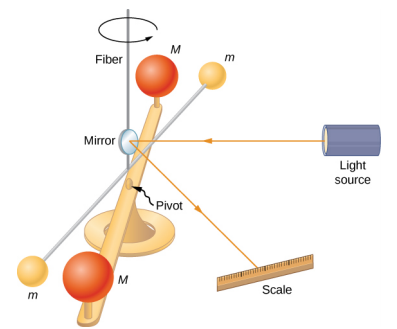
Two small balls of lead were placed on bar supported by a very fine fibre called a torsion fibre. A large fixed ball of lead was placed near each small lead ball and by measuring how much the fibre gets twisted, one can measure the strength of the force. Thus, one may accurately determine the proportionality constant.
Modern definition
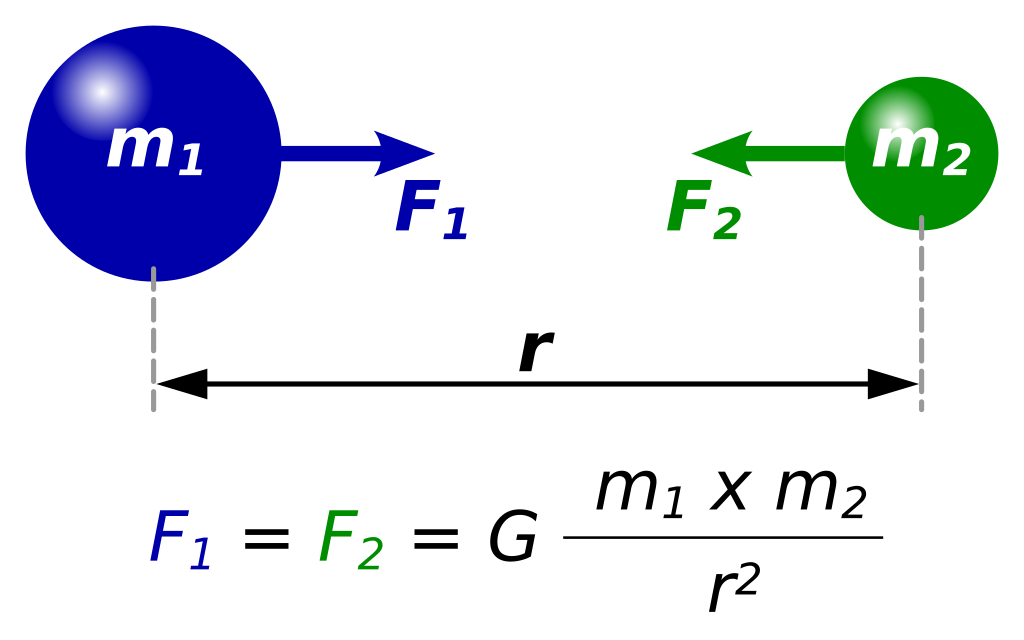
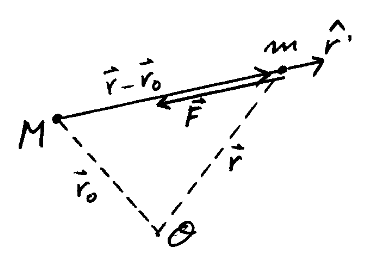
Newton's universal law of gravitation is defined as:
- Every point mass attracts every single other point mass by a force acting the line intersecting both points. The force is proportional to the product of the two masses and inversely proportional to the square of the distance between them.
-
Mathematically, it is written as \[F=G \frac{m_{1}m_{2}}{r^{2}}\] or \[\mathbf{F}_{21}=-G \frac{m_{1}m_{2}}{\left\lVert \mathbf{r}_{21} \right\rVert^{2}}\hat{\mathbf{r}}_{21}\], where \[\mathbf{F}_{21}\] is the force experienced by body 2 exerted by body 1, and \[\mathbf{r}_{21}=\mathbf{r}_{2}-\mathbf{r}_{1}\] is the displacement vector pointing from body 1 to body 2.
The negative sign accounts for the fact that the force vector \[\mathbf{F}\] points inward whereas the unit vector \[\hat{\mathbf{r}}\] points outward.