two-dimensional vertical circular motion
Two-dimensional vertical circular motion
The two important formulas for such scenarios are:
- Gravitational potential energy of the particle at any point along the vertical motion is given as \[mg\cdot (r-r\cos\theta)\].
- Minimum speed required for the particle to complete a vertical circular motion is \[u\ge \sqrt{5gr}\] at the lowest point on the circle
Proof for \[mg\cdot (r-r\cos\theta)\]
Consider a particle of mass \[m\] attached to an inelastic string of length \[r\] . The particle is at rest in equilibrium before being projected with speed \[u\] from the lowest point on the circle. The gravitational potential energy of a particle moving in vertical circular motion is given as \[mg\cdot(r-r\cos\theta)\implies mgr\cdot(1-\cos\theta)\], while it's kinetic energy is given as \[\frac{1}{2}mv^{2}\]. Keep in mind that \[\theta\] is the angle between the particle's location and the downward vertical, while we take the gravitational potential energy of a particle at it's lowest point, i.e. \[\theta=0\] as zero.
Note that when we're calculating the trigonometric functions, we have to keep in mind that our unit circle has been turned clockwise by 90 degrees.
We will now demonstrate why at any given point, the vertical distance of the particle from the ground can be calculated as \[r-r\cos\theta\].
When \[0^{\circ}\le\theta\le 90^{\circ}\], assume we define \[h\] as the vertical distance of the particle below the origin. Then logically we can find the height of the particle from the ground by \[r-h\]. Now, to obtain \[h\], we use the fact that \[\cos\theta=\frac{h}{r}\implies h=r\cos\theta\], substitute that into our equation, and we get \[r-r\cos\theta\], which is exactly our formula.
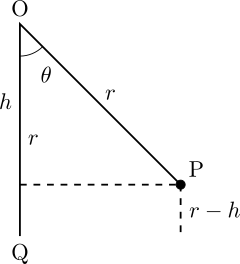
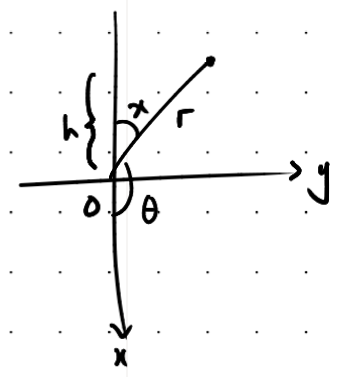
Next, when \[90^{\circ}\le\theta\le 180^{\circ}\], \[\theta\] will have a reference angle, call this \[x\], since they're reference angles we can then establish this relationship \[\cos\theta=-\cos x\] (negative as it's now in the second quadrant). Define \[h\] as vertical distance of the particle above the origin. Then to find the distance of the particle from the ground, we calculate \[r+h\]. Similarly, to obtain \[h\] we use the fact that \[\cos x=\frac{h}{r}\implies h=r\cos x\], substitute that into \[r+h\], we get \[r+r\cos x\] which based on the relationship above also equates to \[r-r\cos \theta\].
The proofs for the other two quadrants are similar in nature.
Proof for \[u\ge \sqrt{5gr}\]
To find the minimum speed required for a particle at the lowest point in the circle to complete it, we will assume its kinetic energy at the circle's highest point must be larger than zero (to have energy to progress past the highest point in the circle).
Initial diagram:
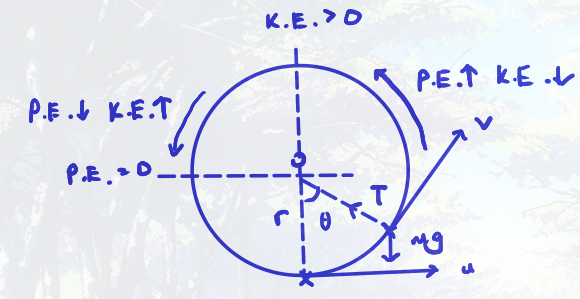
The centripetal force towards center is can be calculated as \[F_{c}=\frac{mv^{2}}{r}=T-mg\cos\theta\].
From the principal of conservation of energy, we know that the kinetic energy at the lowest point, \[\frac{1}{2}mu^{2}\], must be equal to the sum of the kinetic and gravitational potential energy at some higher point, \[\frac{1}{2}mv^{2}+mg(r-r\cos\theta)\], i.e. \[\frac{1}{2}mu^{2}=\frac{1}{2}mv^{2}+mg(r-r\cos\theta)\]. Then,
Substituting \[T-mg\cos\theta=\frac{mv^{2}}{r}\],
Since \[T\ge0\],
At the highest point in the circle \[\theta=180^{\circ}\],
Applications
Angle at which a particle leaves the surface of a hemisphere
Imagine a hemisphere with a particle at the apex of it:
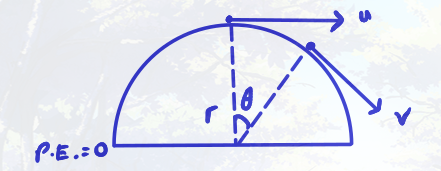
We will now switch the formula a little as our starting point is now different. The particle now has a total initial energy of \[\frac{1}{2}mu^{2}+mgr\]. After it starts rolling, the total energy at any given point would be \[\frac{1}{2}mv^{2}+mg(r\cos\theta)\], as some of its gravitational potential energy has converted into more kinetic energy. The principle of conservation of energy tells us that,
We know that the particle, at point with velocity \[v\] has the following forces acting on it's surface:
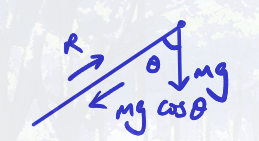
Where \[mg\] is the gravitational force, \[mg\cos\theta\] is the force acting on the surface of the hemisphere caused by gravitational force, and \[R\] is the normal force. Therefore, we can calculate the centripetal force as \[F_{c}=mg\cos\theta-R\]. It is to note that while \[mg\cos\theta\] is larger than the normal force, the particle does not crush or phase into the surface of the object (as per the definition of normal force), as part of the \[mg\cos\theta\] force is used to constantly change the direction of the particle (changing the direction of a moving object requires force).
Then, substitute \[F=\frac{mv^{2}}{r}\] and the equation above to get,
When the particle rolls exactly to the point where it leaves the surface of the hemisphere, the normal force become zero, therefore:
Here, \[\theta\] equals to the total angle in which the particle will travel before leave the surface of the hemisphere, for example, if a miniscule amount of force is applied to the ball, \[u\approx0\], \[\cos\theta=\frac{2}{3}\implies\theta\approx48.2^{\circ}\].
Referenced by:
No backlinks found.