waves
Waves
A wave is a disturbance that propagates, or moves from the place it was created. There are two basic types of waves: mechanical waves and electromagnetic waves.
Intensity
The intensity of a wave is measured by the power per unit area, \[I=\frac{P}{A}\], where \[P\] is power and \[A\] is the area in which the wave passes. For a wave of frequency \[f\] and amplitude \[A\], \[I\propto A^{2}f^{2}\].
Travelling waves and standing waves
All waves only transfer energy and not matter. However, progressive waves transfer energy across a distance by transferring energy to nearby particles while standing waves don't transfer energy as it does not transfer energy to nearby particles.
Travelling waves
Travelling waves, or sometimes known as propagating/progressive waves are characterized by their movement through a medium. These waves transfer energy from one location to another. A classic example is a water wave moving across a lake or sound waves propagating through air. Each point on the wave moves forward with a phase velocity while the shape of the wave moves along with the wave itself, meaning that peaks and troughs of the wave are not stationary but travel through the medium.
There is a net transfer of energy across the medium in the direction of wave propagation. This energy movement is what allows waves to carry signals or energy over distances.
Standing waves
Standing waves do not travel through the medium. Instead, they appear to stand still, vibrating in place. An example would be vibrations on a guitar string between two fixed ends. Standing waves are characterized by nodes (points of no motion) and antinodes (points of maximum amplitude). These positions are fixed in space. The energy of a standing wave is contained within a specific region and does not propagate forward.
Standing waves are often formed by the interference of two progressive waves of the same frequency and amplitude traveling in opposite directions. This can occur, for example, when a wave reflects off a boundary and interferes with incoming waves.
Transverse wave and longitudinal wave
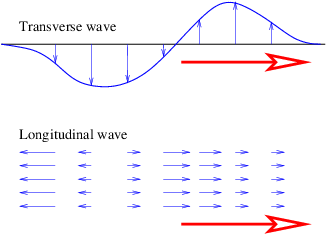
Transverse and longitudinal waves both only indicate the direction of propagation of waves. Therefore, standing and travelling waves are usually either a transverse or longitudinal wave, or sometimes, a combination of both such as water.
Shear transverse mechanical waves propagate only in solids, because they rely on shear rigidity; particles must pull sideways on their neighbours, which requires a non-zero shear modulus. Fluids cannot sustain such shear stress, they simply flow, so they do not carry body shear waves. By contrast, longitudinal mechanical waves need only that particles push and pull along the line of travel, a response governed by the bulk modulus that all phases of matter possess. Hence, pressure waves such as sound pass through solids, liquids and gases.