conventional notations for a wave
Conventional notations for a wave
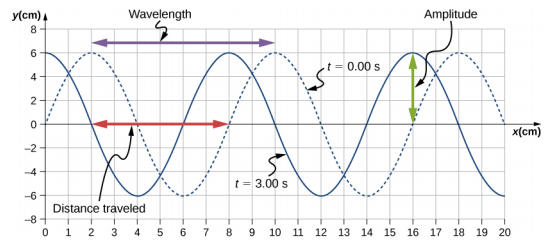
Displacement, \[y=F(x,t)\]
The distance of a particle in a wave in a specified direction from it's rest position.
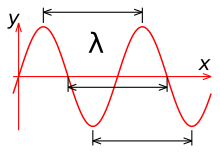
Wavelength, \[\lambda\]
The distance between two successive maxima or minima in the wave. Usually measured in meters.
Amplitude, \[A\]
The maximal distance that a particle in the medium is displaced from its equilibrium position. Usually measured in meters.
Velocity, \[\overrightarrow{v}\] or \[v\]
The velocity with which the disturbance propagates through the medium.
Period, \[T\]
The time it takes for two successive maxima or minima to pass through the same point in the medium. Or in simple words the time it takes for a wave to complete one cycle/repeat.
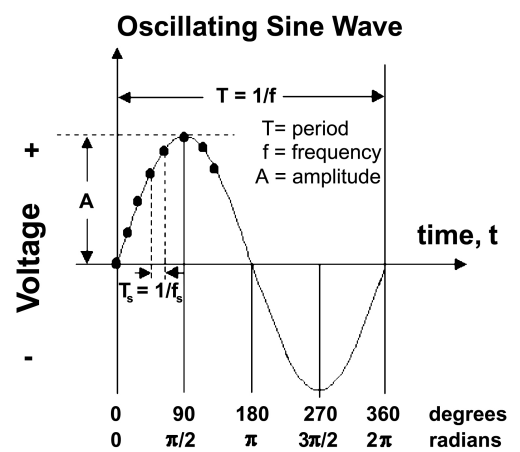
Frequency, \[f\]
Defined as the number of cycles or repetitions per unit of time. Mathematically represented as \[f=\frac{1}{T}\]. It's units are \[\text{Hz}\] or \[\text{s}^{-1}\].
Speed, frequency and wavelength
Speed is defined as distance over time, \[v=\frac{\lambda}{T}\]. Since \[f=\frac{1}{T}\], thus \[v=\frac{\lambda}{\frac{1}{f}}=f\lambda\].
Wavenumber
A wavenumber is defined as the number of radians per unit distance, i.e. \[k=\frac{2\pi}{\lambda}\]. Notice that \[\lambda=vT\], \[k=\frac{2\pi}{vT}=\frac{2\pi}{T}\cdot \frac{1}{v}=\frac{\omega}{v}\], where \[\omega\] is the angular frequency.