Doppler effect
Doppler effect
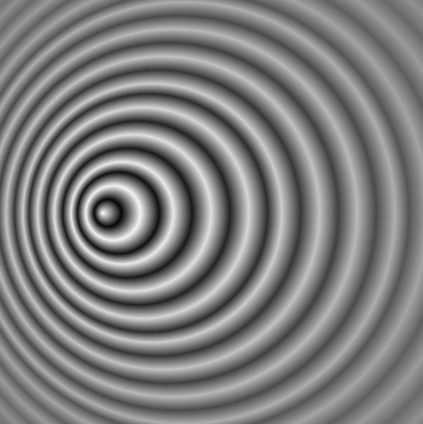
The Doppler effect, also known as Doppler shift, is the change in the frequency of a wave in relation to an observer who is moving relative to the source of the wave.
When the source of the sound wave is moving towards the observer, each successive cycle of the wave is emitted from a position closer to the observer than the previous cycle. Hence, from the observer's perspective, the time between cycles is reduced, meaning the frequency is increased. Conversely, if the source of the sound wave is moving away from the observer, each cycle of the wave is emitted from a position farther from the observer than the previous cycle, so the arrival time between successive cycles is increased, thus reducing the frequency.
Derivation of the observed frequency due to Doppler shift
Stationary observer, moving source
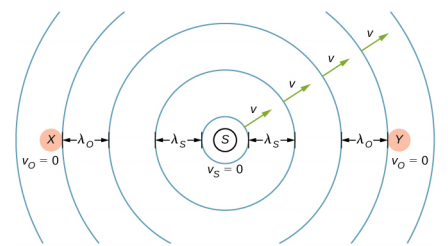
Consider two stationary observers, located on either side of a stationary source emitting sound waves with frequency \[f\]. In this case, the maxima of the amplitude of the wave produced will occur at fixed intervals, spaced time \[T\] apart. We also know that the period of a wave is equal to \[\frac{1}{f}\], so \[T=\frac{1}{f}\]. When the source is at rest, an observer would receive these maxima spaced out by \[T\]. If we were to draw the waves out, we would find that each maxima are separated by a distance, which is also it's wavelength, \[\lambda=Tc_{s}\] where \[c_{s}\] is the speed of sound.
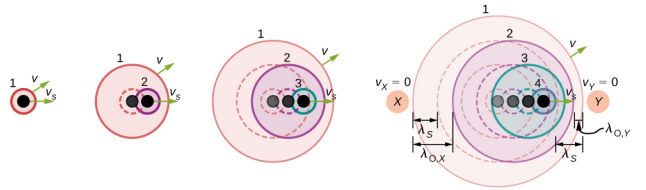
Now assume the source is moving at velocity \[v_{s}\] towards us. After the source emits one maximum, it moves a distance \[v_{s}T\] towards us before emitting the next maximum. Logically, the two maxima would naturally less than \[\lambda\] apart. In fact, they will be of distance \[(c_{s}-v_{s})T\] apart.
To understand why it's \[(c_{s}-v_{s})T\], it's because in one period \[T\], the initial maximum has travelled a distance \[c_{s}T\] while the source has travelled a distance \[v_{s}T\]. Now, at time \[t=T\], the source, at its new position emits the next maximum, which is at distance \[c_{s}T-v_{s}T\] away from the current position of the initial maximum.
So, the second maximum will naturally arrive in less than time \[T\] from the initial maximum. Using \[\text{time}=\frac{\text{distance}}{\text{speed}}\], the time it takes for the second maximum to arrive, \[T^{\prime}=\frac{(c_{s}-v_{s})T}{c_{s}}\]. With this, finding the new frequency would be just substituting this into \[f^{\prime}=\frac{1}{T^{\prime}}=\frac{c_{s}}{(c_{s}-v_{s})T}=\frac{c_{s}}{c_{s}-v_{s}}f\].
In other words, if the source is travelling right at us, the frequency we hear will be shifted higher by a factor of \[\frac{c_{s}}{c_{s}-v_{s}}\]. Similarly, if the source is moving away from us, the distance between each maxima would be of \[(c_{s}+v_{s})T\], thus our perceived frequency would be lower, \[f^{\prime}=\frac{c_{s}}{c_{s}+v_{s}}f\].
Moving observer and source
Now, imagine if both us and the source are in motion. We're moving towards the source at speed \[v_{r}\], the wave will be moving at speed \[c_{s}+v_{r}\] relative to us, thus we just have to factor that into our calculation of \[T^{\prime}\]. Assuming the source is moving away from us, \[T^{\prime}=\frac{(c_{s}+ v_{s})T}{c_{s}+v_{r}}\implies f^{\prime}=\frac{c_{s}+v_{r}}{c_{s}+v_{s}}f\]. Essentially, we just have to determine the direction of motions of the source and observer and flip the signs accordingly.