field (physics)
Field
A field in physics is a physical quantity (represented by a scalar, vector or tensor) that has a value for each point in space and time. In simple words, a field is a function that returns a value for a point in space.
Scalar field
Topological maps are a simple example of what a field is. This type of field is specifically known as a scalar field.
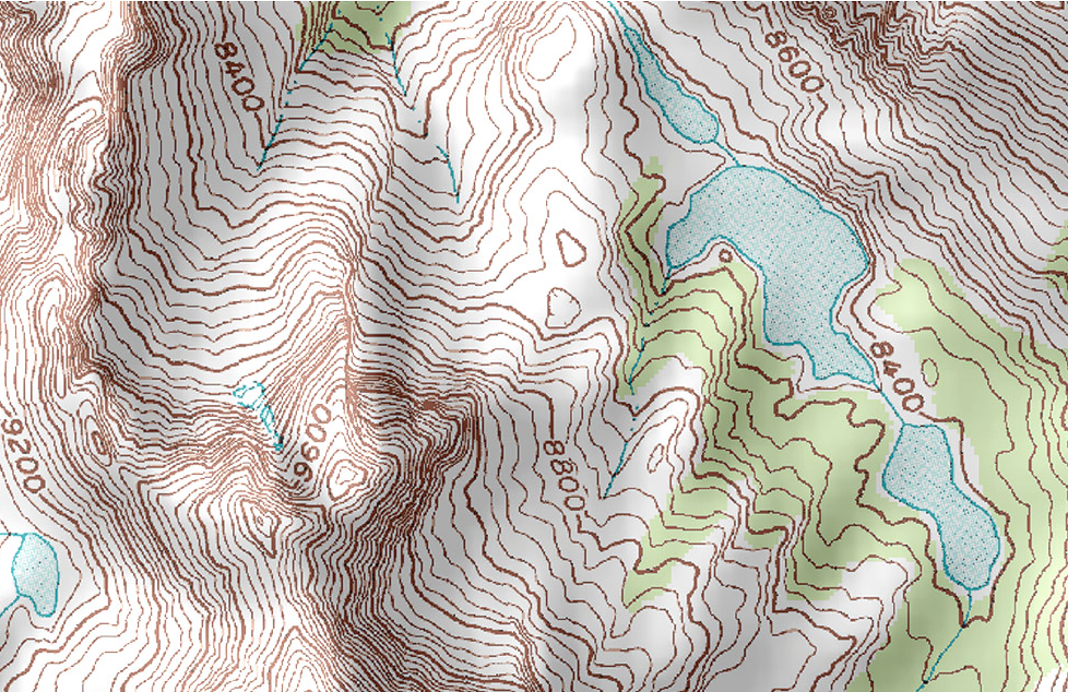
The reason why this, which looks nothing like a magnetic or electric field, is in fact a field is because to make this topological map, someone had to measure the altitude at a sufficiently large number of locations along the terrain. Then, the recorded altitudes would be interpolated between them to produce a continuous map of the altitude of the terrain. Through this process we have assigned a scalar (rough altitude) to every point on the terrain.
This makes the topographical map a decent way of representing altitude \[A\], as it varies continuously with position \[\mathbf{r}\] on the map. We say that the altitude is a "function" \[A(\mathbf{r})\] of the position, i.e. if we know what \[\mathbf{r}\] is, then we know what the altitude \[A(\mathbf{r})\] is at point \[\mathbf{r}\].
An even simpler example would be the temperature in our room (or called a temperature field). Naturally, there will be some areas in our room slightly hotter or colder than the others. Now assume we know the exact temperature at every point in our room (imagine it as an empty three-dimensional space). Then, we can say that the temperature \[T\] is a "function" of position \[\mathbf{r}\], or \[T(\mathbf{r})\]. Thus, this fulfils the definition of a scalar field, i.e. for every point in space (\[\mathbf{r}\]), there is a scalar (\[T\]) associated to it.
Vector fields
Vector fields are very similar to scalar fields, but instead of having a scalar assigned to every point, a vector is assigned instead.
A simple example would be a wind map:
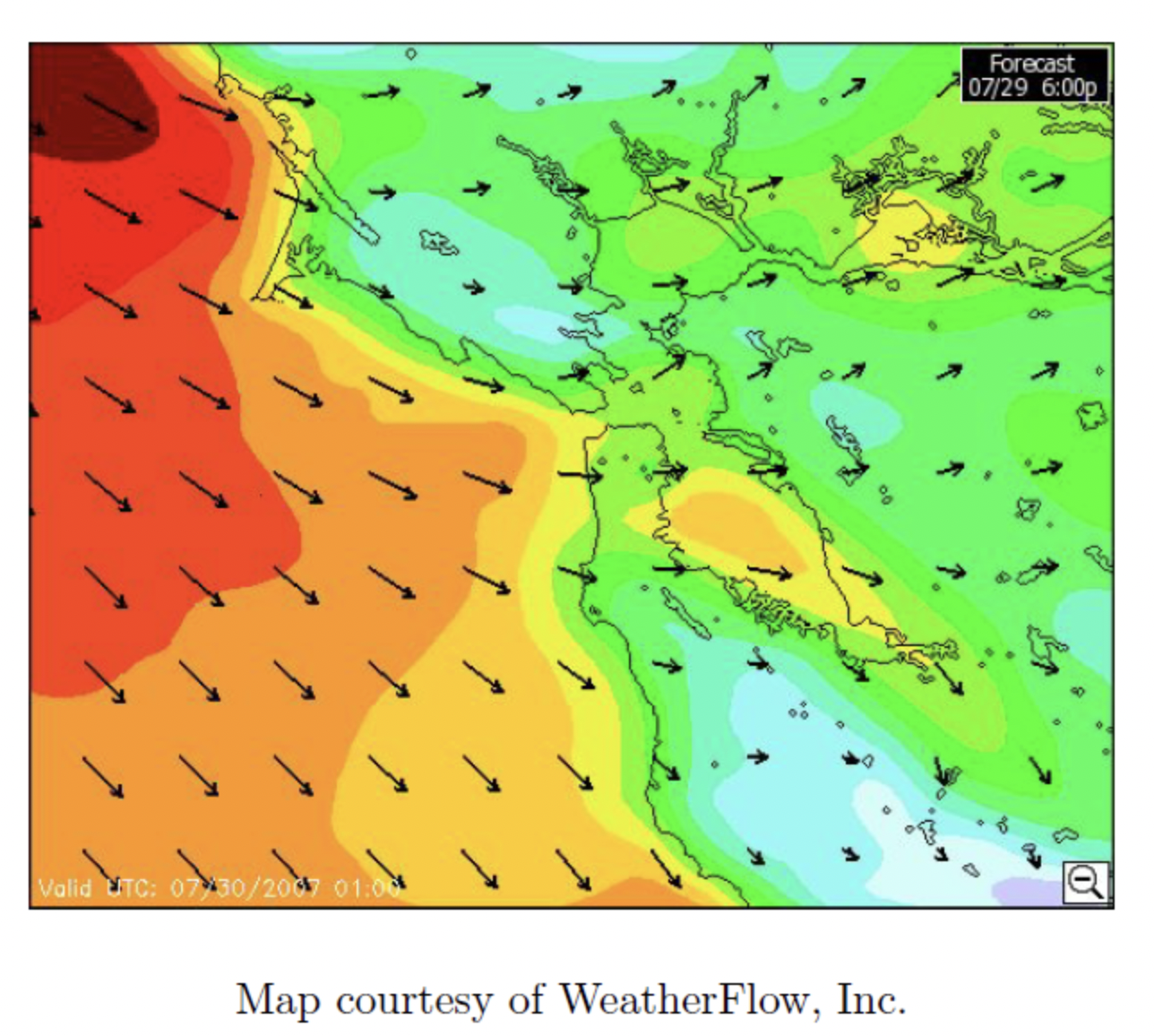
As we can see, every point on this two-dimensional plane (the atmosphere) is assigned a vector (wind speed and direction).
Fields and energy
What is a field?
One way to look at the world is to see it as a cellular automaton; something resembling Conway's game of life. Of course it's not so simple as the playing field looks different from observer to observer but as a mental model it's quite productive. Each little volume has a set of properties which interact with other properties and propagate with each "tick" (only) to neighboring cells, thusly establishing the speed of light.
Such properties are essentially a set of "influences" on various kinds of "particles": Charges are attracted, repelled or deflected. Matter is attracted. Quarks are glued together. These "influences" are what we call "fields" in a macroscopic view. Fields are properties of points in space time that describe how this point in space time interacts with "particles".
How can a field store energy?
One of these is the electrostatic field, for example between capacitor plates. It can accelerate charges, which means that it gives them kinetic energy. The field can do work on matter; that is why we say it "contains" that energy. Like all energy it is conserved: Charges flowing along the field will weaken it until its energy is gone. "How" exactly it stores the energy is a somewhat meaningless question: "How" does a missile store its kinetic energy? Fields and their energy are properties of spacetime volumes; that is all we can say.
While "fields" (i.e., spacetime properties) are "concepts" they do have a certain reality (beyond the fact that we can measure "their" effect, which is somewhat circular): Their energy actually makes the space heavy, although that wording is a bit awkward: Energy is mass, so it doesn't make anything heavy, it is heavy. If you want a bit of pop science, a magnetic field strong enough could conceivably be "heavy" enough to produce a black hole, unless something else happens first, like spontaneous pair production etc. There is no principle reason why this should not be possible with other fields as well.
I'm putting "particles" in quotes because what we call "particles" is, at a closer look, a volume with special set of properties that just happen to perpetuate themselves, sometimes infinitely, sometimes not.
Example
Source (Feynman lectures).
Suppose we have two electrical charges \[q_{1}\] and \[q_{2}\] located at points \[P\] and \[R\] respectively. Then the force between the charges is given by \[\mathbf{F}=\frac{1}{4\pi\epsilon_{0}}\frac{q_{1}q_{2}}{\left\lVert \mathbf{r}_{1}-\mathbf{r}_{2} \right\rVert^{2}}\hat{\mathbf{r}}_{21}\]. To analyse this force by means of the "field" concept, we say that the charge \[q_{1}\] at \[P\] produces a "condition" at \[R\], such that when the charge \[q_{2}\] is placed at \[R\] it "feels" the force.
A way to describe this "force" \[\mathbf{F}\] on \[q_{2}\] is by writing it in two parts, i.e. \[q_{2}\] multiplied by a quantity, call it \[\mathbf{E}\], that would be there regardless if \[q_{2}\] were there or not, provided we keep all the other charges in their places. We say \[\mathbf{E}\] is the "condition" produced by \[q_{1}\] and \[\mathbf{F}\] is the response of \[q_{2}\] to \[\mathbf{E}\].
\[\mathbf{E}\] is then called an electric field where \[\mathbf{E}=\frac{1}{4\pi\epsilon_{0}}\frac{q_{1}}{\left\lVert \mathbf{r}_{1}-\mathbf{r}_{2} \right\rVert^{2}}\hat{\mathbf{r}}_{21}\]. This allows us rewrite the initial equation as \[\mathbf{F}=q_{2}\mathbf{E}\], which expresses the force, the field, and the charge in the field. The point of all these is to divide the part that says "something produces a field" and other that says "something is acted by the field", which simplifies calculations of problems in many situations.
In the case of gravitation, we can do exactly the same thing. The gravitational force is given as \[\mathbf{F}=-\frac{Gm_{1}m_{2}}{\left\lVert \mathbf{r}_{2}-\mathbf{r}_{1} \right\rVert^{2}}\hat{\mathbf{r}}_{21}\]. We can separate this as into: the force on a body in a gravitational field is the mass of that body times the field \[\mathbf{C}\], i.e. \[\mathbf{F}=m_{2}\mathbf{C}\]. Then, the field \[\mathbf{C}\] produced by a body of mass \[m_{1}\] is \[\mathbf{C}=-\frac{Gm_{1}}{\left\lVert \mathbf{r}_{2}-\mathbf{r}_{1} \right\rVert^{2}}\hat{\mathbf{r}}_{21}\].