gravitational field
Gravitational field
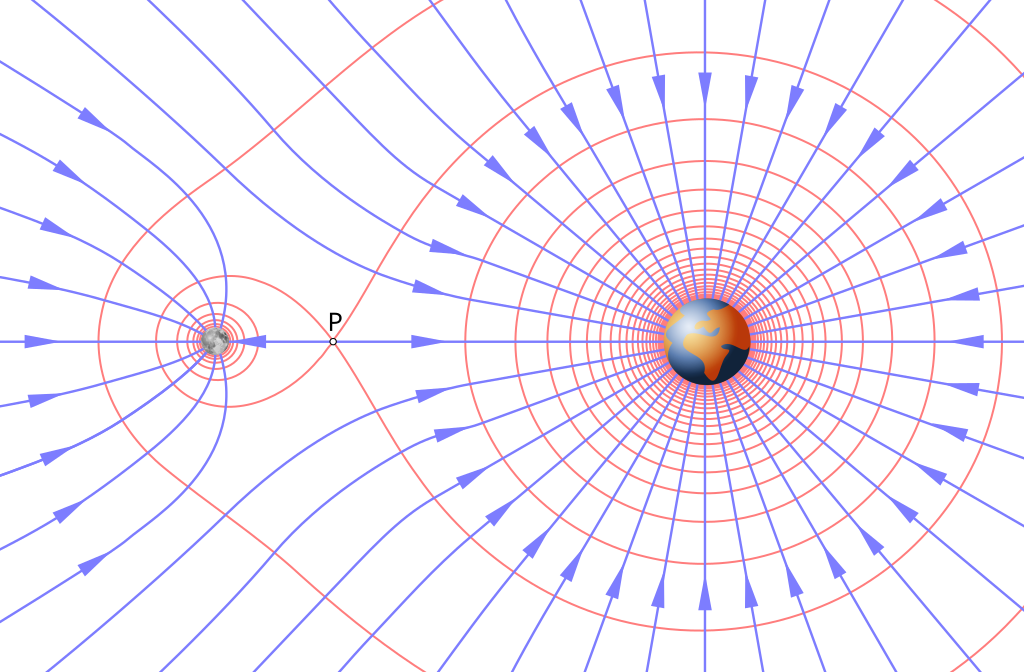
A gravitational field is a vector field used to explain the influences that a body extends into the space around itself. In its original concept, gravity was a force between point masses, but now it's widely described in terms of a field model rather than just simple point attractions.
Definition
The gravitational field at any point \[P\] in space is defined as the gravitational force felt by a tiny unit mass (or test particle) placed at \[P\]. Mathematically, it can be defined using Newton's law of universal gravitation, i.e. \[\mathbf{g}=\frac{\mathbf{F}}{m}=-\frac{GM}{\left\lVert \mathbf{r} \right\rVert^{2}}\hat{\mathbf{r}}\] where \[M\] is the mass of the object whose field we are concerned with.
We say "a tiny unit mass" because we don't want the gravitational field from the test mass itself to disturb the system.
Field with multiple masses
Since gravitational force satisfies the superposition principle (most of the time, if we're not considering extreme cases like black holes), the field around multiple particles is simply the vector sum of the fields around each individual particle.
Let \[M_{i}\] be the mass of particle \[i\] and \[\mathbf{R}_{i}=\mathbf{r}-\mathbf{r}_{i}\] (i.e. the displacement vector pointing from particle \[i\] to a test particle at position \[\mathbf{r}\]),