vector field
Vector field
A vector field is an assignment of a vector to each point in a space, most commonly Euclidean space, \[\mathbb{R}^{n}\]. A vector field on a plane can be visualized as a collection of arrows with given magnitudes and directions, each attached to a point on the plane.
Two and three dimensional space
A vector field on two and three dimensional space is a function \[\vec{F}\] that assigns to each point on the plane a two or three dimension vector given by \[\vec{F}(x,y)\] or \[\vec{F}(x,y,z)\].
Notation for vector function \[\vec{F}\]:
- \[\vec{F}(x,y)=P(x,y)\vec{\imath}+Q(x,y)\vec{\jmath}\]
- \[\vec{F}(x,y,z)=P(x,y,z)\vec{\imath}+Q(x,y,z)\vec{\jmath}+R(x,y,z)\vec{k}\]
Definition
A vector field is a map \[\vec{F}:\mathbb{R}^{n}\mapsto \mathbb{R}^{n}\] that assigns each \[x_{i}\] a vector. More formally, a vector field is a function \[\vec{F}(x_{1},\dots,x_{n})=(P_{1}(x),\dots,P_{n}(x))\] where \[x\] refers to the whole coordinate vector, \[x=(x_{1},x_{2},\dots,x_{n})\].
Vector fields can also be written as a differential operation \[V\], i.e. by representing the unit vectors with \[\frac{\partial}{\partial x_{1}},\dots,\frac{\partial}{\partial x_{n}}\]. For instance, one can rewrite \[\vec{F}(x,y)=P(x,y)\vec{\imath}+Q(x,y)\vec{\jmath}\] as \[V=P_{1}(x,y)\frac{\partial}{\partial x}+P_{2}(x,y)\frac{\partial}{\partial y}\], where \[V=\vec{F}, P_{1}=P,P_{2}=Q\].
Let \[V_{i}=P_{i}\], \[V\] can then be written in general as \[V=\sum_{i=1}^{n}V_{i}(x_{1},\dots,x_{n})\frac{\partial}{\partial x_{i}}\].
The Lorentz vector field is a famous example. Take \[\vec{F}(x,y,z)=\begin{pmatrix} 10y-10x\\-xz+28x-y\\xy-\frac{8}{3}z \end{pmatrix}\].
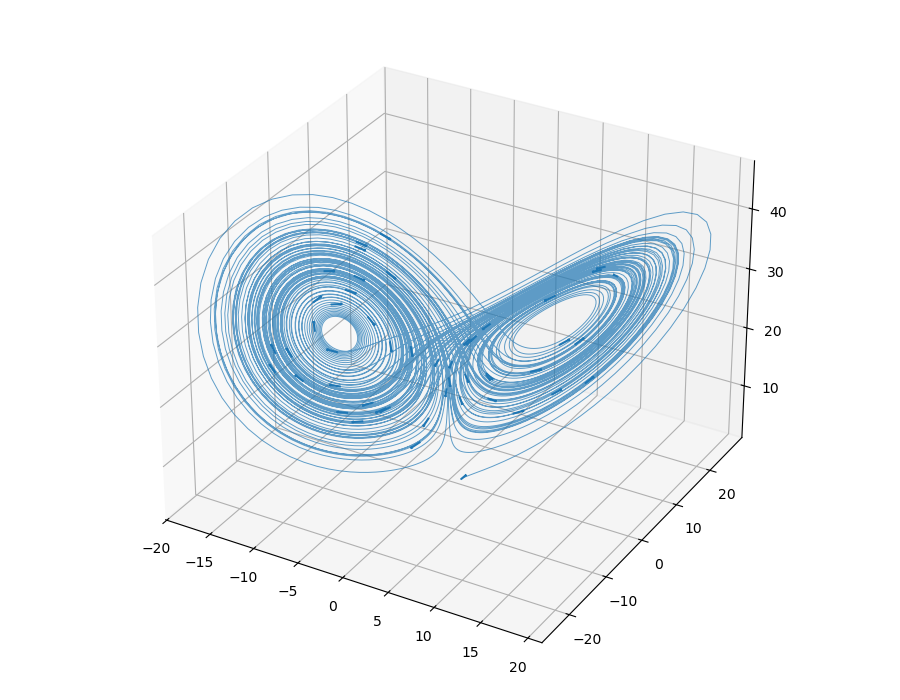
You could also write this vector field as a differential operator \[V\], where \[V=10(y-x)\frac{\partial}{\partial x}+(-xz+28x-y)\frac{\partial}{\partial y}+\left( xy-\frac{8}{3}z \right)\frac{\partial}{\partial z}\].
Example
Consider the a simple vector field, \[\vec{F}(x,y,z)=(2x,-y,3z)\].
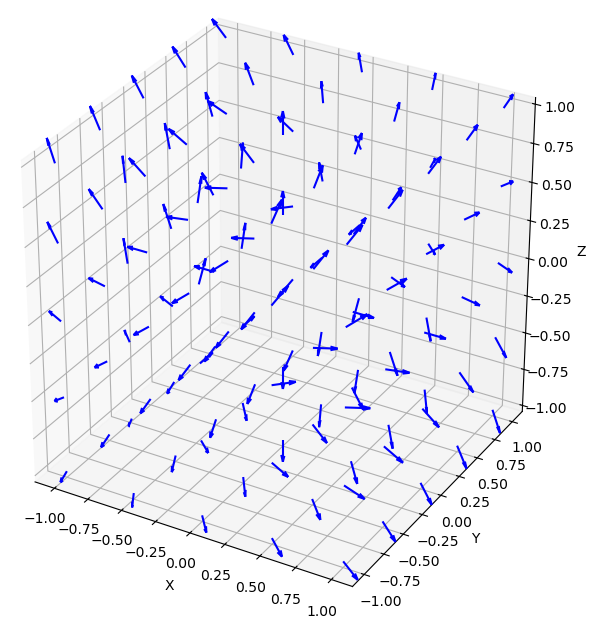
This is what it looks like when we plot the vector associated with some of the points.
If we were to calculate each point manually, take the point \[(1,2,3)\] for example, \[\vec{F}(1,2,3)=(2(1),-(2),3(3))=(2,-2,9)\]. This means that at point \[(1,2,3)\], the vector has a point of +2 along the x-axis, -2 along the y-axis and +9 along the z-axis. When plotted, it can be imagined as an arrow originating at point \[(1,2,3)\] and pointing towards point \[(1,2,3)+(2,-2,9)=(3,0,12)\].