coefficient of restitution
Coefficient of restitution
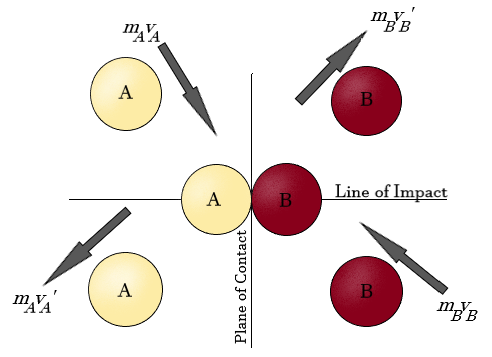
The coefficient of restitution can be thought of as a measure of elasticity of a collision between two bodies. It is a dimensionless parameter defined as the ratio of relative velocity of separation after a two-body collision to the relative velocity of approach before collision, i.e. \[\text{Coefficient of restitution}\, (e)=\frac{\text{Relative velocity of separation after collision}}{\text{Relative velocity of approach before collision}}\].
Range of values for \[e\]
\[e\] is usually a positive real number between 0 and 1.
When \[e=0\], both bodies are moving in the exact same direction and has the exact same velocity, i.e. it's relative velocity of separation after collision is zero. We call this a perfectly inelastic collision. Similarly, if \[\epsilon=1\], this is a perfectly elastic collision where objects rebound with the same relative speed with which they approached.
Usually in real world scenarios, we find \[e\] to have a value between zero and one, which is known as a partially inelastic collision.
Equation
In the case of a one-dimensional collision involving two idealised objects, A and B, the coefficient of restitution is given by, \[e=\frac{v_{b}-v_{a}}{u_{a}-u_{b}}=-\frac{v_{b}-v_{a}}{u_{b}-u_{a}}\] where \[v\] is the final velocity and \[u\] is the initial velocity of the objects. Usually we take the relative velocity of object \[b\] to \[a\].
Notice the negative sign that is there signifies the bounce that happens, i.e. relative speed changes sign after the impact, if it is positive before the impact, it will be negative after the impact. Assume we have a ball traveling towards a wall at 4 meters per second and travels at 2.4 meters per second after colliding with the wall. We take Earth as the reference frame, so the wall is fixed with a relative velocity of 0 meters per second and the ball is moving at 4 meters per second relative to Earth, thus \[e=-\frac{0-(-2.4)}{0-4}=0.6\]. As the ball rebounds in the opposite direction, by convention we assign a negative sign to it. It follows that the negative sign in the equation for \[e\] is merely to achieve a positive \[e\].