asymptote
Asymptotes
An asymptote is generally a line that a curve approaches but does not touch.
Consider the function \[\frac{1}{(x-1)(x-2)}\]:
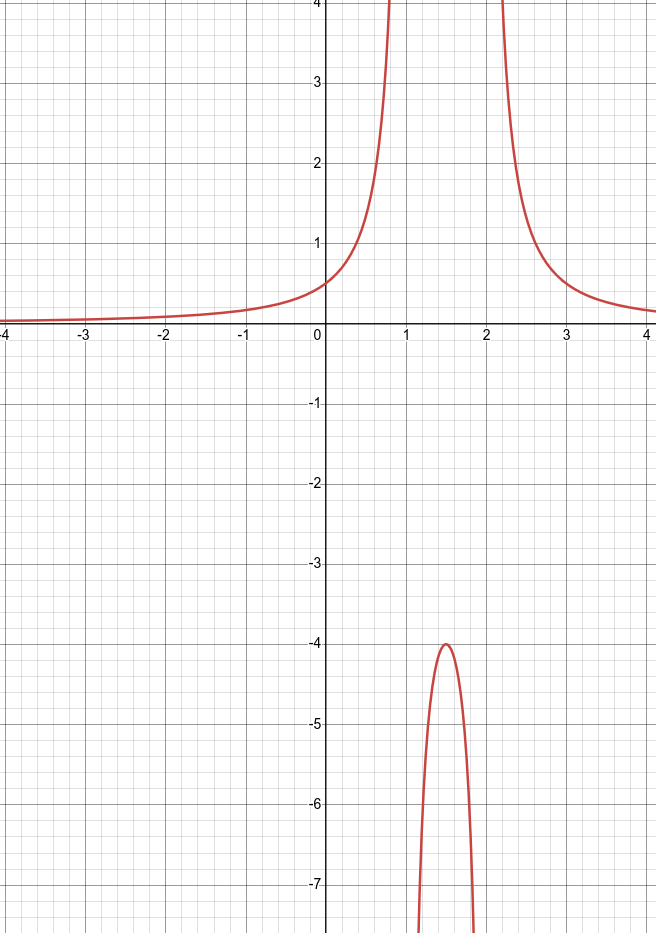
Vertical asymptote
Let \[f(x)\] be a function, if any one of the following limits hold, then the line at \[x=a\] is a vertical asymptote of \[f(x)\]:
- \[\lim_{x\to a}f(x)=\infty\] or \[\lim_{x\to a}f(x)=-\infty\] (infinite limits)
- \[\lim_{x\to a^{-}}f(x)=\infty\] or \[\lim_{x\to a^{-}}f(x)=-\infty\] (right and left-handed limits)
- \[\lim_{x\to a^{+}}f(x)=\infty\] or \[\lim_{x\to a^{+}}f(x)=-\infty\]
Since the function \[f(x)=\frac{1}{(x-1)(x-2)},x\ne1,x\ne2\], it is a fact that the graph will never touch \[x=1\] or \[x=2\] (as that would yield an undefined result). Therefore the vertical asymptote will be \[x=1\] and \[x=2\].
Horizontal asymptote
The line \[y=L\] is a horizontal asymptote of \[f(x)\] if either \[\lim_{x\to\infty}f(x)=L\] or \[\lim_{x\to-\infty}f(x)=L\]. (See limits at infinity)
To find the \[y\]-value that \[f(x)\] does not touch, we find \[f(x)\] when \[x\to\infty\] and \[x\to-\infty\]. Based on the example equation above, when both \[x\to\infty\] and \[x\to\infty\], \[y=0\]. Therefore the horizontal asymptote will be \[y=0\].
Another example would be when \[f(x)=\frac{2x+3}{x^{2}+3x+2}\]. To approximate \[f(x)\] when \[x\to\infty\] and \[x\to-\infty\], we simply take the biggest exponents of the numerator and denominator as any constant would become negligible when \[x\] becomes infinitely large, which would be \[y\approx\frac{2x}{x^{2}}\]. Substituting \[\infty\] and \[-\infty\] into \[x\] would give us \[y=0\].
Oblique asymptote
The line \[y=mx+b\] is an oblique asymptote of \[f(x)\] if either \[\lim_{x\to\infty}[f(x)-(mx+b)]=0\] or \[\lim_{x\to-\infty}[f(x)-(mx+b)]=0\].
Oblique (slant) asymptotes can be found in graphs of equations such as \[f(x)=\frac{x^2+3}{x-7}\], where the degree of numerator is larger than the degree of denominator. For our current \[f(x)\], rearranging it with partial fraction decomposition would become \[x+7+\frac{52}{x-7}\] and the oblique asymptote of \[f(x)\] would be \[x+7\], which is the part that we're interested in as it's our \[mx+b\]. To show that the oblique asymptote is \[x+7\], since \[\frac{x^{2}+3}{x-7}=x+7+\frac{52}{x-7}\] then \[\frac{x^{2}+3}{x-7}-(x+7)=\frac{52}{x-7}\]. Thus, \[\lim_{x\to\infty}\left[\frac{x^{2}+3}{x-7}-(x+7)\right]=\lim_{x\to\infty}\frac{52}{x-7}=0\] and \[\lim_{x\to-\infty}\left[\frac{x^{2}+3}{x-7}-(x+7)\right]=\lim_{x\to-\infty}\frac{52}{x-7}=0\].
Turning point
The method to obtain the turning point is to differentiate \[f(x)\] to get \[\frac{dy}{dx}\] and then solving for \[\frac{dy}{dx}=0\].