partial fraction decomposition
Partial fraction decomposition
First, let \[\frac{p(x)}{q(x)}\] be a rational function.
When the degree of \[p(x)\] is less than \[q(x)\]
\[q(x)\] has non-repeated linear factors
The general formula would be: \[\frac{p(x)}{q(x)}=\frac{A_{1}}{(a_{1}x+b_{1})}+\frac{A_{2}}{(a_{2}x+b_{2})}+\cdots+\frac{A_{n}}{(a_{n}x+b_{n})}\].
An example of such a case would be \[\frac{3x-1}{(x+2)(x-1)}\]. Using the general formula, we decompose it into \[\frac{A}{x+2}+\frac{B}{x-1}\].
Therefore we get \[A+B=3\] and \[-A+2B=-1\] and we get \[A=\frac{7}{3}\] and \[B=\frac{2}{3}\]. Thus the partial fraction decomposition would be \[\frac{3x-1}{(x+2)(x-1)}=\frac{7}{3(x+2)}+\frac{2}{3(x-1)}\].
\[q(x)\] has repeated linear factors
An example of such a case would be \[\frac{-x^{2}+2x+4}{x(x-2)^{2}}\]. Using the general formula, we can decompose it into \[\frac{A}{x}+\frac{B}{x-2}+\frac{C}{(x-2)^{2}}\].
Therefore we get \[A+B=-1\], \[-4A-2B+C=2\], \[4A=4\] and we will get \[A=1\], \[B=-2\] and \[C=2\]. Thus the partial fraction decomposition would be \[\frac{-x^{2}+2x+4}{x(x-2)^{2}}=\frac{1}{x}-\frac{2}{x-2}+\frac{2}{(x-2)^{2}}\].
Additional information
It is to note that \[p(x)\] must be one degree less than \[q(x)\], e.g. \[\frac{1}{x^{2}+1}=\frac{Ax+B}{x^{2}+1}\] or \[\frac{1}{x^{3}+1}=\frac{A}{x+1}+\frac{Bx+C}{x^{2}+x-1}\], to account for all polynomial terms.
Additionally, the reason why \[\frac{Ax^{2}+Bx+C}{x^{3}}\] is that it is the sum of \[\frac{A}{x}+\frac{B}{x^{2}}+\frac{C}{x^{3}}\].
When the degree of \[p(x)\] is equal or more than \[q(x)\]
We will use polynomial division to seperate the expression into \[Q(x)+\frac{r(x)}{q(x)}\], where \[r(x)\] is the remainder of polynomial division. Then do partial fraction decomposition on \[\frac{r(x)}{q(x)}\].
Polynomial division is an algorithm for dividing a polynomial by another polynomial of the same or lower degree, a generalized version of the familiar arithmetic technique called long division.
An example of polynomial division for \[f(x)=\frac{3x^{5}+7x^{4}+8x^{2}+3}{x^{2}-7}\] would be:
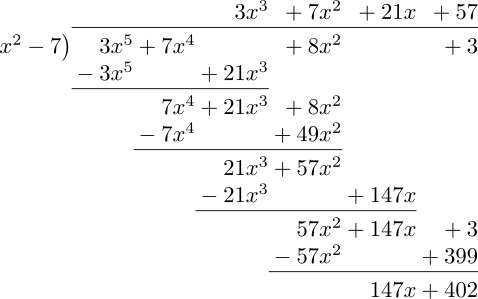
Thus, \[\frac{3x^{5}+7x^{4}+8x^{2}+3}{x^{2}-7}=3x^{3}+7x^{2}+21x+57+\frac{147x+402}{x^{2}-7}\]. Breaking it down would give us \[Q(x)=3x^{3}+7x^{2}+21x+57\] and \[\frac{r(x)}{q(x)}=\frac{147x+402}{x^{2}-7}\].
Polynomial division
The general formula for polynomial division is:
Referencing to the above, for the first iteration, we would first identify the dividend, \[f(x)=3x^{5}+7x^{4}+8x^{2}+3\] and the divisor, \[d(x)=x^{2}-7\]. Then we separate the dividend into \[(3x^{5})+(7x^{4}+8x^{2}+3)\], thus \[ax^{k+n}=3x^{5}\] and \[f=7x^{4}+8x^{2}+3\]. From here, we know \[a=3\] and \[k+n=5\]. Next, we separate our divisor into \[(x^{2})+(-7)\], which tells us that \[bx^{n}=x^{2}\] and \[g=-7\]. By comparison, \[b=1\] and \[n=2\]. Now that we have \[n\], we can calculate \[k=3\]. To use the formula, we just need to calculate our scaling factor \[\frac{a}{b}x^{k}\], which is \[\frac{3}{1}x^{3}\] or \[3x^{3}\]. This matches our value obtained by long division above. To recursively find the next value, we just take:
and repeat this entire process until the degree of the dividend is smaller than the divisor.
Partial fractions in integration
Evaluate \[\int \frac{x^{2}+x+1}{\left( x^{2}+1 \right)^{2}}\,dx\].
First we decompose it into partial fractions, \[\frac{x^{2}+x+1}{\left( x^{2}+1 \right)^{2}}=\frac{Ax+B}{x^{2}+1}+\frac{Cx+D}{\left( x^{2}+1 \right)^{2}}=\frac{1}{x^{2}+1}+\frac{x}{\left( x^{2}+1 \right)^{2}}\]. Then we integrate it, let \[u=x^{2}+1,du=2x\,dx\],