stress and strain
Stress and strain
Stress
Stress is a physical quantity that describes forces present during deformation. For example, an object being pulled apart, such as a stretched elastic band, is subject to tensile stress may undergo elongation. When forces cause a compression of an object, we call it a compressive stress. When an object is being squeezed from all sides, like a submarine in the depths of an ocean, we call this kind of stress a bulk stress. When deforming forces act tangentially to the object's surface, we call them ‘shear' forces and the stress they cause is called shear stress. The greater the force and the smaller the cross-sectional area of the body on which it acts, the greater the stress.
Stress is usually symbolised as \[\sigma\] and given as \[\sigma=\frac{F}{A}\], with units \[\text{Nm}^{-2}\], \[\text{Pa}\] or \[\text{kgm}^{-1}\text{s}^{-2}\].
Strain
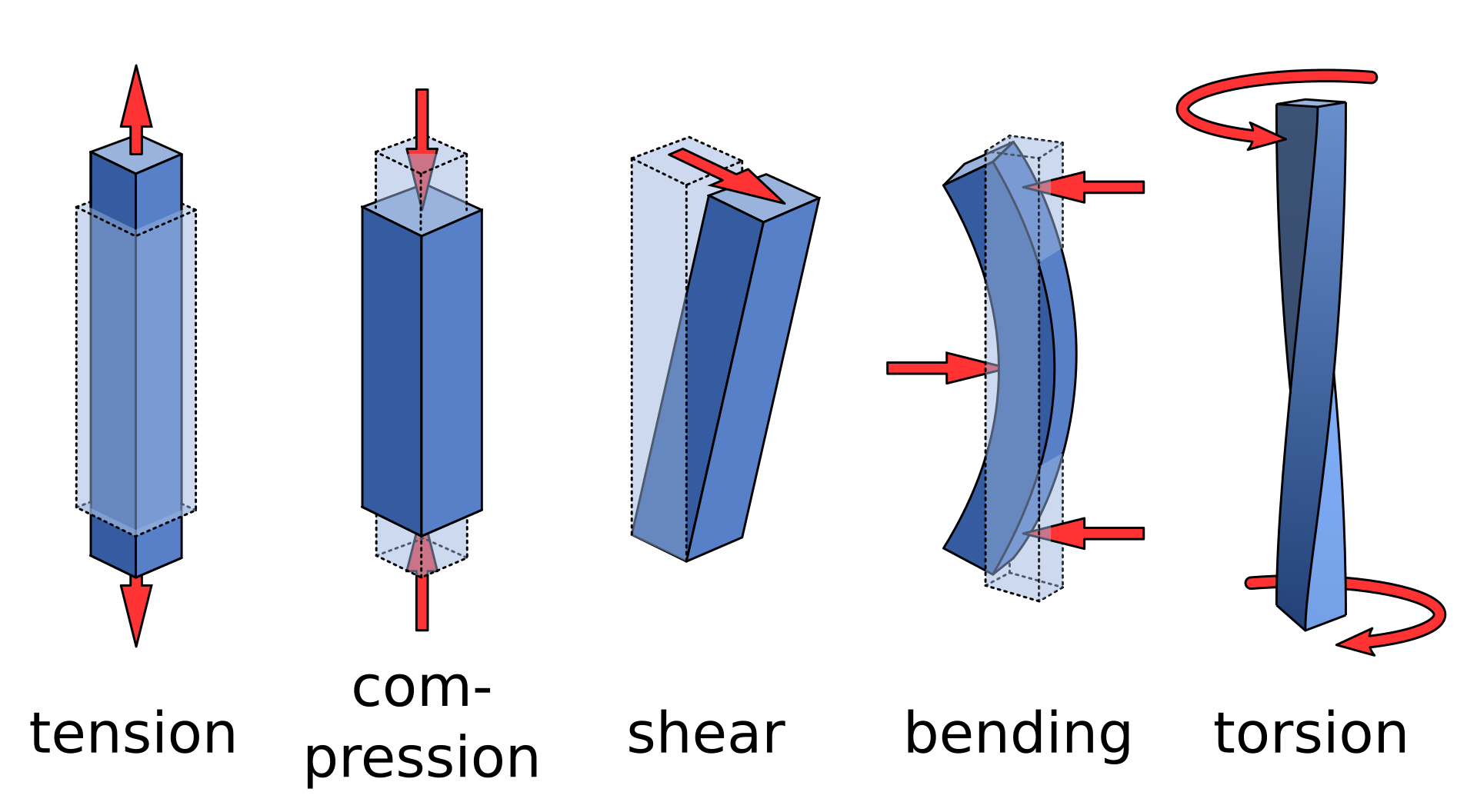
An object or medium under stress becomes deformed. The quantity that describes this deformation is called strain. Strain is defined as relative deformation, compared to a reference position configuration. Usually symbolized as \[\epsilon\], it's units are dimensionless, or more accurately with base units meter per meter (which cancels out each other).
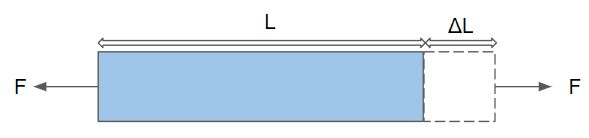
The engineering strain is the most common definition applied to materials used in mechanical and structural engineering, which are subjected to very small deformations. Known also as Cauchy strain, it is expressed as the ratio of total deformation to the initial dimension of the material body on which forces are applied. The normal strain is positive if the material fibers are stretched and negative if they are compressed. Thus, we have: \[\epsilon=\frac{\Delta L}{L}\], where \[\epsilon\] is the engineering normal strain, \[L\] is the original length of the fiber and \[\Delta L\] is the change in length of the fiber.
Relation between stress and strain
The greater the stress, the greater the strain; however, the relation between strain and stress does not need to be linear. Only when stress is sufficiently low is the deformation it causes in direct proportion to the stress value. The proportionality constant in this relation is called the modulus of elasticity. In the linear limit of low stress values, the general relation between stress and strain is: \[\sigma=\delta\cdot\epsilon\], where \[\delta\] is the modulus of elasticity.