tensile and compressive stress, strain and Young's modulus
Tensile and compressive stress, strain and Young's modulus
Tension or compression occurs when two antiparallel forces of equal magnitude act on an object along only one of its dimensions, in such a way that the object does not move.
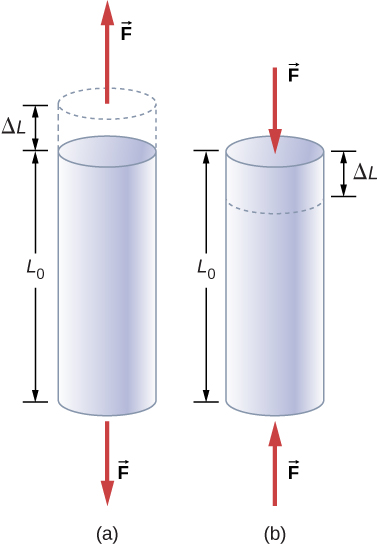 , \[L_{o}\], or \[L\] is the original length, while denote the final length as \[l=L+\Delta L\]
A rod segment is either stretched or squeezed by a pair of forces acting along its length and perpendicular to its cross-section. The net effect of such forces is that the rod changes its length from the original length \[L\] that it had before the forces appeared, to a new length \[l\] that it has under the action of the forces. This change in length \[\Delta L=l-L\] may be either elongation (when \[l>L\]) or contraction (when \[l<L\]).
Tensile stress and strain occur when the forces are stretching an object, causing its elongation, and the length change \[\Delta L\] is positive. Compressive stress and strain occur when the forces are contracting an object, causing its shortening, and the length change \[\Delta L\] is negative.
Tensile stress: \[\sigma=\frac{F_{\perp}}{A}\], where \[F_{\perp}\] is the force perpendicular to the surface of the object, as forces that act parallel to the cross-section do not change the length of an object
Tensile strain: \[\epsilon=\frac{\Delta L}{L}\], it is the measure of the deformation of an object under tensile stress and is defined as the fractional change of the object's length when the object experiences tensile stress
Young's modulus: \[E=\frac{\sigma}{\epsilon}\]