elastic and plastic deformation
Deformation
Deformation may be elastic or plastic. If the deformation is negligible, the object is said to be rigid. Depending on the type of material, size and geometry of the object, and the forces applied, various types of deformation may result.
 Deformation due to compressive stress.
Elastic deformation
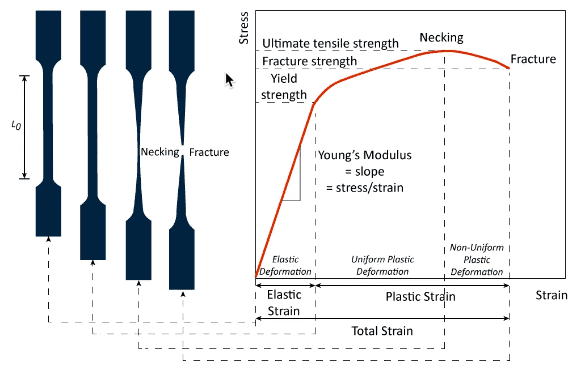
Elasticity is the tendency of solid objects and materials to return to their original shape after the external forces (or load) causing a deformation are removed. An object is elastic when it comes back to its original size and shape when the load is no longer present.
Elastic limit
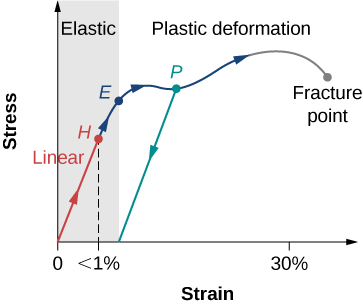
The elastic limit (point E in the first graph) is the stress value beyond which the material no longer behaves elastically but becomes permanently deformed.
A low elastic modulus is typical for materials that are easily deformed under a load; for example, a rubber band. If the stress under a load becomes too high, then when the load is removed, the material no longer comes back to its original shape and size, but relaxes to a different shape and size: The material becomes permanently deformed.
Proportionality limit
The linearity limit, or the proportionality limit (point H in the first graph), is the largest stress value beyond which stress is no longer proportional to strain. Beyond the limit, the relation between stress and strain is no longer linear. When stress becomes larger than the linearity limit but still within the elasticity limit, behavior is still elastic, but the relation between stress and strain becomes nonlinear.
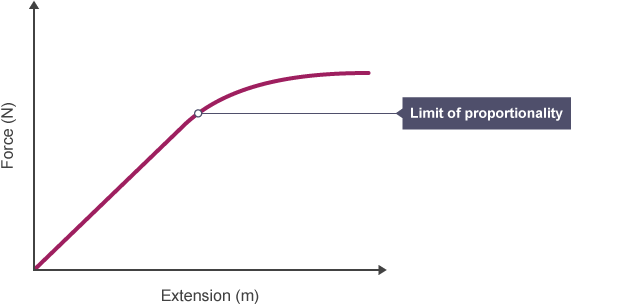 (See Hooke's law)
Plastic deformation
For stresses beyond the elastic limit, a material exhibits plastic behavior. This means the material deforms irreversibly and does not return to its original shape and size, even when the load is removed.
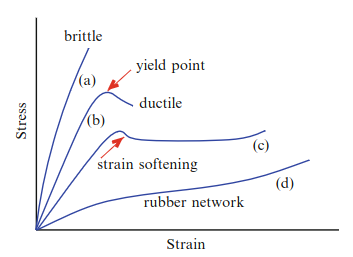
Rubber-like materials show an increase in stress with the increasing strain, which means they become more difficult to stretch and, eventually, they reach a fracture point where they break. Ductile materials such as metals show a gradual decrease in stress with the increasing strain, which means they become easier to deform as stress-strain values approach the breaking point.
Sources
- Rostiashvili, V. G., and T. A. Vilgis. "Statistical thermodynamics of polymeric networks." Encyclopedia of Polymeric Nanomaterials 1 (2014)